

The most popular advice about black metal railing spindles is also the least complete: choose a matte-black finish, match it to the handrail, and focus on the pattern. That approach works for a mood board, but it doesn't tell you whether the railing will carry a real load, stay attached to the structure, or resist corrosion after repeated exposure to rain, salt, and impact.
A black spindle is a visible part of a much larger assembly. Its profile, unsupported length, spacing, fasteners, rails, posts, substrate, and coating system all affect the finished result. The right choice can give a staircase or deck a crisp architectural appearance for years. The wrong one can produce loose connections, deflection, chipped coating, or rust beneath a finish that still looks acceptable from a distance.
Table of Contents
- Why Black Metal Spindles Are More Than Just Aesthetic
- Choosing the Right Spindle Profile and Material
- Spacing, Code Compliance, and Load Requirements
- Coating Systems and Outdoor Durability
- Installation Tips and Long-Term Maintenance
- Conclusion - Investing in Quality Black Metal Spindles
Why Black Metal Spindles Are More Than Just Aesthetic
Black metal spindles don't all perform the same way, even when they look identical in a product photograph. A slender round bar, a hollow tube, and a solid square bar may share the same color while behaving differently under bending, impact, vibration, and connection stress. The finish can also hide important differences in the base metal and preparation beneath it.
A spindle isn't a decorative infill placed between two rails. It's part of a guard system that must move force through the infill, into the rails, through the posts, and finally into the deck, stair, balcony, or other structural framing. The 2024 International Building Code egress guidance treats the guard as an engineered assembly, not as a collection of attractive individual components.
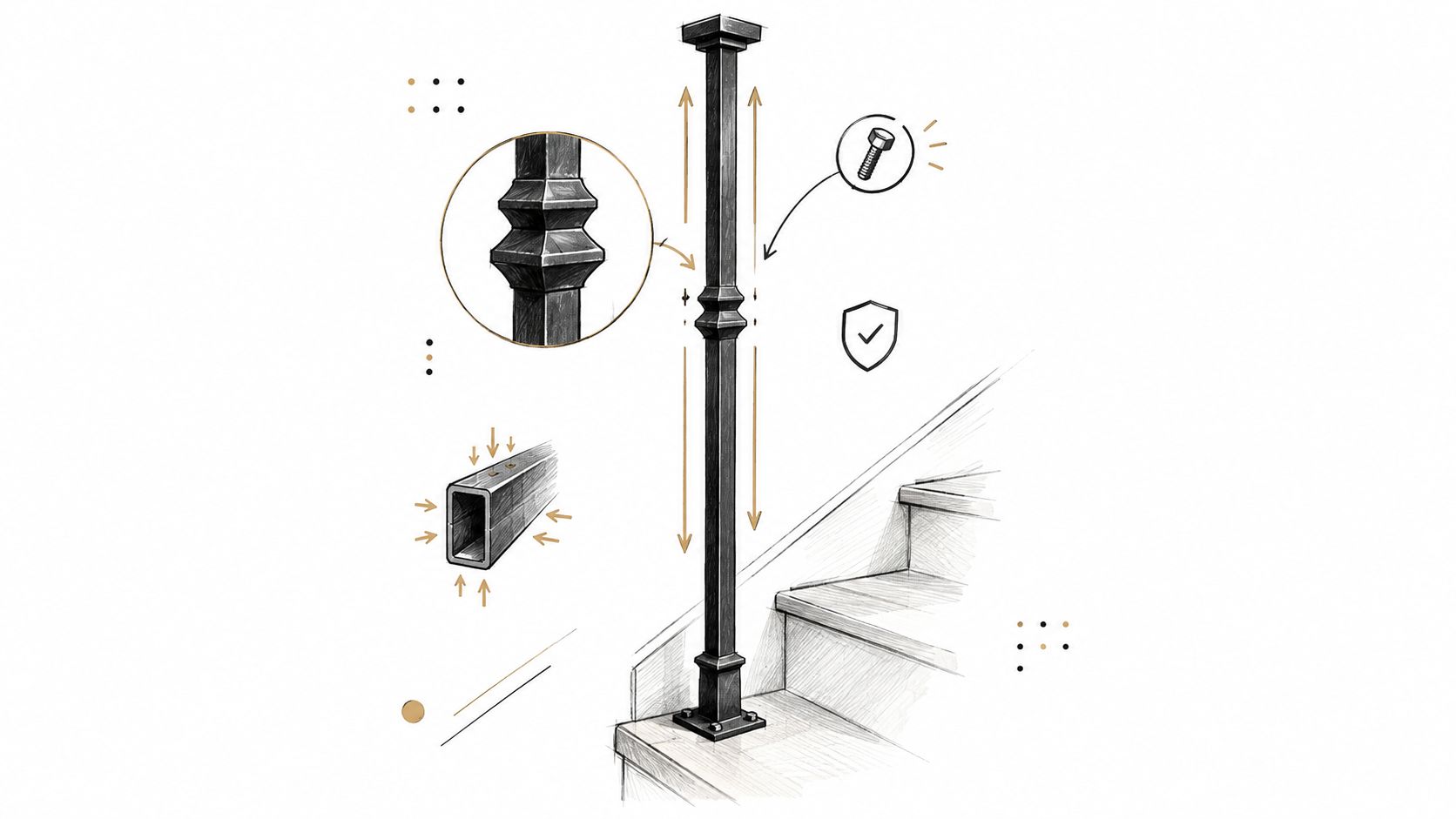
The load path matters more than the color
Under the referenced 2024 International Building Code framework, handrails and guards must resist a 200-pound, or 0.89 kN, concentrated load in the applicable direction. The top rail must also resist a 50-pound-per-linear-foot, or 0.73 kN/m, load. The referenced requirements specify that these loads aren't assumed to act concurrently, and guard infill components face a separate 50-pound concentrated load requirement. These figures come from the ICC code guidance.
Those requirements don't mean you can select any spindle with a sufficient-looking diameter. A bar may have adequate axial capacity while still bending under lateral force, buckling locally, pulling out of a weak connection, or allowing excessive rail movement. The surrounding assembly can fail before the spindle itself reaches its theoretical material capacity.
For that reason, evaluate these parts together:
- Spindle geometry: Diameter, wall thickness, profile, unsupported length, and spacing affect stiffness and movement.
- Rail connections: Welds, screws, brackets, and mechanical fasteners must keep the spindle securely engaged with the top and bottom rails.
- Post anchorage: Posts and rails need positive connections to structural framing, not just attachment to a finish layer.
- Supporting structure: Deck boards, stair treads, rim boards, joists, and balcony framing must accept and transfer the railing forces.
- Mounting conditions: A surface-mounted system and a fascia-mounted system may require very different hardware and blocking.
Practical rule: A visually minimal railing is only successful when the hidden load path is at least as deliberate as the visible pattern.
The same principle applies to design longevity. A black finish can make a staircase appear refined and a deck appear more open, but it can't compensate for an unsuitable substrate or poor drainage. Before comparing decorative patterns, identify whether the spindle is intended for an interior stair, a covered porch, an exposed deck, a poolside setting, or a commercial balcony.
For design inspiration, a gallery of black metal deck railing applications can help you evaluate how black metal interacts with wood, concrete, glass, and open exterior views. Use those examples to define the visual direction, then verify the engineering and environmental requirements separately.
Choosing the Right Spindle Profile and Material
Profile selection is a balance between stiffness, visual weight, fabrication, installation, and environment. There isn't one universally superior shape. The best choice depends on how exposed the railing is, how long each spindle runs without support, how the connections are made, and how much visual density the design can carry.
Profile comparison
| Profile | Visual character | Practical strengths | Main trade-off |
|---|---|---|---|
| Round rod | Traditional, light, and visually quiet | Works well where a slender appearance matters and surfaces are easy to align | Can appear less architectural, and a slender member may be more sensitive to unsupported length |
| Round tube | Clean and familiar | Reduces weight compared with a solid member and can suit interior stair work | Wall thickness and connection details matter, not just outside diameter |
| Flat bar | Broad, graphic, and contemporary | Creates a strong vertical rhythm and a more substantial visual face | Orientation affects stiffness, and broad faces can make spacing look tighter |
| Square tube | Crisp and geometric | Fits modern interiors and structured architectural designs | Corners, welds, and coating coverage need careful attention |
| Solid square bar | Dense and substantial | Gives a heavier visual and tactile presence | Adds weight and may demand more robust handling and connections |
A flat bar installed with its broad face aligned in the wrong direction can look strong while offering less resistance in the direction that matters. A hollow tube can be entirely appropriate for a residential interior, but its wall thickness, end treatment, and attachment method still need review. A solid bar isn't automatically the safest option either. Extra material can increase weight without correcting poor anchorage or weak rails.
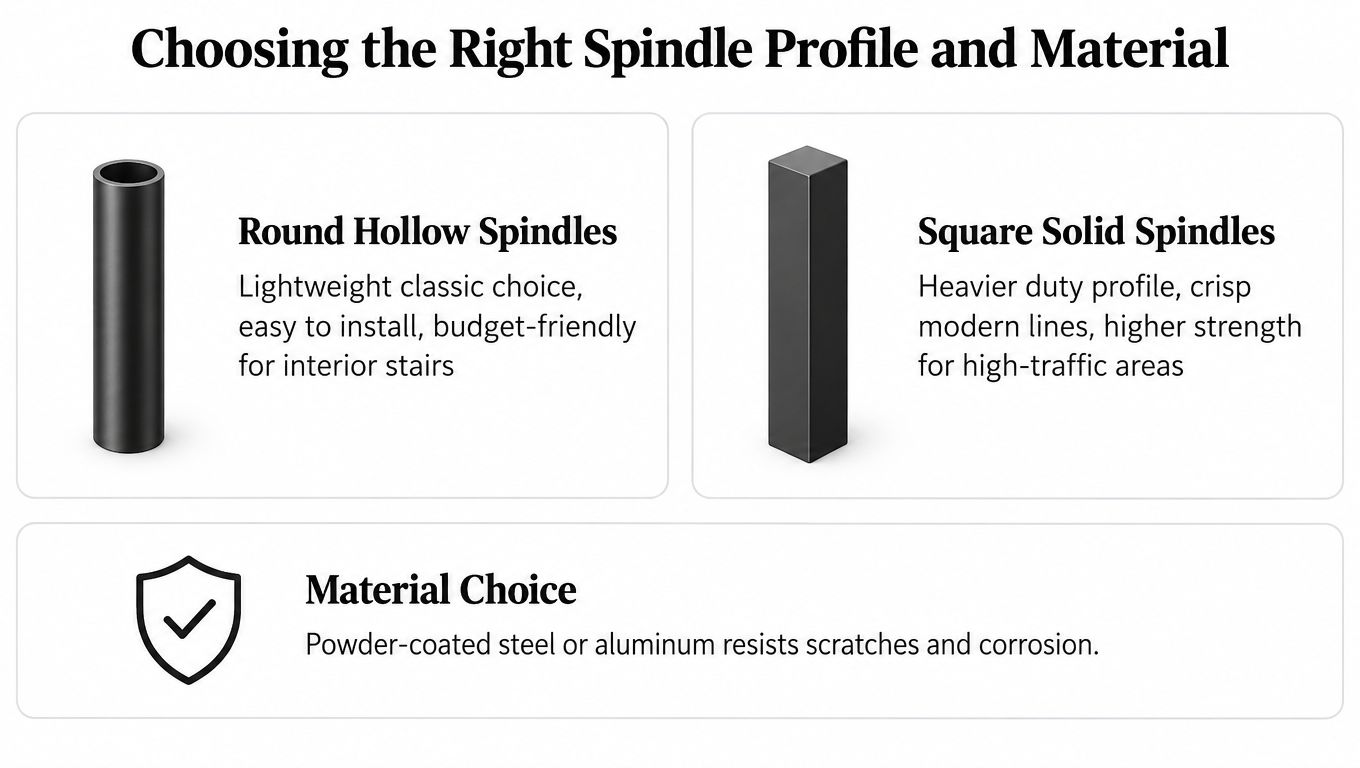
Match the material to the exposure
Carbon or mild steel offers useful strength and fabrication flexibility, but it depends heavily on preparation and corrosion protection outdoors. Once a coating is breached, moisture can reach the steel at scratches, cut ends, welds, and fastener interfaces. Steel is often a sensible choice when the fabricator can document the preparation and finish rather than just labeling the product “black powder-coated.”
Stainless steel is often the stronger candidate for aggressive exterior locations, but grade, finish, fabrication, and compatible fasteners still matter. Stainless isn't a substitute for sound detailing. Crevices, contamination, trapped water, and poor dissimilar-metal choices can create problems even when the exposed surface looks premium.
Aluminum can reduce weight and offers useful corrosion resistance, but its strength and deflection characteristics differ from steel. It should be selected as a complete system, with compatible coating, hardware, and connection details. Don't substitute one material for another merely because both are available in black.
Use a simple decision filter:
- Start with location. Interior stairs, covered exterior areas, exposed decks, pool zones, coastal sites, and industrial settings impose different demands.
- Define the visual mass. Round profiles recede, while square and flat profiles create a stronger graphic pattern.
- Review the unsupported length. Longer spans increase the importance of stiffness and connection design.
- Confirm fabrication details. Ask how ends, welds, holes, and field cuts will be protected.
- Specify the complete system. The spindle, rails, posts, anchors, and fasteners must work together.
A profile that looks elegant in a showroom may be too delicate for a high-traffic commercial stair, while a heavy solid bar may overwhelm a narrow residential landing. Good specification keeps the appearance intentional without treating appearance as the performance criteria.
Spacing, Code Compliance, and Load Requirements
A railing can look perfectly aligned and still fail inspection or create a dangerous opening. Spacing must be checked on the installed assembly, not estimated from a catalog image or measured only between centerlines. Stair runs add another complication because the vertical relationship between the sloped rail, tread, and spindle changes from position to position.
Local authorities may amend or interpret model-code provisions differently, so confirm the applicable requirements before ordering materials. The deck railing code requirements guide is useful as a planning reference, but it doesn't replace the approval process of the authority having jurisdiction.
Measure the finished opening
The familiar child-safety rule uses a sphere test for openings, but the exact local requirement must be verified rather than assumed. Measure the clear opening after the spindle, shoes, fasteners, rails, and trim are installed. A gap that appears narrow at the center of a level run can change near a post, on a stair angle, or at a decorative transition.
Before drilling, mark the actual rail length and identify the end conditions. Don't divide the run by eye. Account for the width of posts, the return at landings, the spindle profile, and any required clearance from the stair edge or walking surface.
A reliable field sequence looks like this:
- Confirm the jurisdiction. Identify the code edition, local amendments, occupancy classification, and whether the work requires a permit or review.
- Draw the run. Record level sections, stair sections, landings, transitions, and post locations.
- Set the end limits. Establish the first and last spindle positions from the actual posts or returns.
- Calculate the layout. Divide the usable length into equal bays rather than forcing a final narrow gap.
- Mark both rails. Transfer the positions with a story stick, template, or carefully checked measurement rather than marking each location independently.
- Verify the installed clearances. Recheck the physical openings after the spindle and rail assembly is fixed.
Check the load path before installation
The code loads apply to the guard and handrail assembly, so the installer must look beyond the infill. The referenced guidance requires guards to transfer railing loads to the floor or deck below. It also warns against fastening to I-joists or trusses unless the connection has been specifically designed for that condition. Those details are addressed in the 2024 IBC guidance.
A spindle that fits neatly into a top and bottom rail still needs a stable rail system. Posts should be positively anchored to structural framing, and the connection should resist movement in the direction of the expected load. Surface screws driven only into decking, fascia, drywall, or finish trim may hold the railing in place during light use but fail when someone leans or falls against it.
Field check: Push the completed rail laterally at several points, then inspect the posts, rail joints, and spindle ends. Movement at one connection often indicates an assembly problem, not a defective spindle.
Stair geometry deserves separate attention. Measure each run from the actual finished surfaces, account for the rail slope, and avoid assuming that a level-run template will transfer accurately to stairs. If the geometry, mounting condition, commercial occupancy, or structural support falls outside prescriptive residential details, obtain engineering review or acceptance from the authority having jurisdiction before fabrication.
Coating Systems and Outdoor Durability
“Black powder-coated” describes a color and a process, not a complete durability specification. Two spindles with the same matte-black appearance may have different substrates, pretreatment, coating chemistry, film thickness, edge protection, and expected maintenance requirements.
For exterior black steel spindles, the coating system matters because corrosion begins where moisture and contaminants reach the substrate. Rain, ultraviolet exposure, pool chemicals, coastal salts, road salt, and industrial pollution can exploit a scratch or poorly prepared edge. Once corrosion develops beneath the coating, bubbling, edge creep, loss of adhesion, and section reduction can follow.
Specify the system beneath the finish
Powder-coating specifications commonly distinguish AAMA 2603, AAMA 2604, and AAMA 2605 for progressively more demanding exposure categories. A basic indoor or mild-outdoor application shouldn't be specified the same way as an exposed coastal balcony or a high-rise exterior. The powder-coating specification standards reference provides useful background on these distinctions.
The standard designation alone isn't enough. Ask the supplier or finisher to identify:
- Substrate: Carbon steel, stainless steel, aluminum, or another base material.
- Pretreatment: Cleaning, abrasion, chemical preparation, and conversion treatment used before coating.
- Coating class: The applicable AAMA performance category for the exposure.
- Film thickness: The specified and verified coating build for the system.
- Cure verification: How the finisher confirms that the powder has cured correctly.
- Edge and cut-end protection: The treatment for field cuts, drilled holes, welds, and exposed ends.
- Fastener compatibility: The grade and finish of fasteners, washers, brackets, and anchors.
- Repair procedure: The approved method for correcting chips and scratches without trapping corrosion.
A supplier who can't answer these questions is offering a finish description, not a durability specification.
Location changes the maintenance burden
A sheltered interior stair generally has a different risk profile from an exposed deck. A coastal railing faces chloride exposure, while a poolside installation faces repeated wetting and chemical contamination. A railing beside a winter road may collect de-icing salts at the lower rail and post bases. Industrial pollution can create another pathway for coating degradation.
The technical review of powder-coated metal performance emphasizes that protection depends on both the coating chemistry and the metal substrate. It also highlights the limited value of treating accelerated salt-spray results as a standalone prediction of natural outdoor service life. That matters because a high test figure doesn't eliminate the need for proper detailing, inspection, rinsing, and repair.
Drainage is part of the coating system. Design spindle-to-rail interfaces so water can escape, avoid pockets that hold wet debris, and inspect lower junctions where moisture tends to remain. A tiny breach at a cut end can matter more than a broad, intact exposed face.
Inspect the vulnerable points
Don't wait for widespread rust. Check the areas most likely to receive impact or retain moisture:
- Cut ends and drilled holes: Look for exposed steel, bubbling, and discoloration.
- Welds and joints: Inspect for hairline coating breaks and early edge creep.
- Fasteners: Check for movement, incompatible corrosion, and staining around the connection.
- Lower rails: Remove accumulated dirt and salt before it remains wet against the finish.
- Spindle shoes and interfaces: Look for trapped water and coating damage caused by movement.
- Impact areas: Repair scratches and chips before corrosion spreads beneath the coating.
Rinse exterior railings according to the exposure rather than relying on the label “low maintenance.” Use clean water and a mild cleaning solution appropriate to the finish, then dry areas that retain moisture. Coastal, poolside, and salt-exposed installations deserve closer attention than protected inland railings. Cosmetic fading is a finish issue. Bubbling, rust staining, loose material, and section loss are corrosion issues that require prompt correction.
Installation Tips and Long-Term Maintenance
A professional installation starts before the first spindle is cut. Confirm the finished floor, deck, stair, and trim conditions, then dry-fit the rails and posts so the layout reflects what will remain in place. Many alignment problems come from measuring against unfinished surfaces and discovering later that flooring, nosings, fascia, or cap trim has changed the available height.
Prepare, fit, and protect
Use a stable reference line for the top and bottom rails. On stairs, establish the rail angle first, then transfer spindle positions from a template or story stick. Cut each spindle to its actual location when conditions vary. Small differences in hole depth, rail slope, and landing geometry can make a pre-cut batch inconsistent.
Protect the finish during fabrication and assembly:
- Use padded supports: Keep coated spindles off abrasive concrete, metal benches, and gritty floors.
- Deburr every cut: Remove sharp edges and loose coating fragments before fitting.
- Seal exposed steel: Treat field cuts and drilled areas with the approved touch-up system.
- Avoid forced alignment: If a spindle needs to be bent or heavily pulled into place, stop and correct the layout.
- Check fastener seating: Tighten hardware without crushing tubes, stripping threads, or damaging the coating.
- Clean before final inspection: Metal dust and installation debris can hide chips and loose connections.
Mechanical fasteners, welds, brackets, and adhesive systems aren't interchangeable. Use the connection method approved for the specific rail and spindle design. A decorative shoe can conceal a joint, but it shouldn't be used to hide movement or compensate for an undersized connection.
Treat stairs as a separate installation
Level and stair sections shouldn't be installed from the same assumptions. The slope changes the relationship between the spindle, rail, tread, and lower connection. At landings, the visual pattern may also need to transition without creating an oversized opening or a cramped final bay.
Dry-assemble a short portion first. Check the rail line from normal standing positions, inspect the spacing from several angles, and confirm that the handrail remains comfortable to use. This trial assembly often catches a pattern problem before every component has been permanently fixed.
Installation advice: Finish cutting, drilling, and touch-up work before the final cleaning. Coating damage is easier to find on a clean assembly, and late metalwork is less likely to scar adjacent finished surfaces.
Maintain the assembly, not just the appearance
Routine care should include a visual and physical inspection. Look for chipped paint, rust, loose fasteners, movement at posts, rail deflection, damaged shoes, and water trapped at lower joints. Guidance for metal railing maintenance commonly recommends an annual inspection, with extra attention where salt, pool moisture, or de-icing chemicals are present. The black metal railing cleaning guide can help establish a finish-safe cleaning routine.
Clean with a soft cloth or non-abrasive brush and a mild solution, then rinse away residue. Don't use aggressive abrasives that turn a small surface mark into a larger coating breach. If you find a chip, remove loose material, clean and dry the area, apply the approved corrosion treatment if required, and use a compatible touch-up coating. If rust has spread beneath the finish, the repair may require removal of compromised coating and professional refinishing rather than a cosmetic dab of paint.
Conclusion - Investing in Quality Black Metal Spindles
A successful railing project isn't defined by the black finish alone. It depends on whether the spindle profile suits the run, whether the spacing remains compliant after installation, whether the rails and posts transfer forces into sound framing, and whether the coating system matches the environment.
The most expensive mistake is often the component that looked inexpensive and simple at the time. A spindle selected only by color may need replacement because the connection is weak, the substrate is poorly protected, or the finish wasn't specified for the site. A well-documented system costs less trouble because the material, preparation, hardware, geometry, and maintenance expectations are clear from the beginning.
For a staircase, deck, balcony, or commercial guard, ask for product documentation rather than relying on a finish label. Confirm the substrate, profile, connection method, environmental category, and field-repair procedure. Then have the completed railing checked against the applicable local requirements before people depend on it.
The right black metal railing spindles can provide a clean architectural rhythm without sacrificing strength or serviceability. Choose them as engineered components, not decorative accessories, and the finished railing will look better because it was built to perform.
Ultra Modern Rails supplies factory-direct modern cable railing systems for residential and commercial projects, including custom sections for decks, balconies, stairs, patios, pools, and hospitality spaces. Visit Ultra Modern Rails to request a custom quote and drawing, then work with its team to match black metal finishes, mounting styles, handrails, and wood tops to your project.