

The railing is finished. The posts are set, the cable is tensioned, the handrail is on, and then you walk the run and find the three spots that still look raw. There's a bright cut end at the last terminal, a turnbuckle hanging in open air, and a hole through a post that's two or three times the diameter of the wire passing through it.
Those three details are what covers exist for, and they're also where most of the confusion starts. A cover will finish a railing. It won't make the railing corrosion-proof, and it won't make it compliant.
Table of Contents
- What a Stainless Steel Cable Cover Is For
- Cover Types and the Job Each One Does
- Which Stainless Grade Fits the Site
- Sizing a Cover for an All-Stainless Cable Run
- How to Install Covers Without Hiding Problems
- Covers on Decks Stairs and Commercial Rails
- Confirm the Cover Before You Order
What a Stainless Steel Cable Cover Is For
The diagram below shows the difference between a run left open and one with its details closed off.
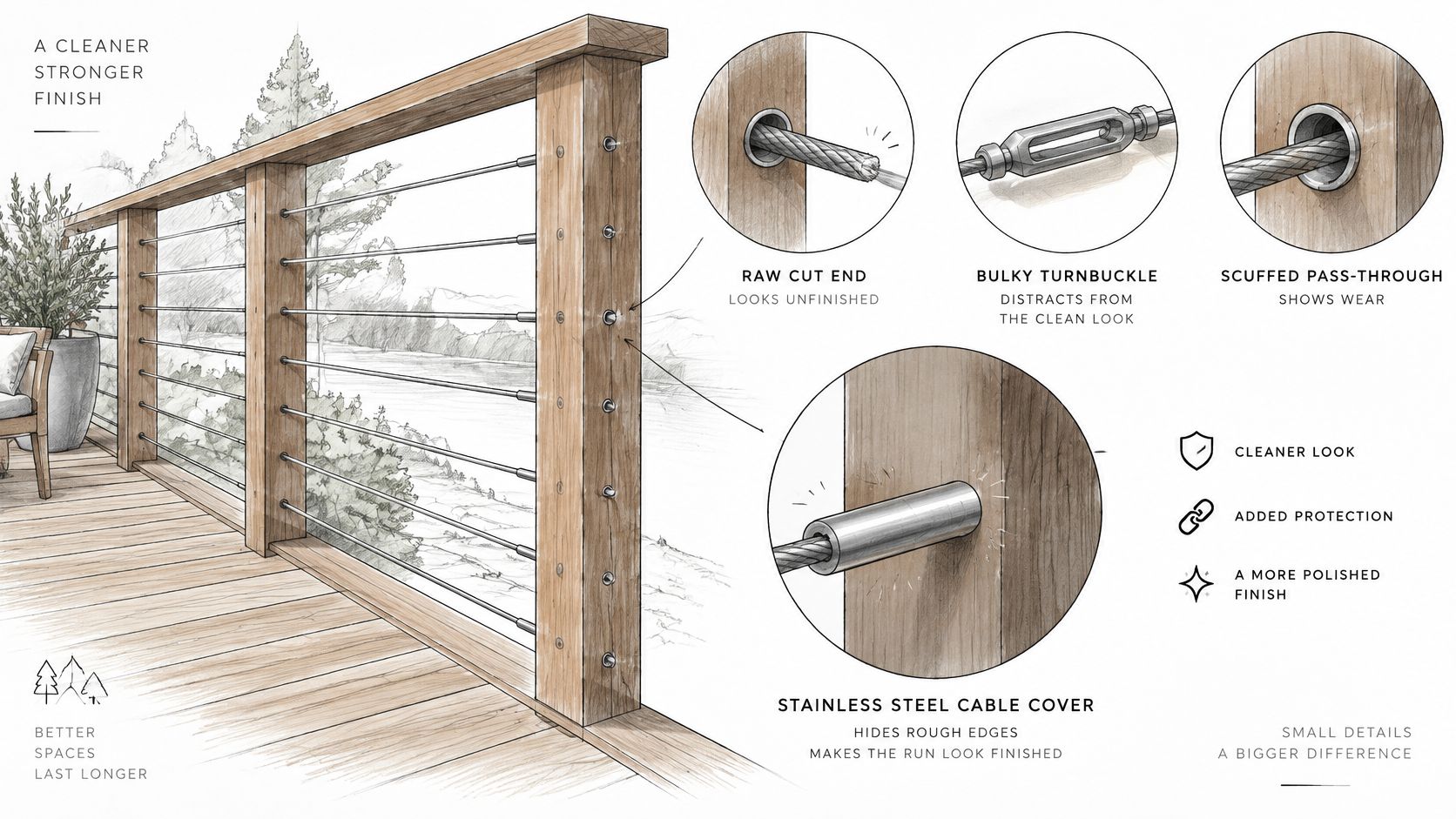
A stainless steel cable cover is a cap, sleeve, shroud, or bushing that sits over the cable, over a fitting, or over the hole the cable passes through. It's a hardware part, not a coating and not a treatment. Three jobs, in this order:
- Protect the wire. A cover keeps abrasion and grit off the strand where the cable rubs an edge, a handrail return, or a busy pass-through.
- Tidy the look. An open railing shows all its hardware. Covers give the run a clean line without touching the tension.
- Conceal a splice or a cut end. The cut end of wire rope is sharp, bright, and unfinished. A cap hides it and gives the terminal a deliberate stop.
The closest everyday parallel: a cover is the boot on a connector. The boot finishes the joint and keeps dirt out. The connector still carries the current.
Stainless means the cover is made from an iron alloy with enough chromium to form a passive oxide skin, so it resists rust far better than painted or plated steel. It doesn't mean the part never needs care. Stainless steel has been an architectural material since Harry Brearley produced an alloy of 12.8 percent chromium and 0.24 percent carbon in 1913, a milestone recorded in the British Stainless Steel Association's account of the discovery.
One limit worth saying plainly: a cover is not proof the railing meets code. Guard height, cable spacing, post attachment, and load capacity are code and engineering questions, and a tidy ferrule cap answers none of them.
Cover Types and the Job Each One Does
Match the part in your hand, or the symbol on your drawing, to a row before you compare finishes or grades.
| Cover type | Main job | Load role | Typical use |
|---|---|---|---|
| End cover or ferrule cap | Hide the cut cable end and terminal fitting | Not structural | Deck and stair terminations |
| Splice or turnbuckle cover | Conceal a mid-run joint | Must still allow retensioning | Long runs and repairs |
| Protective sleeve | Shield cable from abrasion and dirt | Not load-bearing | Edges, returns, and busy passages |
| Bushing or grommet | Isolate the cable at a post hole | Load stays in cable and post | Post penetrations and mixed metals |
| Decorative shroud | Finish the look over hardware | Can trap moisture if sealed | Interiors and hospitality railings |
End covers live at the last post of a deck or the bottom of a stair run, where the cable terminates into a fitting. They're cosmetic and protective, and that's the whole job. A loose one rattles in the wind, which is how most homeowners discover the fit was wrong.
Splice and turnbuckle covers handle the mid-run joint on a long balcony or a repair. Buy one that slides or unscrews, because the fitting underneath still needs to be turned for tension. A cover that's been painted or caulked shut over a nut hides the one adjustment the railing will need in five years.
Protective sleeves sit where the rope rubs something: a handrail return, a screen frame, a high-traffic pass-through on a commercial guard. They carry no load. If a sleeve gets crimped hard enough to put a kink in the strand, it has become a problem, not a shield.
Bushings and grommets are the isolating interface where cable meets a post hole. This is the part that matters when the post or nearby hardware is aluminum, galvanized steel, or treated wood. The load stays in the cable and the post; the bushing's job is to keep two different metals from becoming a corrosion cell.
Decorative shrouds finish the hardware in a lobby, a restaurant, or a high-end stair. They're the most likely to be sealed tight, and a sealed shroud over a wet fitting is where pitting gets its start.
Failure mode by type, in one line each: loose caps rattle, sealed splice covers hide a nut nobody can turn, and a shroud with no drainage holds water against the fitting.
Decide the one job the cover has to do before you look at a catalog. A part bought for looks will be asked to do a job it was never designed for.
Which Stainless Grade Fits the Site
Buying any cover labeled stainless for a pool deck or a coastal balcony is the most common specification mistake in this product category. The label names an alloy family. It says nothing about how that alloy behaves on your site.
Stainless steel earns its name from chemistry. The family is defined as an iron-based alloy with at least 10.5 percent chromium by mass and a maximum carbon content of 1.2 percent, as set out in the worldstainless introduction to stainless steels. That chromium forms a thin oxide skin that slows corrosion and can re-form after a light scratch, but only where oxygen reaches the metal and chlorides are not sitting in a crevice.
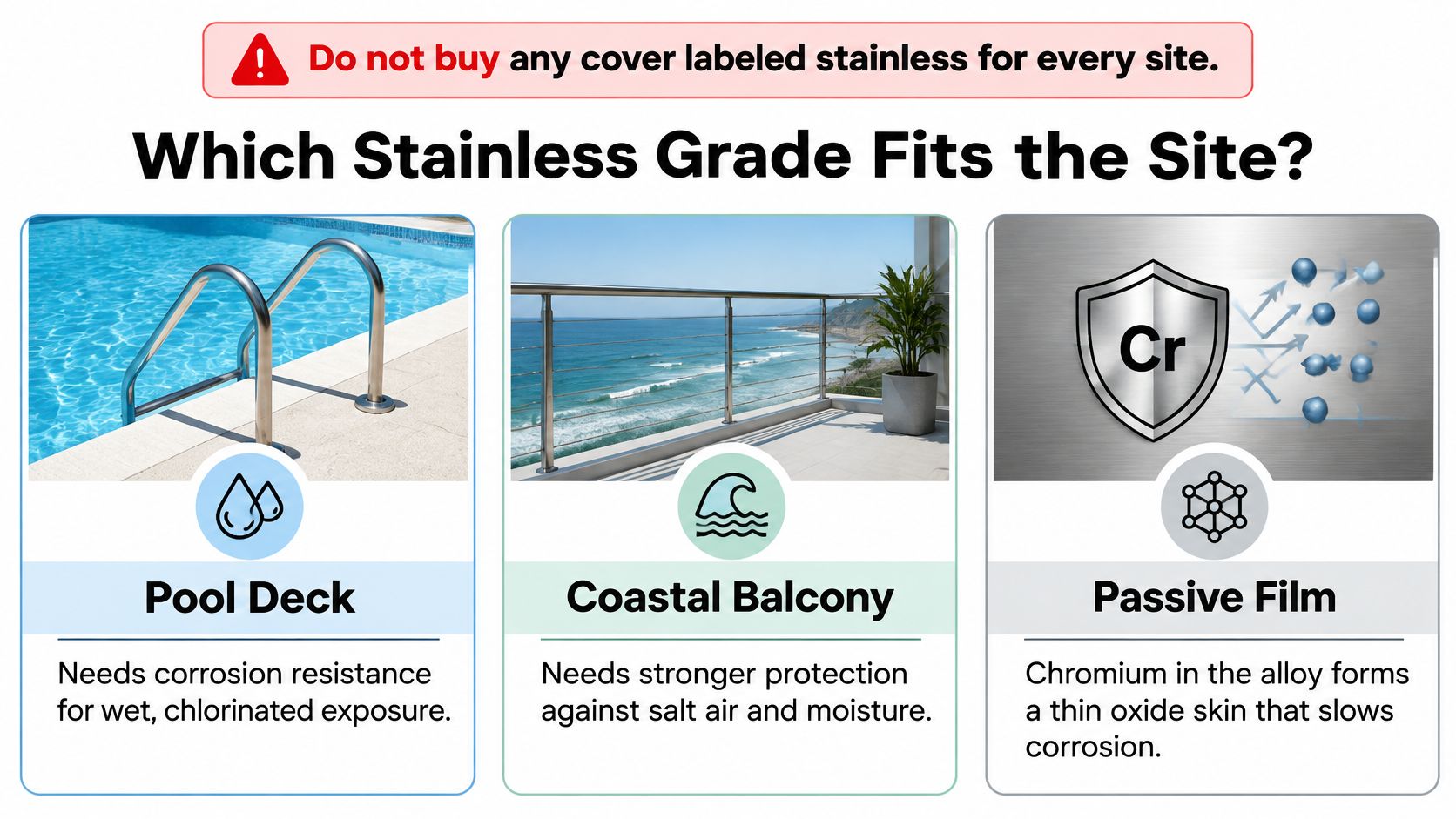
Grade 304 is the everyday architectural choice for inland decks away from salt. Grade 316 adds molybdenum, which strengthens the passive film where chlorides are present, and that is why marine hardware and coastal specs default to it. Read the two grades this way: 304 handles weather, while 316 handles salt dissolved in that weather.
One point specifiers miss: a 316 cover over a 304 cable does not upgrade the run. The cable, the fittings, and the cover each carry their own grade, and the lowest one sets the ceiling for the whole assembly. Order the cover in the same grade as the hardware it protects.
| Site | Preferred approach | Main risk | Upkeep |
|---|---|---|---|
| Inland residential deck | 304 stainless is usually enough | Ordinary dirt and light moisture | Rinse seasonally and check ends |
| Coastal balcony or pool surround | 316 marine-grade stainless | Pitting and crevice attack from chlorides | Fresh-water rinse after splash or salt air |
| Snow-belt with deicing salt | 316 rather than bare 304 | Salt spray and deposits under covers | Rinse after storms and inspect fittings |
| Severe industrial or constant chloride | Project-specific higher alloy | A cover cannot fix the wrong cable grade | Engineer spec plus a written rinse plan |
Covers cut both ways here. A sleeve or shroud reduces how much salt reaches the wire, and it also creates a place for salt to collect and stay wet: at the fitting, under the sleeve, and where the cable enters the post. The corrosion that ends a railing's life is usually localized in a crevice rather than spread across a visible surface, so a higher grade buys time while a blocked crevice spends it.
For the tensioning sequence and hardware handling that goes with this, the video below walks through a cable railing build from the posts up.
Build a care rhythm instead of a maintenance-free assumption. Rinse with fresh water after salt spray, pool splash, or a deicing storm, and open removable covers once a season to look underneath rather than waiting for brown stains to appear. Choosing 316 does not replace that rinse where salt is routine.
Sizing a Cover for an All-Stainless Cable Run
Treat the cover as one line on a bigger order. The cable underneath sets what will fit, and a sleeve bought by appearance alone is how runs end up with rattling caps or crushed strands.
Fit the cover to the wire, not to the look
Measure the cable diameter before anything else, then pick a cover with an inside fit snug enough not to rattle and loose enough that it can't crush the strand. Architectural railing runs on small wire rope, and stainless steel cable in guard-infill sizes is much finer than the rope an industrial cover was built around. A cap sized for a marina cable will slide, spin, and collect water.
Write the cable spec, not the word stainless
Procurement documents should list the cable alloy, construction, diameter, minimum breaking strength, and the applicable rope-wire specification. ASTM A492, as described in the ASTM standard for round stainless steel rope wire, governs stainless wire intended for stranding into wire rope and controls chemical composition across chromium, nickel, molybdenum, nitrogen, carbon, manganese, phosphorus, sulfur, and silicon, along with tensile-strength requirements. ASTM A580 covers stainless wire mechanical properties, including tensile strength, yield strength, and elongation, and recognizes cold-worked conditions that raise strength.
The point for a buyer is simple. A polished cover can't rescue an underspecified cable, and a cover can't compensate for the wrong alloy or a damaged passive surface in a chloride-heavy location.
| Item | What to record | Why it matters |
|---|---|---|
| Cable alloy | 316 or 304 stainless wire rope per ASTM A492 | Sets corrosion resistance of the run |
| Cable diameter | Measured wire diameter, for example 5/32 inch | Sets the inside fit of the cover |
| Minimum breaking strength | The published rating for that diameter and construction | Confirms tensile capacity of the cable |
| Construction | Strand pattern as supplied, for example 7x7 or 1x19 | Affects strand fatigue and how the cover seats |
| Cover metal | Same stainless family as the cable or more resistant | Avoids a galvanic weak side |
| Termination access | Removable or open-ended | Keeps the tension check possible |
Three fit errors that cause hidden damage
A sharp bend forced inside a sleeve loads the strand unevenly and starts fatigue where you can't see it. A cover that pinches the wire does the same thing more slowly. A closed end that traps water at a termination keeps the fitting wet long after the rest of the rail has dried.
Practical rule: the cover metal should be the same stainless family as the cable, or more corrosion resistant, so the cover never becomes the weak side of a galvanic couple.
Then apply the access test. Every fitting a cover hides must still be reachable for a tension check without cutting, prying, or drilling.
How to Install Covers Without Hiding Problems
A cover is a coordination part, not a lid. It has to sit in an assembly that still carries its guard load, still drains, and can still be inspected.
Public specifications show what that assembly is expected to do. Wire-cable railing assemblies may need to resist a 50-pound-per-linear-foot uniform load and a 200-pound concentrated load, and the New York State DOT local specification for wire rope railing also calls for bushings, grommets, or washers to separate dissimilar materials and prevent electrolytic corrosion. The cover takes none of that load. Its only job is to not interfere with the parts that do.
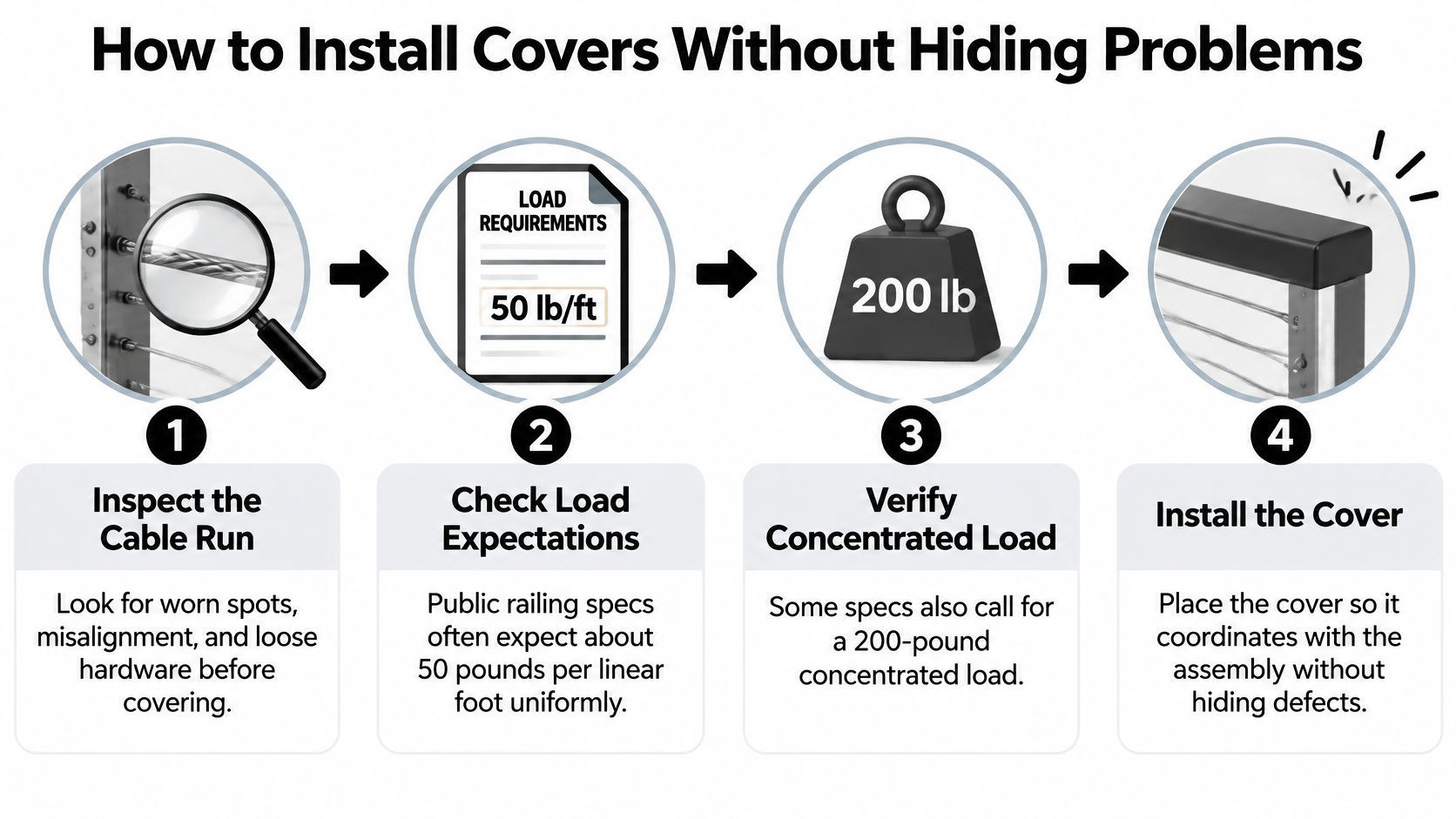
Here's the order that keeps a clean-looking rail inspectable.
- Confirm the code and the tensioning method first. Local guard requirements and the engineered tension procedure come before any sleeve goes on, because they decide where fittings must stay open.
- Isolate stainless from other metals. Put a bushing or washer between stainless and aluminum, galvanized steel, or treated-wood hardware so the pair doesn't form a corrosion cell.
- Pre-drill stainless at slow speed with a cobalt bit. Standard high-speed bits work-harden the metal and wander, and a ragged hole traps water at the post.
- Apply nickel-based or molybdenum-based anti-seize to the screw threads before assembly. Grease and WD-40 must not be used on stainless fasteners.
- Slide the cover on only after the cable is seated, with no kink and with a small path for water to leave. A cover pushed on over a twisted strand hides the twist permanently.
- Tension, then fit the end cover or shroud so it can be removed. Tag the fitting or note it on the drawing so the next person knows it's adjustable.
- Come back after the settling period. Open the removable covers, check for cable slip, salt film, or trapped moisture, and retension if the system calls for it.
If a cover needs a tool nobody carries to get it off, it won't come off.
The full sequence for posts, cable, and tensioning sits in our cable railing installation walkthrough, and it's worth reading before you order covers rather than after.
The safety point is blunt. A cover that conceals a loose fitting or a damaged strand isn't a finish upgrade. It's a maintenance problem with a lid on it.
Covers on Decks Stairs and Commercial Rails
Four scenes show how these rules land on real jobs.
A straight residential deck in a dry inland suburb. Brushed end caps at each termination and simple post bushings do the work, and 304 is a reasonable grade where no pool or road salt reaches the rail. The mistake this site invites is buying a sealed decorative shroud for the look and trapping condensation inside it.
A stair run. More terminations, a direction change, and cable that stretches a little more under load. End covers here have to come off easily, because the fittings at the top and bottom of a stair are the ones that get retensioned first. The mistake is a cap that threads on tight with no flats to grip.
A pool surround or oceanfront balcony. 316 cable and 316 covers, open-ended sleeves, and a fresh-water rinse after splash or heavy salt air. A sealed shroud over a wet fitting is where pitting starts on this site, so the detail that looks most finished is the one to question.
A hotel or restaurant rail. A long hospitality run with a lot of public hands on it gets decorative shrouds for a clean line, but staff need a way to open them for inspection, and the assembly still has to be documented for the intended guard load rather than judged by appearance. The commercial railing systems guidance covers how those runs get specified.
The contrast is worth holding onto. A homeowner needs matching end caps, a snug fit, and one removable access point per run. A commercial specifier should be asking for alloy, cable diameter, and inspection access in the submittal, and should reject any package that answers with the word stainless and nothing else.
Confirm the Cover Before You Order
Run this list before the order goes out.
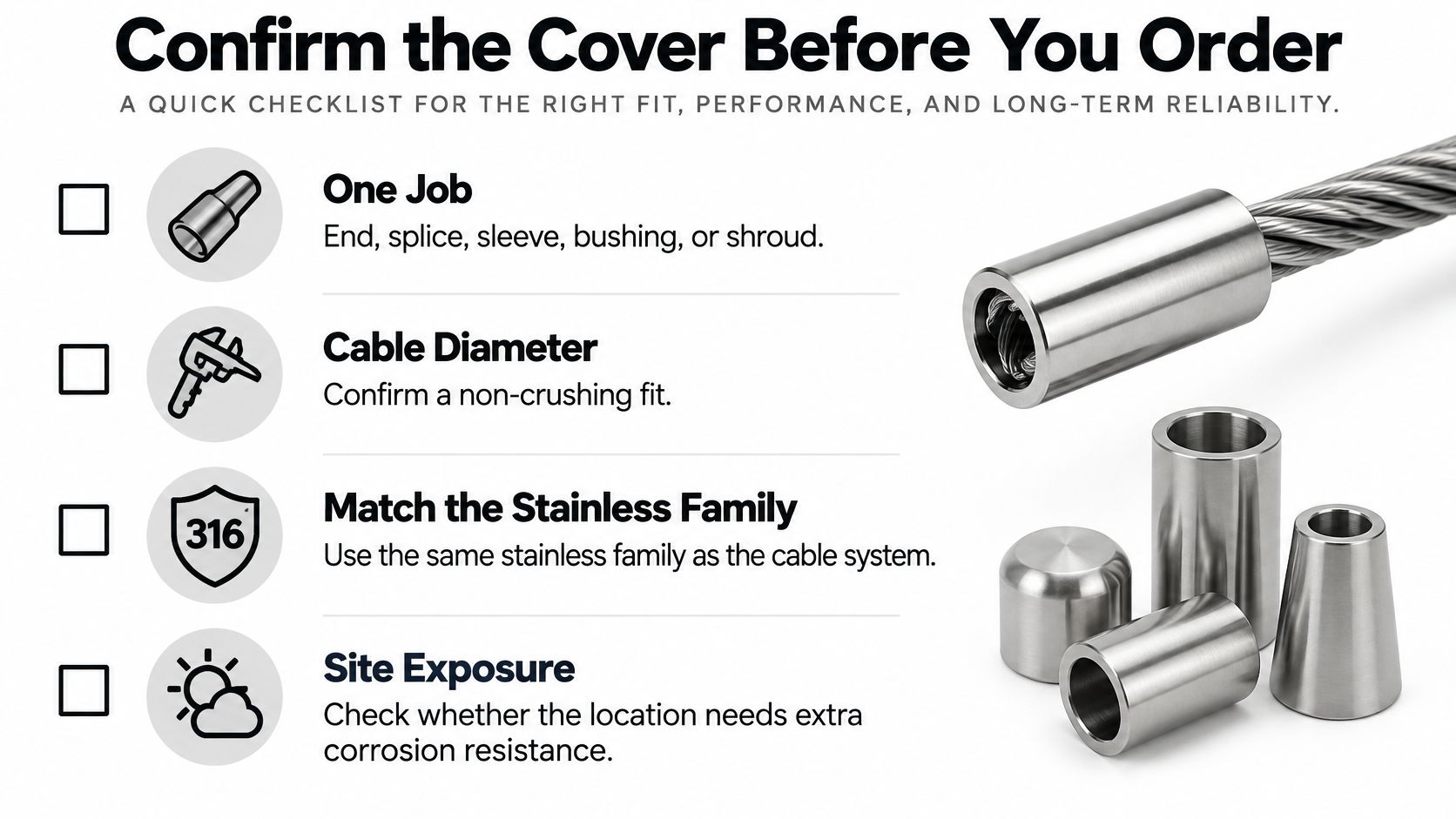
- One job. End cover, splice cover, protective sleeve, bushing, or decorative shroud. Pick one per location.
- Cable diameter and a non-crushing fit. Measure the wire, not the hole.
- The same stainless family as the cable, or better. A cover should never be the least corrosion-resistant part of the run.
- 316 where the site is coastal, poolside, or salted. 304 handles the ordinary inland deck.
- Isolation from aluminum, galvanized steel, and treated wood. Bushing, grommet, or washer at every mixed-metal contact.
- Removable access for retensioning. Every hidden fitting stays reachable.
- A rinse plan. Fresh water after salt, splash, or a deicing storm, plus a seasonal look under the covers.
Local code and project engineering still govern loads and spacing. Nothing on this list changes that.
Ultra Modern Rails builds factory-direct cable railing for indoor and outdoor decks, stairs, and commercial spaces, with all cable and hardware in 100 percent stainless steel and standard cable in 5/32 inch 316 marine-grade stainless wire rope. A cover specified to that diameter and grade lines up with the run it's going on, rather than sitting on top of it.
Ultra Modern Rails supplies complete stainless steel cable railing systems at factory-direct prices, with the cable, hardware, and handrail matched as one package instead of assembled part by part. Send your dimensions and we'll return a free custom quote and drawing within 24 hours, with your cover style, site exposure, and any fittings that must stay accessible noted on the plan. Visit Ultra Modern Rails to start your project.