

The usual advice is to buy the most rot-resistant wood you can afford. That's incomplete. A board can survive outdoors and still make a poor top rail if it splinters under your hand, checks around screws, or holds rain against a cable fitting. The best wood for a deck top rail is the right grade of wood, shaped and fastened for its exposure, not just the toughest species on the rack.
Table of Contents
- Why a Top Rail Is Not a Decking Board
- Quick-Pick Woods for a Top Rail
- Heartwood Grade Decides Durability More Than Species
- Keep Water Out of Cable Fittings and Holes
- Service Life and Maintenance by Species
- Matching Wood to Your Site and Budget
- Order the Rail and Prepare Your Quote
Why a Top Rail Is Not a Decking Board
A decking board carries shoes across its face. A top rail carries hands along its edges, receives concentrated pressure at brackets, and exposes joints and fastener holes to weather. A rough patch that's tolerable under a shoe isn't acceptable where someone slides a bare hand.
That changes how you should buy the lumber. Look beyond decay resistance to hand comfort, dimensional stability, fastener holding, repairability, maintenance effort, and cost. With stainless cable hardware, also consider how the wood meets the metal and whether you can reach those connections for inspection.
Start with the support system
A wood cap over a metal guard isn't a substitute for properly designed posts, anchorage, or other required guard members. Some railing assemblies use the top member structurally, so don't assume that any attractive board can replace the specified rail.
For an all-wood arrangement, the connections deserve equal attention. This guide to wood-post cable railing is a useful starting point when deciding how posts, cables, and a wood top work together.
Before choosing a species, establish:
- Support layout: Is the wood supported continuously, attached to brackets, or spanning between posts?
- Hand-contact profile: Can you ease the edges without compromising the required section?
- Repair access: Can you remove a damaged cap without dismantling the cable system?
- Finish expectation: Do you want maintained color, paint, or natural weathering?
Practical rule: Choose the railing assembly first. Then choose wood that fits its support, connection, and finishing requirements.
A dense hardwood doesn't correct a weak splice. A beautifully clear cedar board doesn't correct a bracket that holds water.
Quick-Pick Woods for a Top Rail
Quick-pick wood species for a deck top rail
| Species | Relative cost | Best fit |
|---|---|---|
| Western redcedar | Low to mid | Residential rails where light weight and comfort matter |
| Redwood, old-growth heartwood | Mid to high | Visible rails where natural decay resistance matters |
| Redwood, second-growth | Mid | Budget redwood; confirm heartwood content before buying |
| Ipe | High | Coastal, wet, shaded, or high-traffic rails |
| White oak | Mid to high | Humid or seasonally wet sites, with sealed end grain |
| Honduran mahogany | High; confirm sourcing | Warm-toned rails where supply is verified |
| Black locust | High; limited supply | Long-life rails where local supply exists |
| Pressure-treated southern pine | Low | Budget rails to be painted or stained, with corrosion-rated fasteners |
These are relative material-cost tiers, not installed prices. Local stock, appearance grade, usable lengths, and machining can change the order, so get quotes for the actual finished profile rather than comparing rough-board prices.
What each choice means on the job
Western redcedar is a practical residential choice when easy shaping and a comfortable surface matter more than resistance to dents; don't overdrive screws into its soft fibers.
Old-growth redwood heartwood suits a prominent natural-finish rail, but only when the supplier can substantiate the material rather than relying on a redwood label.
Second-growth redwood can suit a cost-conscious project, provided you inspect the boards instead of assuming they perform like durable old-growth heartwood.
Ipe earns its place where wear resistance matters: the Black Locust Lumber outdoor-decking guide reports Janka hardness of about 3,680 lbf, alongside the need for predrilling, high-quality stainless screws, and sealed cut ends.
White oak is worth considering for humid or seasonally wet sites when the fabrication plan includes careful end protection and stainless connections.
Honduran mahogany suits a warm-toned architectural rail, but confirm the exact species, exterior suitability, and replacement supply before specifying it.
Black locust makes sense where a supplier can provide straight, usable rail stock, not merely where the species is available as short or irregular lumber.
Pressure-treated southern pine is the budget route when you're willing to select carefully, prepare the surface, and maintain a painted or stained finish.
Hardness isn't the whole decision
Janka hardness is a reference measure for clear wood, not a rating for hand comfort or complete railing performance. A hard board can still have sharp edges, poorly placed knots, or an awkward profile.
Ipe also adds weight and drilling time, and some finishes don't bond readily to its low-porosity surface. If you accept a silver-gray appearance, you can avoid much of the work associated with preserving its original color, but you still need to inspect the assembly.
Heartwood Grade Decides Durability More Than Species
At the lumberyard, inspect a cut end before judging the face. A pale outer band may indicate sapwood, while the inner portion is heartwood; color is a useful clue, but it isn't a substitute for a supplier's grade description.
Ask what the grade guarantees. Clear stock describes appearance and defects; it doesn't automatically guarantee all-heartwood material. For a naturally durable rail, you need to discuss both.
The distinction is visible in the board's cross-section.
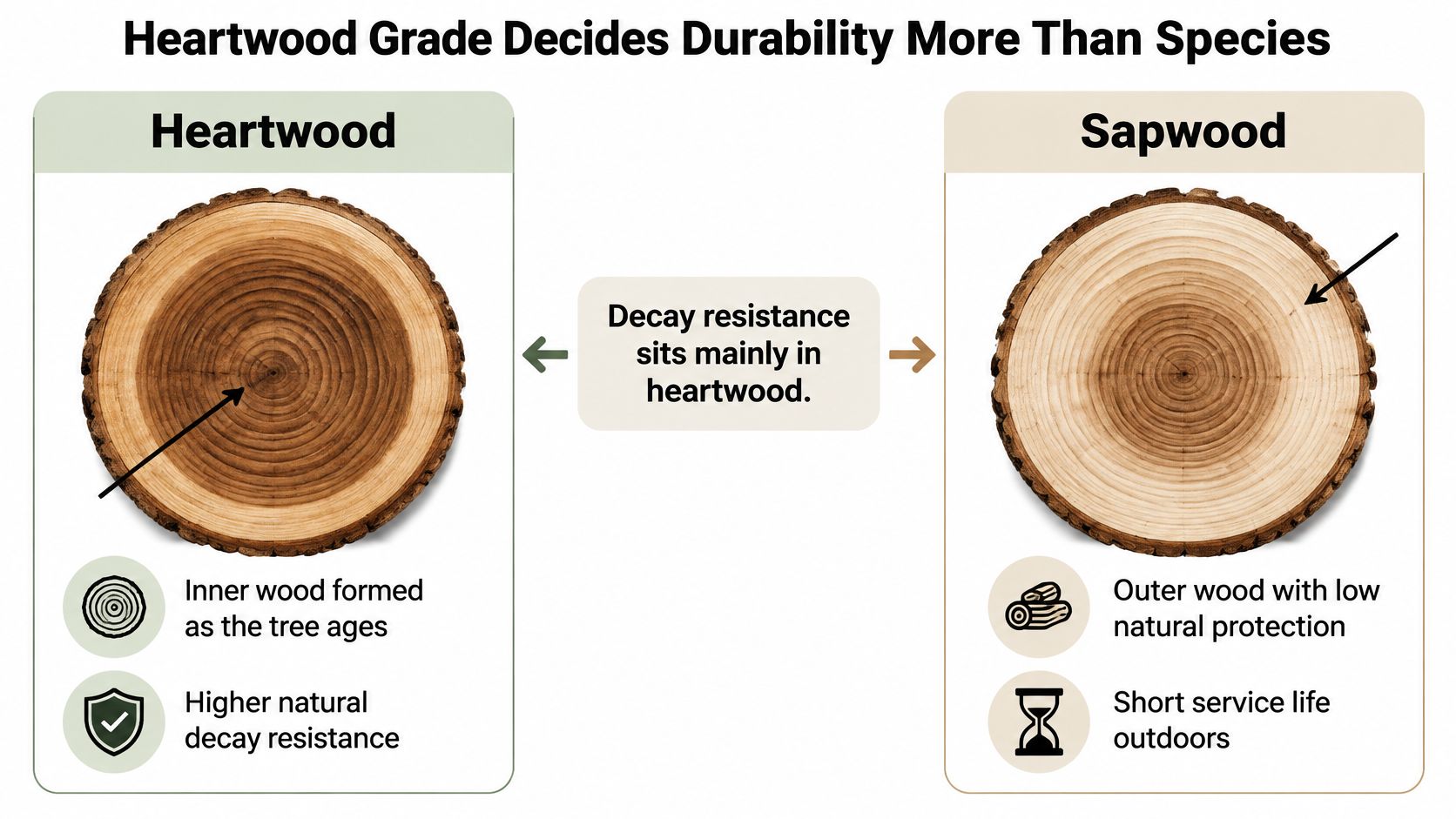
Why the inside of the tree matters
The U.S. Forest Products Laboratory's Wood Handbook describes untreated sapwood of all species as having low decay resistance and generally short service life under decay-favorable conditions, while heartwood contains species-specific extractives that can inhibit fungi and insects; its classifications place western redcedar among resistant or very resistant woods and distinguish highly decay-resistant old-growth redwood heartwood from generally low-to-moderate-resistance second-growth material.
That makes redwood a useful buying example. Two boards carrying the same species name can offer very different natural protection. Paying for the name without verifying the wood portion and growth source can leave you with a premium-looking rail that doesn't deliver the durability you expected.
Redwood's comparatively light weight, straight grain, workability, and stability also make it attractive for hand-contact surfaces. Those qualities are useful only if you select a board with clean edges and sound material where the brackets and splices will land.
Inspect the whole usable length
Don't select a rail by its best-looking middle section. Sight along the board, inspect both ends, and turn it over to check the underside where mounting screws will enter.
- Confirm heartwood content: Ask for a written grade description or supplier confirmation.
- Check fitting locations: Reject loose knots, splits, and damaged fibers where screws or brackets must go.
- Evaluate grain: Favor straight-grained stock that can be shaped into a smooth, consistent edge.
- Allow for trimming: Make sure removing a checked end won't leave the board too short for the planned joint.
Buy the board you can turn into a sound rail, not the board with the most attractive species label.
Natural-resistance classifications are broad averages, not promises for every board. Your purchasing specification should combine durable heartwood, suitable appearance quality, protected cuts, and connections that don't retain water.
Keep Water Out of Cable Fittings and Holes
The USDA Wood Handbook chapter on wood preservation states that decay can be prevented from starting or progressing when wood stays below 20% moisture content, and reports that only 5% to 10% wood weight loss from decay can accompany approximately 20% to 80% reductions in mechanical properties.
You won't keep every exterior rail dry during a storm. The practical goal is to let it dry afterward, especially where the underside meets a post cap, bracket, or fitting. Don't wait for obvious softness before investigating a connection that stays wet.
Detail each connection before assembly
- Protect fresh end grain. Cut and dry-fit the rail, then apply a compatible exterior end-grain sealer before fastening it. With treated lumber, use the appropriate field-cut preservative where required by the treatment system, then complete the finish schedule.
- Lay out holes accurately. Clamp a drilling guide or use the bracket as an approved template. Drill cleanly, remove chips, and protect exposed wood in the bore without obstructing threads or the fitting's intended function.
- Keep drainage paths open. Don't fill a bracket's drainage opening with sealant. Where a penetration needs sealing, use a compatible exterior sealant locally rather than bedding the entire connection in a water-holding pocket.
- Shape the rail to shed water. Ease hand-contact edges and use a profile that drains without creating a sharp or uncomfortable grip. Avoid recessed screw heads that become little cups.
- Match screws to the connection. Use the specified diameter, embedment, and corrosion resistance. A corrosion-resistant screw still fails as a connection if it's too short, overdriven, or installed in split wood.
Fastener and hole rules by species for cable-fitted rails
| Species | Pre-drill holes | Fastener | Cable fitting note |
|---|---|---|---|
| Western redcedar | Yes, especially near ends | Marine-grade stainless screws | Seal fitting holes; avoid wet pockets at brackets |
| Redwood | Yes, especially near ends | Marine-grade stainless screws | Protect bores; keep weak material away from fittings |
| Ipe | Required | High-quality stainless screws | Seal cut ends; make precise bores |
| White oak | Required | Stainless screws | Avoid galvanized fasteners because of tannin staining; protect cuts |
| Pressure-treated southern pine | Yes | Stainless or fasteners rated for the treatment | Match treatment to exposure and hardware to preservative |
| Black locust | Required | Stainless screws | Use pilot holes to limit splitting near ends |
Treat these as material-selection rules, not a substitute for the railing manufacturer's connection details. If you specify Honduran mahogany, confirm pilot-hole and fastener requirements for the exact stock rather than treating every mahogany trade name alike.
Inspect where water actually lands
Use the deck cable railing hardware guide to coordinate fittings before drilling. In many systems, cables terminate in posts rather than the wood cap, so distinguish actual cable penetrations from ordinary cap-mounting holes.
After heavy rain, inspect the underside and bracket interfaces. Look for retained water, dark wet bands, loose screws, and cracks extending from holes. Correct the drainage problem before covering the stain with another coat of finish.
Service Life and Maintenance by Species
The Black Locust Lumber service-life comparison gives approximate decking planning ranges of 10 to 20 years for pressure-treated pine, 15 to 25 for cedar, 20 to 30 for redwood, 25 to 40 for ipe, and 30 to 50-plus for black locust. Treat these as broad planning ranges. A top rail's exposure, drainage, finish, and connection details affect how long it remains sound.
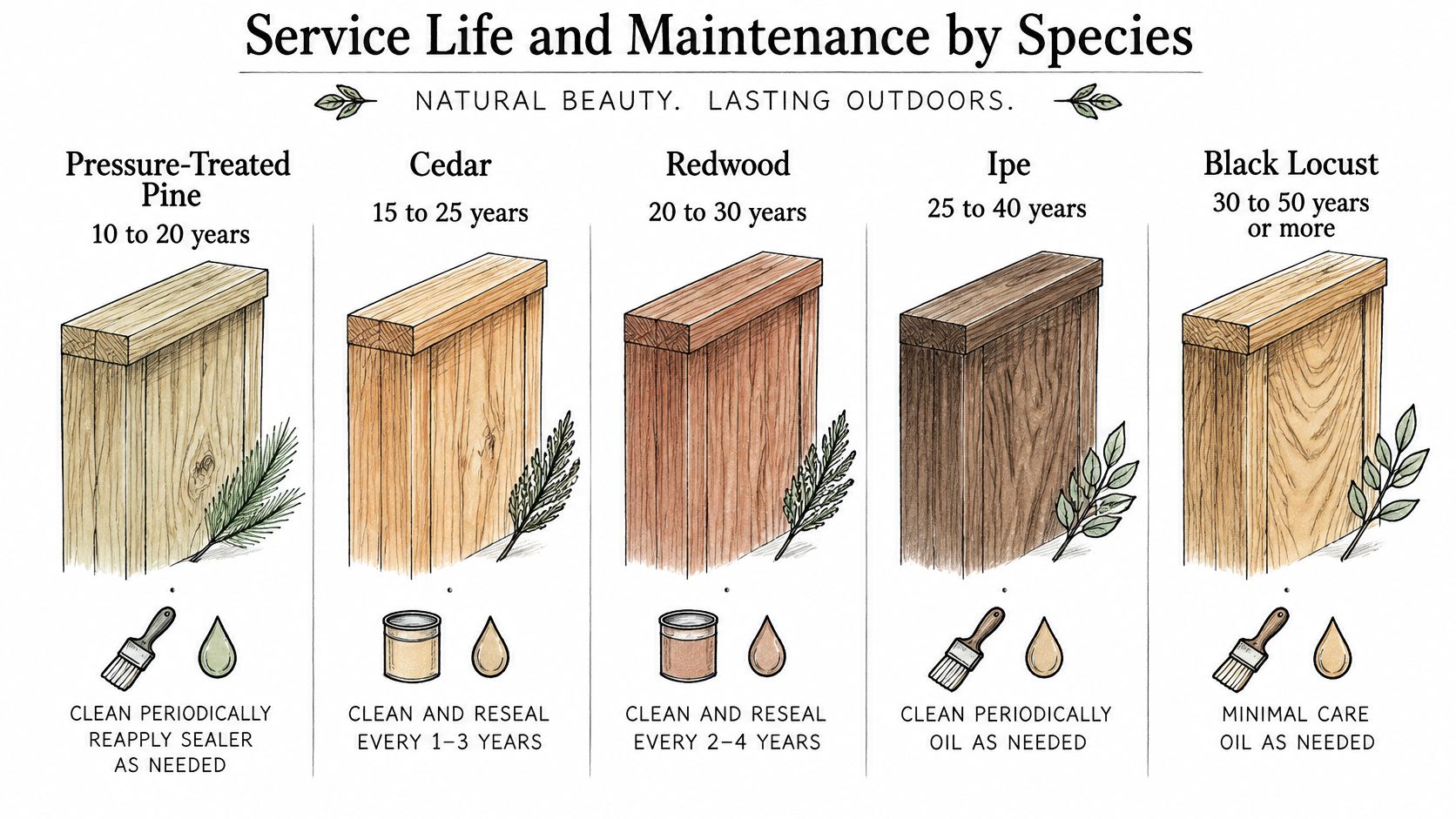
Planning service life and maintenance effort by species
| Species | Planning service life | Maintenance note | Best exposure |
|---|---|---|---|
| Pressure-treated southern pine | Shorter planning horizon | Seal and recoat regularly | Budget rails, painted or stained |
| Western redcedar | Intermediate planning horizon | Protect ends; recoat periodically | Residential rails with overhead shelter |
| Redwood | Intermediate to longer planning horizon | Select durable heartwood; maintain finish | Visible rails in dry or temperate climates |
| Ipe | Longer planning horizon | Less color-maintenance work if allowed to gray | Coastal, wet, and high-traffic rails |
| Black locust | Longest range in the cited comparison | Inspect connections; confirm replacement supply | Long-life rails where supply exists |
| White oak | No verified range available | Protect end grain and inspect checking | Humid sites with stainless fasteners |
A sheltered cap generally faces less weathering than a shaded rail with wet bracket pockets. Inspect the actual water paths before setting a maintenance schedule.
Three maintenance scenarios
Annual cleaning and finish assessment suits owners who want consistent color and a smooth surface. Wash with a mild exterior-wood cleaner, let the rail dry, sand raised fibers, and recoat when the finish needs it. Avoid layering fresh finish over a sound coating.
Periodic maintenance suits owners who accept some fading between visits. A penetrating finish is generally easier to refresh locally than a peeling film. Check joints and hand-contact edges between recoating jobs.
Neglected exposure means more than faded color. On a rail left untouched for years, debris can collect at brackets, cracks can open at cuts, and loose connections can go unnoticed. Durable heartwood allows more tolerance, but regular inspection still matters.
The video shows wood-deck service-life comparisons and maintenance considerations.
Compare total effort, not just purchase price
Ask suppliers for a price per usable linear foot of finished rail, including machining and waste. Divide the quote by the lower and upper ends of the applicable planning range for a rough material-only annual comparison, then account for installation and upkeep.
Generic decking prices won't reflect a custom rail profile. Premium hardwood can reduce replacement frequency while increasing drilling labor, handling effort, and the difficulty of finding a matching replacement board.
Ownership test: Choose a rail you can maintain and repair with locally available materials.
Matching Wood to Your Site and Budget
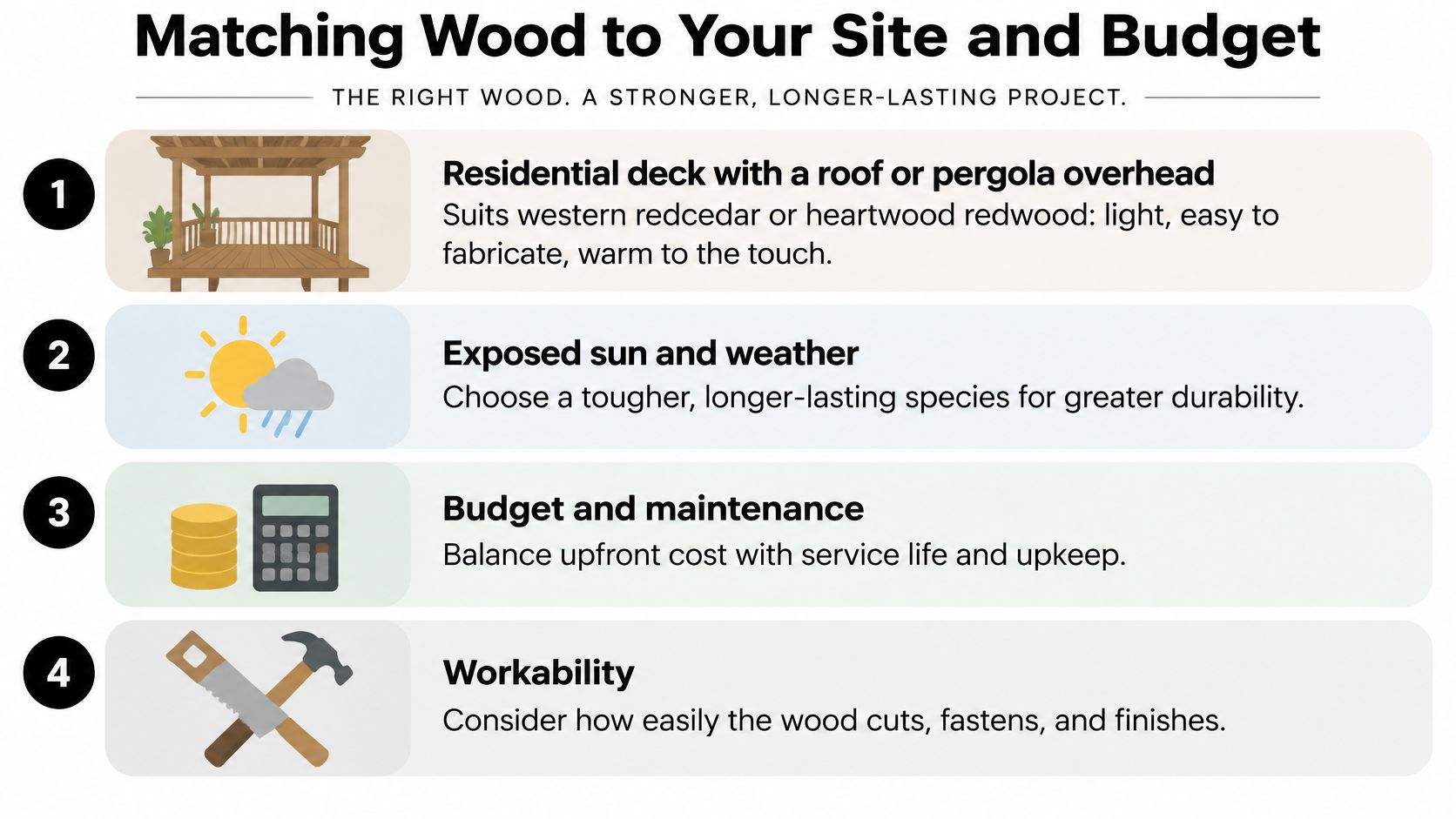
A top rail must stay comfortable to grip, hold its fasteners, and shed water in the conditions where people use it. Choose for exposure, traffic, repair access, and installed cost, not species reputation alone.
A sheltered residential deck
For a roofed or pergola-covered deck, compare the available rail stock by straightness, grain, and price. A wood-deck guide from Networx notes that quality cedar can last up to approximately 30 years under suitable conditions. That is an upper-end decking reference, not a service-life promise for an exposed top rail.
Fastener bearing deserves attention. Soft fibers can crush under a tightly driven screw or small bracket. Use the connection specified for the assembly, and stop driving once the parts seat.
A coastal or shaded, heavily used deck
On a wet, high-traffic site, weigh durability against machining effort, fastener requirements, and replacement access. If the cap is hard to reach or remove, a higher initial material cost may be worthwhile when it reduces the chance of frequent repairs.
For a hotel terrace or restaurant, check the finished edge profile against the handrail-height requirements for the project. Specify a smooth, rounded contact edge, and make sure cable fittings do not create pockets that hold water against the rail.
A humid site with seasonal movement
Specify white oak for humid sites, with inspected grain and protected end cuts. Include stainless connections in the detail, and seal exposed end grain to limit water entry.
Check the span and joint layout before ordering. A continuously supported cap and a rail spanning between posts put different demands on the assembly. Account for wood movement in the joint detail and confirm that the support spacing suits the selected rail profile.
A budget-led renovation
Pressure-treated southern pine can suit a project where the owner accepts a painted or stained finish and can select suitable stock. Reject badly twisted boards rather than pulling them straight with cap screws, which can leave the rail under strain.
Compare the lumber price with the upkeep and repair demands of other low-maintenance deck railing options. A low material cost may not mean a low project cost.
Bring these conditions into the quote:
- Weather: Sun exposure, roof cover, salt air, and prevailing rain.
- Use: Residential hand contact, commercial traffic, or likely impact.
- Appearance: Maintained natural color, stain, paint, or weathered gray.
- Construction: Post spacing, support arrangement, joint locations, and repair access.
- Budget: Installed cost and the maintenance you'll perform.
Order the Rail and Prepare Your Quote
A quote is more useful when it accounts for the rail layout and the connections, not just the wood by the foot. Use the species and finish selected for the site, then give suppliers enough detail to price the complete assembly.
Prepare a usable specification
- Send a layout sketch. Mark each run, corner, stair, and change in direction. Include post-to-post lengths and post spacing so the supplier can distinguish overall dimensions from clear openings.
- List the required components. Identify the rail sections, handrails, mounting style, supports, and hardware needed for the layout. For cable systems, note where stairs or direction changes affect the sections.
- Request a sample section. Check the profile and how the wood top meets the railing before ordering full runs. A sample can also help confirm that the chosen finish suits the project.
- Confirm the guard design. Check local requirements with the building authority, and coordinate post anchorage, cap support, and any separate graspable stair handrail.
- Ask for a coordinated drawing and quote. Include the sketch, measurements, component list, and finish choice. A drawing can help resolve fit and mounting questions before the order is finalized.
One system option is Cable Railing - Stainless Steel With Wood Handrail For Stairs, offered for stairs, balconies, decks, and other applications.
Ultra Modern Rails offers custom cable railing systems with wood handrails for decks, balconies, and stairs. Submit the run lengths, post spacing, and preferred wood species to request a quote and drawing for the project.