

You're standing in a living room beneath an open stair, or perhaps beside a mezzanine that overlooks a hallway. Thin stainless cables seem to disappear into the architecture, leaving the space bright and visually connected. That clean appearance is appealing, but it can also create a dangerous misunderstanding: interior stainless steel cable railing isn't a decorative wire installation. It's a structural guard system.
The cables, posts, handrail, fittings, anchors, and supporting structure work together. Material grade affects corrosion resistance, cable tension affects post reactions, and mounting details determine whether loads reach the building safely. A good specification therefore starts with structure and user safety, then resolves appearance.
Table of Contents
- Why Interior Stainless Steel Cable Railing Looks Simple but Acts Structural
- The Material Story Behind Stainless Cable Railing
- Code Loads and Clearance Rules Every Interior Railing Must Meet
- Comparing Mounting Styles for Interior Cable Railing
- Choosing a Handrail That Complements Cable Infill
- Specifying Finishes, Cable Construction, and Hardware Compatibility
- Maintenance Habits That Protect Indoor Stainless Cable Railing
- Putting It All Together from Concept to Installed Railing
Why Interior Stainless Steel Cable Railing Looks Simple but Acts Structural
A cable railing can look almost weightless from across a room. On a stair, the eye follows the slim horizontal lines rather than the posts and connections. At a mezzanine, the open infill preserves sightlines and makes the edge feel less imposing.
The building, however, doesn't treat those cables as decoration. A guard protects people at a raised edge, so the complete assembly must resist forces transferred through the handrail, posts, fittings, anchors, and supporting substrate. The cables help control the openings, but they can't compensate for a weak post connection or an undersized stair stringer.
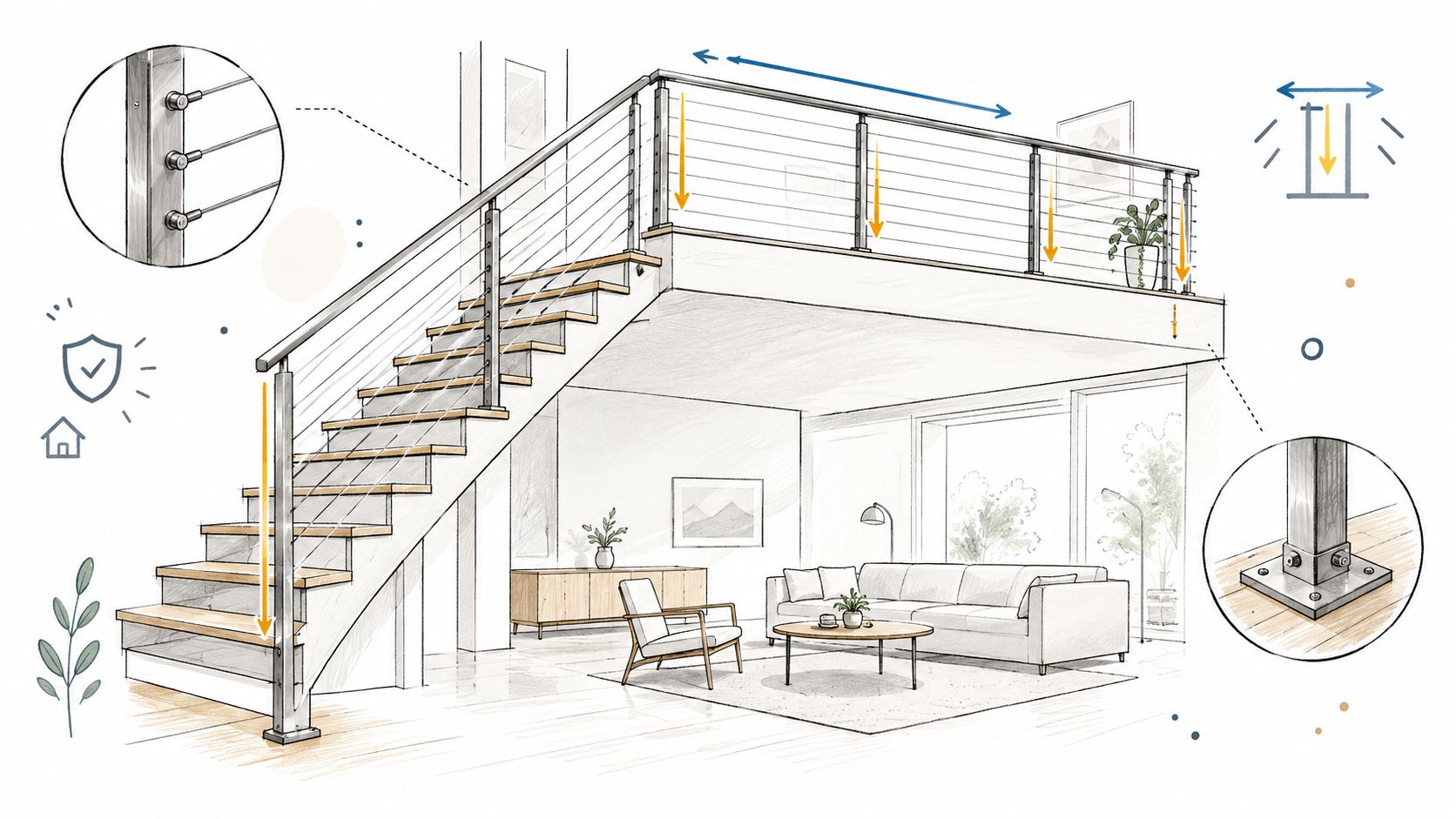
Follow the load path
Think of a person leaning against the top rail. The force travels from the handrail into its supports, down through the posts, through the bases or fascia connections, and finally into the floor, stair framing, concrete, or wall structure. At the same time, the cable infill must limit openings so a person, especially a child, can't pass through the guard.
That makes several apparently minor decisions structural decisions:
- Post layout: Longer unsupported spans can allow more movement and increase demand on termination posts.
- Cable tension: Tension reduces visible sag, but it also increases reactions at end posts and fasteners.
- Handrail profile: A narrow cap may look minimal, while a continuous graspable rail can provide better support on stairs.
- Anchorage: A beautiful post attached only to finish flooring isn't equivalent to a post connected to structural framing or concrete.
- Stair geometry: Angled cable runs, landings, transitions, and changing post heights require coordinated detailing.
Practical rule: Specify the guard as one tested or engineered assembly. Don't select cable, posts, fittings, and anchors as unrelated parts.
A strong design can still feel light. The aim isn't to make the railing visually heavy. It's to hide the complexity where appropriate while making the structural logic clear in the drawings and quotation. Once you see the system this way, the finish, mounting style, and handrail become easier to evaluate because each choice has a safety role as well as a visual one.
The Material Story Behind Stainless Cable Railing
Stainless steel is an alloy, not a coating applied over ordinary steel. Its corrosion resistance comes from the chemistry of the metal itself, particularly its chromium content.
Historical accounts trace important developments through several stages. English researchers Woods and Clark patented an acid- and weather-resistant alloy containing 30–35% chromium and 2% tungsten in 1872, while later work by P. Monnartz and W. Borchers identified a major improvement when iron alloys contained at least 10.5% chromium. On 13 August 1913, Harry Brearley produced an alloy containing 12.8% chromium and 0.24% carbon, widely recognized as the first true stainless steel. The history and material chemistry are documented by the British Stainless Steel Association.
How the passive film protects the surface
Chromium reacts with oxygen and forms an extremely thin, stable chromium-oxide film on the surface. If the surface is scratched, exposed chromium can form a new protective layer when oxygen is available. That self-repairing behavior explains why a properly selected stainless cable system can maintain its appearance and performance in ordinary interior conditions without paint.
“Stainless” still doesn't mean stain-proof. Contaminants can interfere with the protective behavior, particularly when they remain on the surface or become trapped around fittings. Carbon-steel dust, chloride residues, fingerprints, and aggressive cleaning chemicals can create staining or localized corrosion even when the base alloy is corrosion resistant.
Selecting the alloy for the room
Type 304 is commonly suitable for conditioned interiors with ordinary atmospheric exposure. Type 316 or 316L is the more conservative specification where chlorides may be present, including rooms near swimming pools, coastal homes with salt-laden air infiltration, commercial kitchens, and areas where deicing salts enter the building.
The difference matters because 316 contains molybdenum, which improves performance in chloride-bearing environments compared with 304. The alloy should appear on the specification alongside cable diameter, construction, finish, and fitting material. Treating grade as an afterthought can leave a visually refined installation with a material choice poorly matched to its environment.
Code Loads and Clearance Rules Every Interior Railing Must Meet
A railing quote can look complete while leaving the most important question unanswered: what exactly has been designed to carry the required loads?
Common guard specifications identify a 200-pound (0.89 kN) concentrated horizontal load applied over 1 square foot (0.09 m²) to the infill system. They also commonly require a 50-pound-per-linear-foot (0.73 kN/m) uniform infill load. Representative top-rail criteria include a 50-pound-per-linear-foot horizontal load applied concurrently with a 100-pound-per-linear-foot vertical load, plus a 200-pound concentrated load in any direction. These benchmarks are summarized in the architectural cable railing guard specifications.
The practical meaning is straightforward. The cable must resist more than light hand contact, the top rail must handle people leaning or pulling in different directions, and the connections must transfer those forces into the building.
Translate the numbers into design decisions
The load doesn't stop at the cable. It moves through the entire guard:
- A person applies force to the handrail or infill.
- The rail and cable fittings transfer force to the posts.
- Posts transfer force through bases, fascia plates, or standoffs.
- Anchors transfer force into framing, concrete, steel, or another verified substrate.
Cable tension reduces visible sag, but greater tension also increases reactions at termination posts and fasteners. That's why installers should follow the manufacturer's tested assembly and tensioning method rather than tightening cables by feel. A strong cable installed in a weak substrate is still a weak guard.
Height depends on the application and jurisdiction. Specifications commonly identify 36 inches (914 mm) for some guard applications and 42 inches (1,067 mm) for others. In U.S. practice, guards are generally required where an open-sided walking surface is more than 30 inches (762 mm) above the floor or grade below, measured within 36 inches (914 mm) horizontally of the edge. Confirm the applicable requirement with the local authority because occupancy, building type, and jurisdiction can change the result.
Cable spacing is part of the safety conversation
Project specifications commonly limit cable spacing to approximately 2.5–3 inches on center, while the governing residential or commercial code controls the final guard height and loading. Stair runs deserve extra attention because the cable follows an angle and the openings can behave differently from those on a level guard.
For a useful consumer-facing explanation to share with a contractor, review these cable railing code requirements. Ask the railing supplier to identify the supporting substrate, post spacing, end-post capacity, attachment method, and expected inspection points. Those details tell you whether the proposal describes a complete guard system or only a collection of attractive components.
Comparing Mounting Styles for Interior Cable Railing
The best mounting style depends less on the railing's appearance than on what exists behind the finish. A surface post on a concrete slab, a fascia post on a stair stringer, and a wall standoff may look related, but they develop their strength through different structural paths.
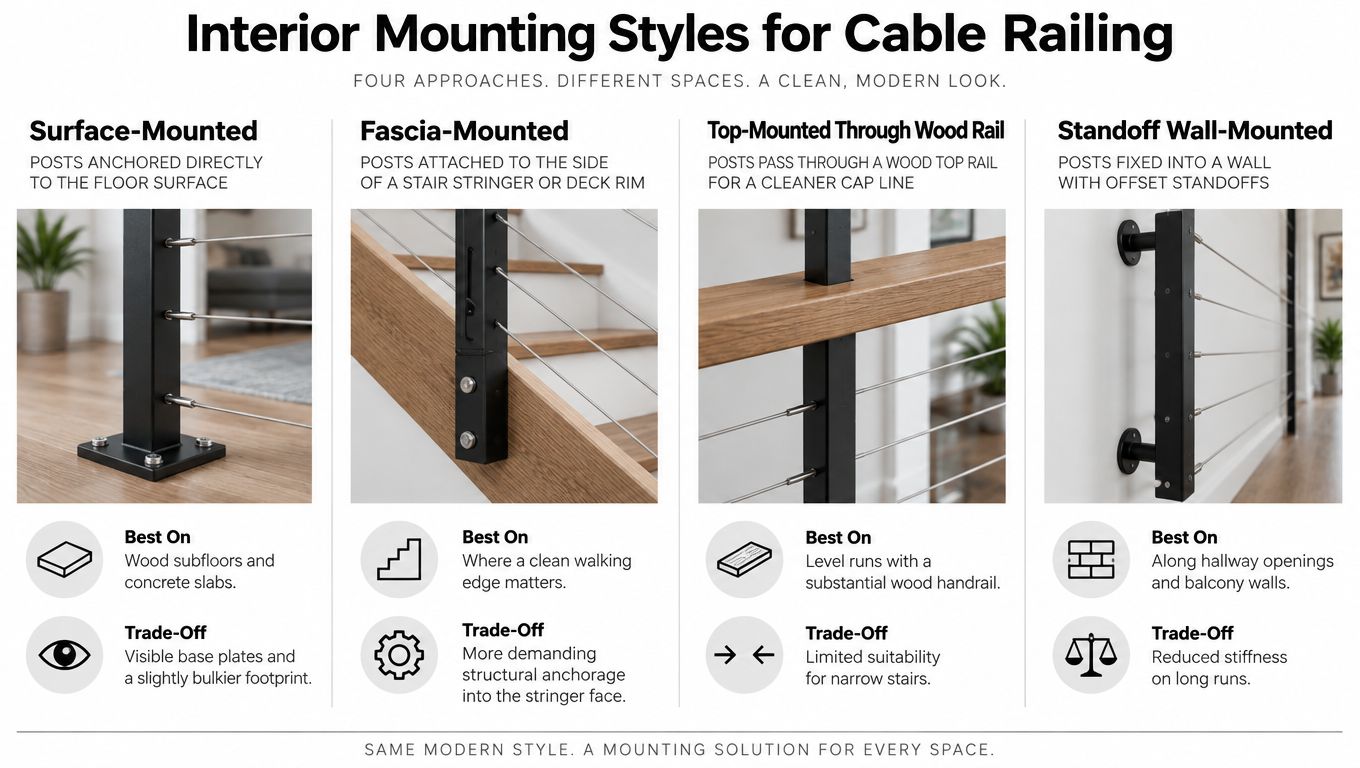
Four common approaches
Surface-mounted posts sit on the floor, stair tread, landing, or slab. This is often the most direct arrangement when the substrate can accept properly sized anchors. The trade-off is a visible base plate and a footprint that may slightly reduce clear walking width.
Fascia-mounted posts attach to the side of a stair stringer, deck rim, or structural slab edge. They preserve more of the walking surface and can give a stair a cleaner edge, but the side structure must provide enough depth and strength for the anchors. Finish trim can also make access difficult during installation.
Top-mounted posts through a wood rail pass through a substantial wood top rail. This can produce a clean cap line on a level run, but it requires a strong rail and careful coordination between the post, cable fittings, and handrail. Narrow stairs may not provide enough room for this arrangement.
Standoff wall-mounted posts use offsets to fix the system into a wall or wall-side structure. They can suit hallway openings and balcony edges, but the wall construction must be verified. Long runs may need additional support because the offset increases the lever arm between the guard and the wall.
| Mounting Style | Best Substrate | Key Trade-Off |
|---|---|---|
| Surface-mounted | Wood framing or concrete slab | Visible base plates and a larger footprint |
| Fascia-mounted | Stair stringer, rim structure, or slab edge | Cleaner walking edge, more demanding side anchorage |
| Top-mounted through wood rail | Substantial wood handrail on a level run | Clean cap line, limited use on narrow stairs |
| Standoff wall-mounted | Verified structural wall | Useful where floor posts don't fit, reduced stiffness on long runs |
A level run over a properly framed wood floor may suit surface mounting. A concrete mezzanine edge may require anchors selected for concrete and edge clearances. A steel stair stringer may support fascia mounting if the connection has been designed for the actual steel thickness and loads.
Use the interior railing mounting types guide to compare layouts, but don't choose from images alone. Before fabrication, document what the anchor reaches, how close it is to an edge, and whether the substrate can accept the anticipated forces.
Choosing a Handrail That Complements Cable Infill
Cable infill and the handrail serve different structural and human functions. The cables close the guard opening, while the handrail gives a person a continuous surface to find, guide along, and grasp. Coordinating their finish can create visual unity, yet their dimensions should follow use rather than match by default.
A slim stainless cap may suit a minimalist mezzanine where the edge mainly defines the guard line. Stairs call for closer attention to grip and visibility. A substantial round or shaped handrail is easier to see and hold, especially for children, older adults, or anyone using the stair cautiously. Wood adds warmth and a familiar tactile surface. Stainless steel keeps the composition crisp and visually light.
Start with how people use the stair
A stair in a multigenerational home needs more than a finish comparison. Aging-in-place remodeling is heavily driven by homeowners aged 65 and older, according to national remodeling industry data. That pattern supports a practical design priority: a guard can satisfy dimensional requirements and still feel difficult to use if the handrail is hard to locate or grip.
A clear sightline is valuable, but it should not replace a handrail that users can find and hold comfortably.
Consider a continuous wood handrail above stainless cable infill. The wood provides the warm, graspable element, while the slender cables maintain the guard function below. A stainless tube may be a better visual fit where the stair connects to a metal-framed mezzanine or where the interior uses other exposed metalwork.
Surface contrast also affects recognition. A polished rail can reflect bright interior light and visually disappear. Satin stainless or contrasting wood can make the handrail easier to identify. Lighting should reach the tread nosings, handrail, and landing transitions without creating glare.
Keep guard and handrail requirements separate during design review. Confirm whether the proposed top rail is intended to be graspable, whether it remains continuous through transitions, and whether its profile suits the people using the stair. Code guidance such as the California cable rail technical bulletin emphasizes graspable, continuous handrails for aging users. A well-specified cable system lets the guard close the opening while the handrail performs its own job clearly.
Specifying Finishes, Cable Construction, and Hardware Compatibility
A cable guard may look visually light, yet every component must work as one structural assembly. Give the fabricator enough information to select the alloy, cable construction, surface finish, fittings, and connection method without making assumptions. “Stainless cable railing” alone leaves too many decisions open.
Build the specification in layers
Start with the alloy. 316 or 316L stainless steel provides a conservative choice for interiors where chlorides may be present, while 304 can suit ordinary conditioned spaces. ASTM A492 covers stainless steel rope wire, including chemical composition controls and tensile-strength requirements. The ASTM A492 standard reference helps document the material criteria for the project.
Define the cable construction next. 1x19 stainless cable is widely used in architectural railing because its strands create a clean appearance and relatively stable geometry. Diameter should follow the tested railing system and project requirements, not appearance alone. A larger cable may reduce visible deflection, but it also has to match the fittings, swages, anchors, and tensioning method.
Then specify the visible finish and the parts that must work with it:
- Satin finishes soften reflections and generally suit contemporary residential interiors.
- Mirror finishes produce a brighter surface, though they show fingerprints and surrounding reflections more readily.
- Matching fittings keep termination components visually related to the cable and posts.
- Compatible tools help prevent iron contamination from carbon-steel dust or contact.
- Handrail material should be coordinated with the posts and cable finish so the complete assembly looks intentional.
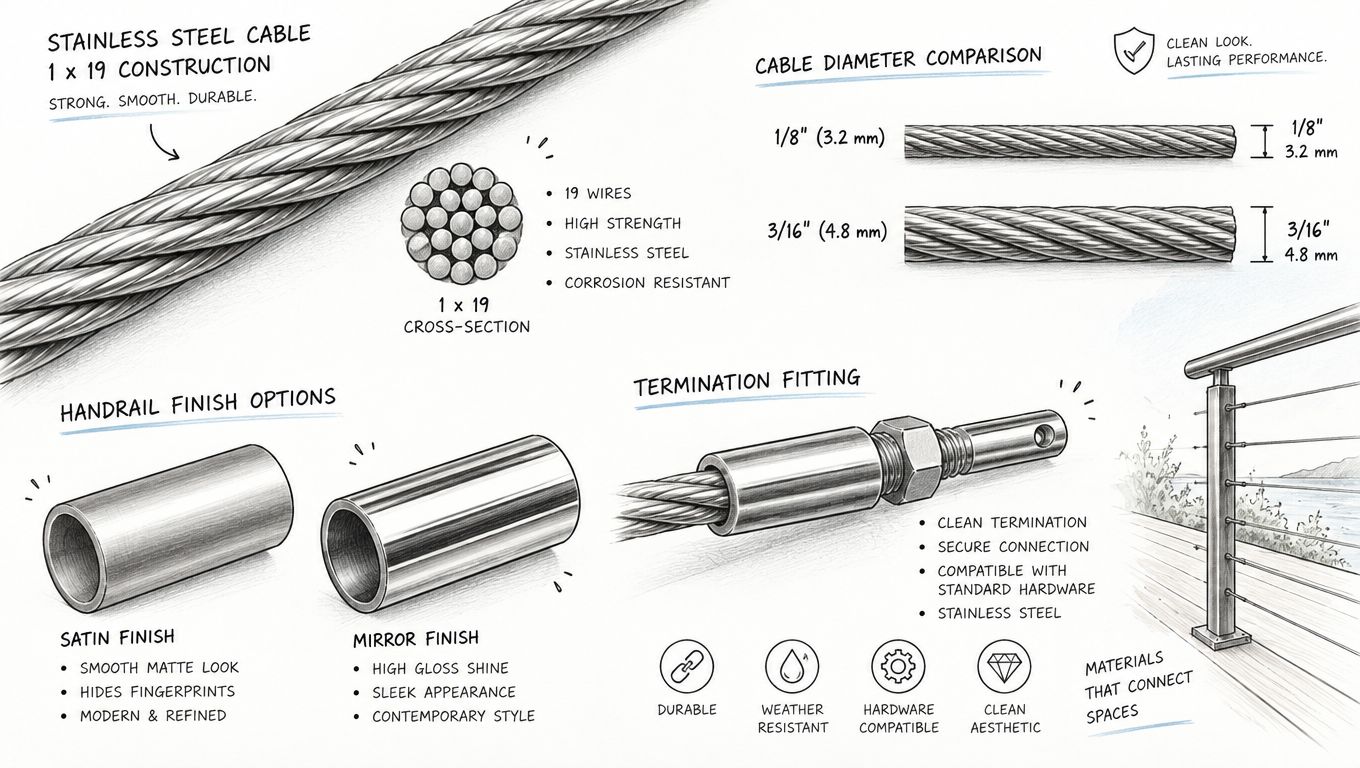
Read the hardware schedule, not only the product photo
A photograph may show an attractive post, but it does not prove that the complete guard can be installed, tensioned, adjusted, and secured correctly. The schedule should identify termination fittings, intermediate supports, stair components, anchors, tensioning parts, and any adjustment or locking device required by the governing requirements.
Confirm the diameter and spacing limits covered in the code section above, then specify the adjustment device and tension lock required for the assembly. These details matter because cable tension must remain controlled after installation, while the fittings must transfer forces into the posts, framing, and substrate.
For a practical hardware review, compare fitting types and connection roles in this guide to stainless steel cable railing hardware. Before fabrication, request a drawing showing post locations, cable paths, rail height, mounting plates, substrate assumptions, and termination points. That drawing turns the design intent into an installable structural system.
Maintenance Habits That Protect Indoor Stainless Cable Railing
Indoor placement lowers exposure, but it doesn't eliminate corrosion risk. Fingers leave residues, cleaning products collect around fittings, carbon-steel dust can contaminate the surface, and chlorides can enter from pools, coastal air, kitchens, or deicing salts.
Pool rooms require special care. High humidity, warm temperatures, acidic moisture films from water disinfection, and deposited salt aerosols can create a highly corrosive atmosphere. Technical research indicates that selected high-alloy stainless steels may be required in highly corrosive indoor-pool environments if components aren't cleaned regularly, and the same guidance warns against bleach, chloride-containing cleaners, abrasives, and hydrochloric acid on stainless surfaces. See the technical research on stainless steel in indoor pool environments.
Match care to exposure
For an ordinary conditioned interior, wipe visible fingerprints and residue with a chloride-free, non-abrasive cleaner, then dry the surface. Pay attention to swages, threaded fittings, cable ends, and the underside of the handrail, where residue can remain unnoticed.
A pool room, commercial kitchen, or coastal home needs a more deliberate routine:
- Rinse contamination promptly: Remove salt or chemical residue before it dries around fittings.
- Use compatible products: Choose a mild, chloride-free, non-abrasive cleaner.
- Avoid damaging chemicals: Don't use bleach, chloride-containing products, abrasives, or hydrochloric acid.
- Inspect connections: Look for looseness, staining, pitting, cable movement, or changes in post alignment.
- Record adjustments: If a cable requires retensioning, document what changed and confirm that the adjustment lock remains secure.
“Low maintenance” should mean simple maintenance, not no maintenance. A homeowner or facilities team can tie cleaning to the environment: occasional care in a dry interior, more frequent attention near chlorides, and documented inspections where the atmosphere is aggressive.
Putting It All Together from Concept to Installed Railing
Start by identifying the guard location, occupancy, substrate, stair geometry, and environmental exposure. Confirm height, opening, and load requirements with the local authority, then choose the mounting style and handrail profile that fit the structure and the people using the space.
Write the specification with alloy, cable construction, diameter, finish, fittings, anchors, post spacing, and adjustment details. During installation, inspect substrate preparation, post alignment, cable tension, handrail continuity, and final clearances. Set a maintenance routine based on exposure rather than assuming every interior room needs the same care.
Ultra Modern Rails offers custom stainless steel cable railing sections, handrails, mounting styles, and wood-top options, along with project drawings for interior applications. Ask any supplier for a complete quote that shows the full load path, not only the visible cable components.
If you're planning an interior stair, mezzanine, or balcony, Ultra Modern Rails can help you develop a custom cable railing layout with coordinated sections, handrails, mounting styles, and wood tops. Visit the site to request a project drawing and quote that reflects your substrate, code needs, finish preferences, and intended use.