

The most popular advice about an outdoor rope stair railing is also the most misleading: choose a weather-resistant rope, tension it between posts, and enjoy the nautical look. That approach treats rope as decoration first and as an exterior safety component second. Outside, ultraviolet light, rain, drying cycles, temperature changes, abrasion, and sustained tension all affect how the system performs.
Rope can work outdoors, but it isn't maintenance-free and it isn't automatically a legal handrail. The reliable approach is to decide first whether rope will serve as infill, a visual accent, or the actual gripping surface, then specify the material, anchorage, inspection routine, and code details around that decision.
Table of Contents
- The Reality of Rope Railings in Exterior Environments
- Navigating Building Codes and Handrail Requirements
- Evaluating UV Degradation and Material Lifespan
- Comparing Rope Infill to Modern Cable Railing Systems
- Structural Anchoring and Tensioning Best Practices
- Making the Right Choice for Your Outdoor Space
The Reality of Rope Railings in Exterior Environments
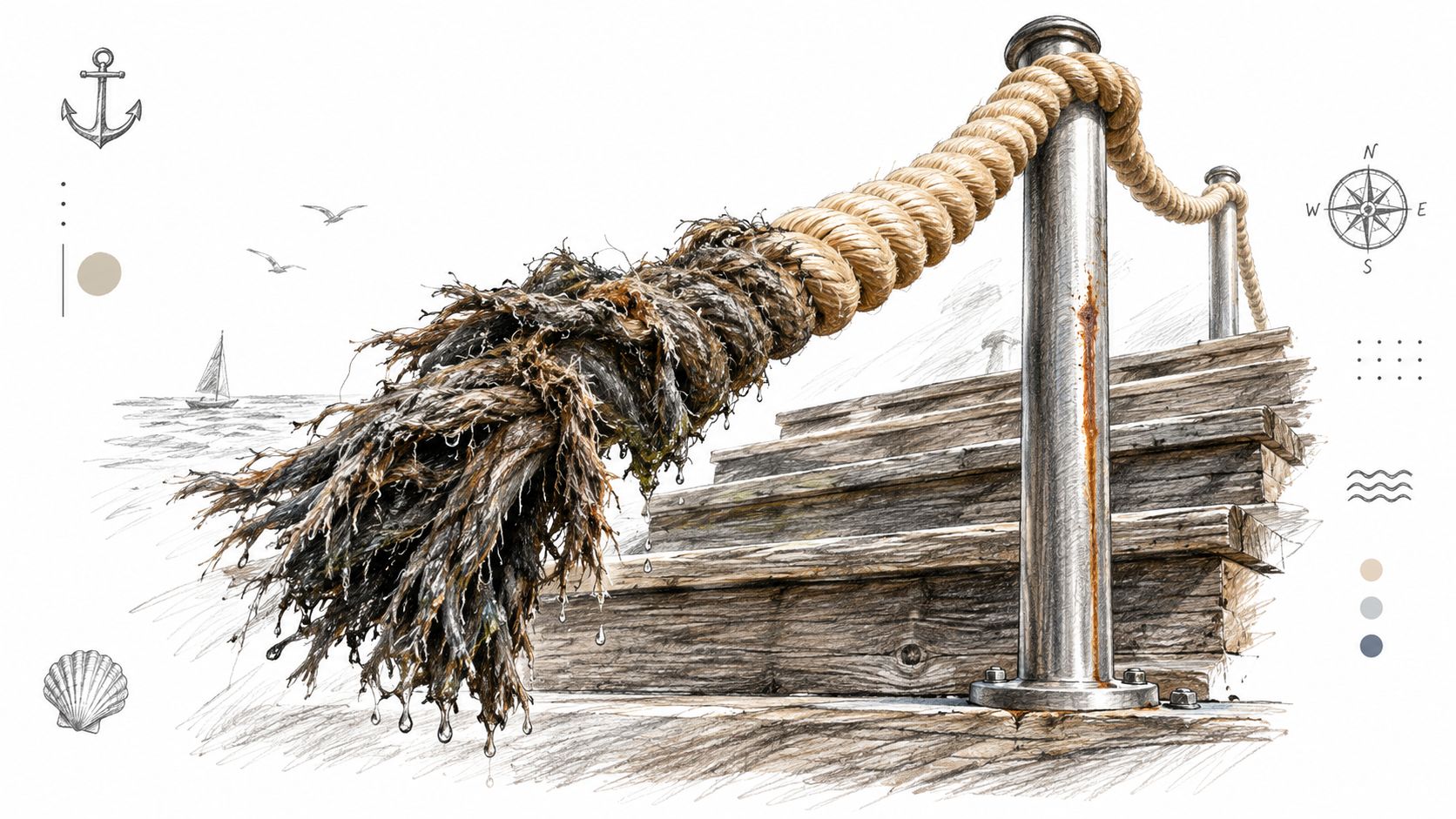
Rope has a legitimate architectural history. In Boston, documented ropefields in Charlestown were established in 1638, and by 1666, shipbuilder Nehemiah Bourne had constructed a ropewalk measuring 984 feet. These facilities twisted and laid fibers into continuous cordage for ships, rigging, and structural uses, which helps explain why rope still suggests flexibility, toughness, and maritime craft. The history of rope-making and ropewalks also shows why appearance alone has never been enough. Fiber, construction, tension, and maintenance determine performance.
A deck or stair railing faces a different problem from a sheltered shipyard component. Sunlight attacks exposed fibers, while wetting and drying alter tension and dimensional stability. A rope can fade, stiffen, roughen, or begin to fray before a homeowner notices an obvious loss of strength.
The nautical look has a maintenance cost
Accelerated testing with the Austrian Research Institute exposed rope samples to approximately 2,000 hours of simulated weathering. The test included rain-and-dry cycles and alternating light and darkness, and researchers estimated that it represented roughly two to three years of use in a Central European climate. The UV-resistance testing report found that ordinary outdoor exposure can reduce breaking strength, increase elongation, and make fibers stiffer to handle.
The tested effects were more pronounced in polyamide ropes than in polyester ropes. Some covers also frayed under load. That doesn't mean every polyester or synthetic rope will perform identically, but it does rule out a blanket promise that any rope labeled outdoor-rated can be installed and forgotten.
Practical rule: Treat outdoor rope as an engineered exterior component, not as a decorative accessory with a long service life guaranteed by appearance.
Natural rope introduces additional uncertainty. Its texture may suit a rustic stair, pool deck, or coastal property, but moisture retention, drying conditions, dirt, and contact with fittings all influence aging. Synthetic rope can reduce some of those problems, yet it still needs inspection and may require retensioning as it elongates under sustained load.
The most successful designs set expectations early. Use rope where its texture and movement add value, keep it away from unnecessary abrasion, protect terminations, and make sure a separate handrail carries the gripping function when the rope can't provide a consistent hold.
Navigating Building Codes and Handrail Requirements
A rope railing can look like a handrail without functioning as one. Building officials and users care about continuity, height, graspability, openings, and structural support, not whether a project has an attractive nautical theme.
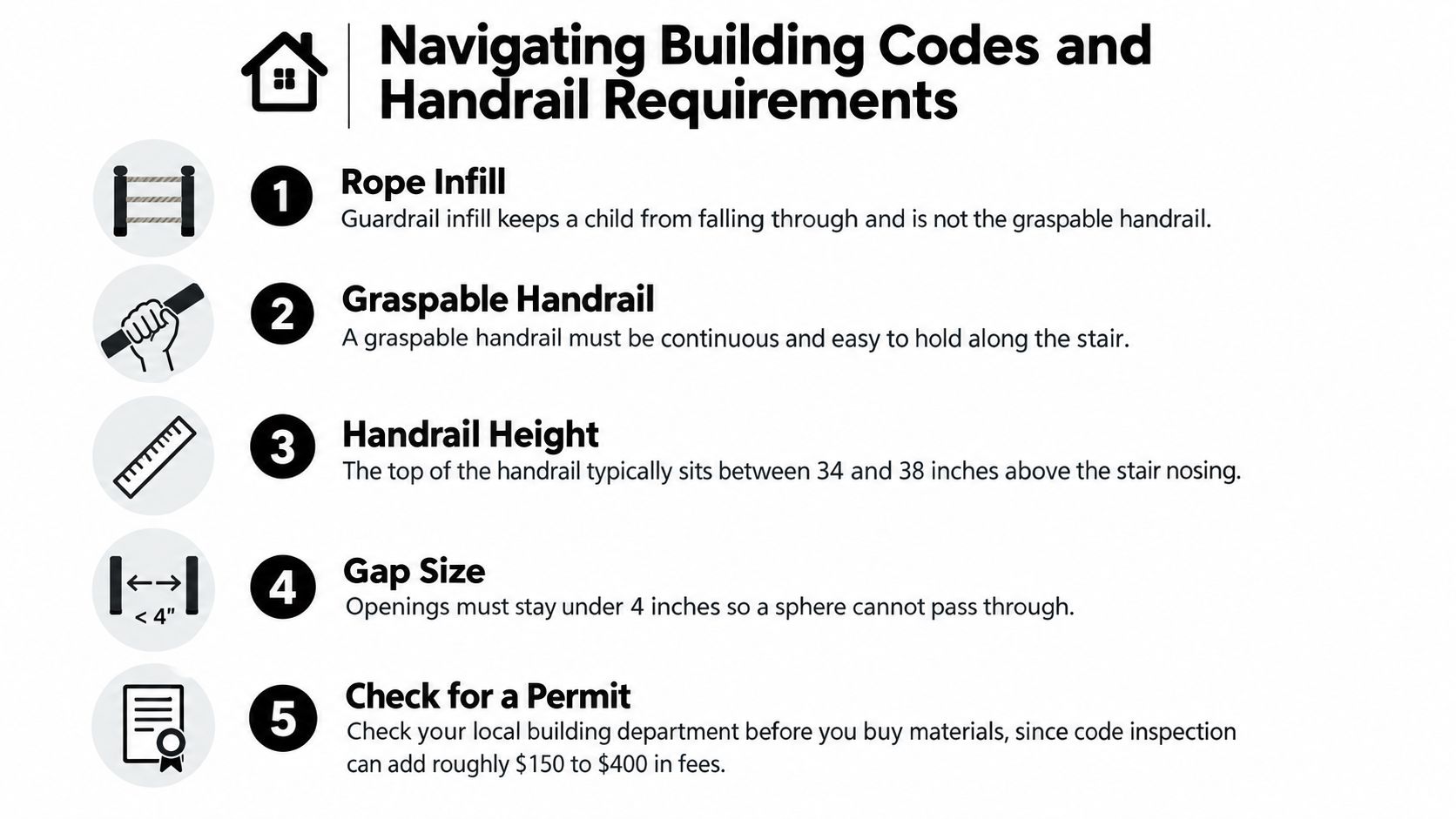
For a U.S. residential stair, a handrail generally sits 34 to 38 inches vertically above the stair-tread nosings. It should continue for the full flight and remain readily graspable. A circular handrail typically has an outside diameter between 1.25 and 2 inches. These dimensions and the requirements for exterior stairs are summarized in Seattle's municipal handrail guidance.
Separate the handrail from the guard infill
The cleanest mental model uses two different components:
- Guard infill: Rope fills the space between posts or beneath a top rail, helping create a visual barrier and limiting fall-through openings.
- Graspable handrail: A continuous, stable element gives the user a secure hand position while climbing or descending.
- Top rail: Depending on the system and local rules, this may serve as part of the guard assembly, but it isn't automatically a compliant handrail.
- End treatment: The handrail must extend or return where the authority having jurisdiction requires it. Knots and abrupt rope terminations can interrupt a sliding grip.
- Opening control: Rope spacing and deflection must be evaluated against the adopted guard rules. A flexible line that sags under contact can create an opening that wasn't present during installation.
For accessibility-covered exterior stairs that form part of a required means of egress, the U.S. Access Board stairway guidance calls for handrails on both sides and continuous gripping surfaces along the flight. That makes a flexible decorative rope a poor choice as the only support on switchback stairs, commercial properties, and routes exposed to wet conditions.
A hybrid layout usually works better. Install a rigid, code-compliant handrail at the required height, then use rope below it as infill or as a secondary visual element. This preserves the coastal character without asking a flexible material to perform a job it may not satisfy.
A rope-looking stair railing isn't automatically a compliant handrail. Specify the gripping surface separately unless the rope's geometry, texture, compression, continuity, and attachment have been accepted by the local authority.
Before ordering materials, give the building department a drawing showing stair geometry, handrail height, post locations, rope spacing, attachment details, and the proposed handrail profile. The stair railing requirements guide from Ultra Modern Rails can help organize the questions, but the locally adopted code and the authority having jurisdiction control the approval.
Evaluating UV Degradation and Material Lifespan
A rope inspection shouldn't begin with the question, “Does it still look good?” Surface appearance can remain acceptable while the fibers have lost strength or the system has developed excessive elongation. Inspect the rope, fittings, posts, and surrounding structure as one assembly.
Look, touch, and measure
Use a consistent routine:
- Scan for color changes. Yellowing, fading, or darkened wet areas can indicate exposure or contamination. A change in color isn't proof of failure, but it deserves closer inspection.
- Run a gloved hand along the rope. Stiffness, roughness, unusual hard spots, and surface microcracks can indicate fiber damage. Stop handling the rope if strands are cutting or shedding.
- Inspect the cover and strands. Fuzzing, broken yarns, pulled fibers, and fraying under load are replacement warnings, not cosmetic defects.
- Check tension. Compare the line with its original installation condition. Visible sag, slippage at a termination, or a rope that no longer returns to shape can affect both the barrier and its appearance.
- Examine the hardware. Look for corrosion, deformation, sharp edges, cracked fittings, and movement at the connection. The stainless steel and steel corrosion guide offers useful context for evaluating metal components.
- Check the surrounding wood or framing. Water trapped around penetrations can cause rot or loosen the attachment even when the rope itself looks sound.
Polyester showed less strength loss than polyamide in the cited accelerated testing, but no fiber should be selected on that comparison alone. Exposure level, rope construction, coating, contact with metal, salt or pool chemicals, and the quality of the termination all affect the result.
Replace uncertainty, not just visible failure
Manufacturers' limits should govern replacement. Remove and replace rope after serious fraying, damaged strands, compromised terminations, severe stiffness, or a history you can't verify. Retensioning may correct ordinary looseness, but it won't restore fibers damaged by ultraviolet exposure or abrasion.
Keep a simple record of installation, cleaning, inspections, and adjustments. That record helps distinguish normal tension changes from progressive deterioration. It also gives the next owner or contractor useful information instead of leaving them to judge an aging railing from a photograph.
Comparing Rope Infill to Modern Cable Railing Systems
Rope and stainless steel cable can create a visually open barrier, but they behave differently after installation. Rope contributes texture and movement. Cable offers a more predictable geometry, particularly when the posts, fittings, and handrail are designed as a coordinated system.
| Feature | Outdoor Rope Railing | Stainless Steel Cable Railing |
|---|---|---|
| Visual character | Nautical, rustic, and tactile, with visible knots or braided texture | Minimal, linear, and visually quiet |
| UV response | Can fade, stiffen, elongate, or fray depending on fiber and exposure | Metal does not have a textile cover that degrades in the same way |
| Tension stability | May require inspection and retensioning as the rope changes length | Tension is more predictable when posts and fittings are correctly specified |
| Maintenance | Requires checks for fuzzing, discoloration, moisture, sag, and connector wear | Requires inspection, cleaning, and attention to corrosion or contamination |
| Hand contact | May be soft or textured, but can be difficult to grasp consistently | Usually paired with a separate rigid handrail |
| Coastal suitability | Depends heavily on rope material, construction, and exposure | Marine-grade stainless components are suited to demanding exterior conditions when properly detailed |
| View preservation | Open, but the rope has a substantial visual profile | Fine cable preserves a clean, unobstructed appearance |
| Design flexibility | Strong choice for a deliberate coastal or rustic theme | Strong choice for contemporary, architectural, and low-maintenance designs |
Where rope earns its place
Rope makes sense when texture is central to the design and the owner accepts scheduled inspection. It can work as infill on a sheltered deck, beside a rigid handrail on a coastal stair, or as a replaceable accent where the rope isn't the primary fall-protection component.
The visual payoff is real, but it comes with more variables. Knots can loosen, flexible lines can sag, and weather exposure can change the feel of the material. A rope railing also demands careful detailing at every end because a weak termination can undermine an otherwise sound line.
Where cable is the more sensible pivot
Cable is usually the better fit for exposed stairs, pool areas, ocean-facing decks, and properties where the owner wants the railing to recede visually. Properly selected stainless steel, especially a marine-grade specification where chloride exposure is a concern, avoids the finite textile surface that ultraviolet light and moisture can attack.
Cable still isn't maintenance-free. Salt, dirt, crevices, incompatible metals, and poor drainage can cause localized corrosion. The benefit is predictability. A correctly installed cable system gives the designer a stable infill element, while a rigid top handrail handles graspability and code requirements.
For a deeper evaluation of the design and maintenance trade-offs, compare cable railings with traditional railing systems before committing to a rope-only concept.
Structural Anchoring and Tensioning Best Practices
A strong rope or cable can't compensate for weak posts. The railing transfers horizontal and vertical forces through its fittings, posts, fasteners, and supporting structure, so the load path must be designed from the hand-contact zone back into the building.
Start with the structure
Posts should connect to stair stringers, deck framing, balcony structure, or a structural wall. Fastening a post only to trim, fascia, thin decking, or nonstructural cladding leaves the system dependent on materials that weren't designed to resist railing forces.
Before drilling, identify the framing and confirm its condition. On stairs, account for the angle of the stringer and the direction of the applied force. On decks, verify that the framing can accept the concentrated loads at each post rather than assuming the visible deck surface represents the structure below.
Detail every termination
Use outdoor-rated rope construction, corrosion-resistant fittings, and positive mechanical terminations. A knot may suit an ornamental end, but it shouldn't be the only safety-critical connection unless the system has been specifically engineered and accepted for that use.
Provide a tensioning method that allows inspection and adjustment. Tension should be firm enough to control sag without overstressing posts, fittings, or the rope. Penetrations need drainage and sealing details so water doesn't remain trapped around fasteners or inside wood.
The same principles apply to cable. Stainless fittings, compatible metals, sound swaging, and accessible adjusters make future inspection possible. Avoid mixing hardware casually, particularly where dissimilar metals can remain wet.
Load path matters more than rope diameter. The post spacing, anchorage, fitting, framing, and deflection control determine whether the finished railing behaves safely.
As a practical U.S. workplace benchmark, the technical summary of OSHA railing guidance describes handrails and top rails resisting at least 200 pounds of force applied within 2 inches of the top edge in a downward or outward direction. Residential rules and local codes may differ, but the benchmark illustrates why a product's nominal breaking strength doesn't establish compliance. The assembly must resist real contact without dangerous movement, and the authority having jurisdiction may apply different requirements.
Making the Right Choice for Your Outdoor Space
The best-looking outdoor rope railing is often the wrong long-term choice. Use rope because you want the texture and are willing to live with inspection, cleaning, retensioning, and eventual replacement, not because the photos make it seem simple.
Rope works best as an accent where exposure is moderate and the railing is not being asked to do every job at once. On required stairs, switchbacks, commercial paths, and wet approaches, the safer approach is usually rope infill paired with a separate rigid handrail that can meet grip and continuity requirements. If you want the clean view without the upkeep that comes with natural or synthetic fibers, stainless cable is usually the more durable fit.
Cable also holds its geometry better in places that punish soft materials, including coastal decks, pool areas, and fully exposed stairs. That does not remove the hard parts. Posts still need proper anchorage, and the full assembly still has to satisfy local code.
Before you buy anything, ask the building department a few direct questions:
- Is the rope serving as infill, handrail, or both?
- What handrail height, grip profile, extensions, and side clearance apply?
- What opening and load rules apply to this stair or deck?
- Which materials and fittings suit the site's moisture and salt exposure?
- How will the posts connect to structural framing?
Then ask for a drawing of the whole assembly, not a product photo. Ultra Modern Rails offers factory-direct stainless steel cable railing systems, custom sections, handrail options, mounting styles, and design support for stairs, decks, balconies, patios, pools, and commercial spaces.
If you are choosing between decorative rope and stainless cable, send your stair or deck dimensions and site exposure conditions. Visit Ultra Modern Rails to request a custom quote and drawing, then take that proposal to your local building department before ordering materials.