

“Stainless” doesn't mean a cable hook is automatically safe, corrosion-proof, or suitable for every railing. A bright finish can hide the wrong alloy, an unverified load rating, or a poor fit between the hook and cable. The useful questions are what grade the hook is, how it will be loaded, whether it matches the rest of the hardware, and how you'll inspect it.
Table of Contents
- What Stainless Steel Cable Hooks Are and Why Grade Matters
- Choosing Between 304 and 316 Stainless Steel Hooks
- Load Ratings, Working Limits and What the Numbers Mean
- Matching Hooks to Cable Railing Hardware
- Corrosion Care and When to Replace a Hook
- Confirm Grade, Load and Inspection Before You Order
What Stainless Steel Cable Hooks Are and Why Grade Matters
A stainless steel cable hook is a forged or fabricated fitting, usually with an eye, a throat and sometimes a latch. It holds or tensions steel cable and connects it to terminals, posts or anchor fittings. A common mistake is to choose one by appearance alone. Think of the hook as one link in a chain: the weakest link can limit the whole assembly, so the alloy and rated load matter more than a polished surface.
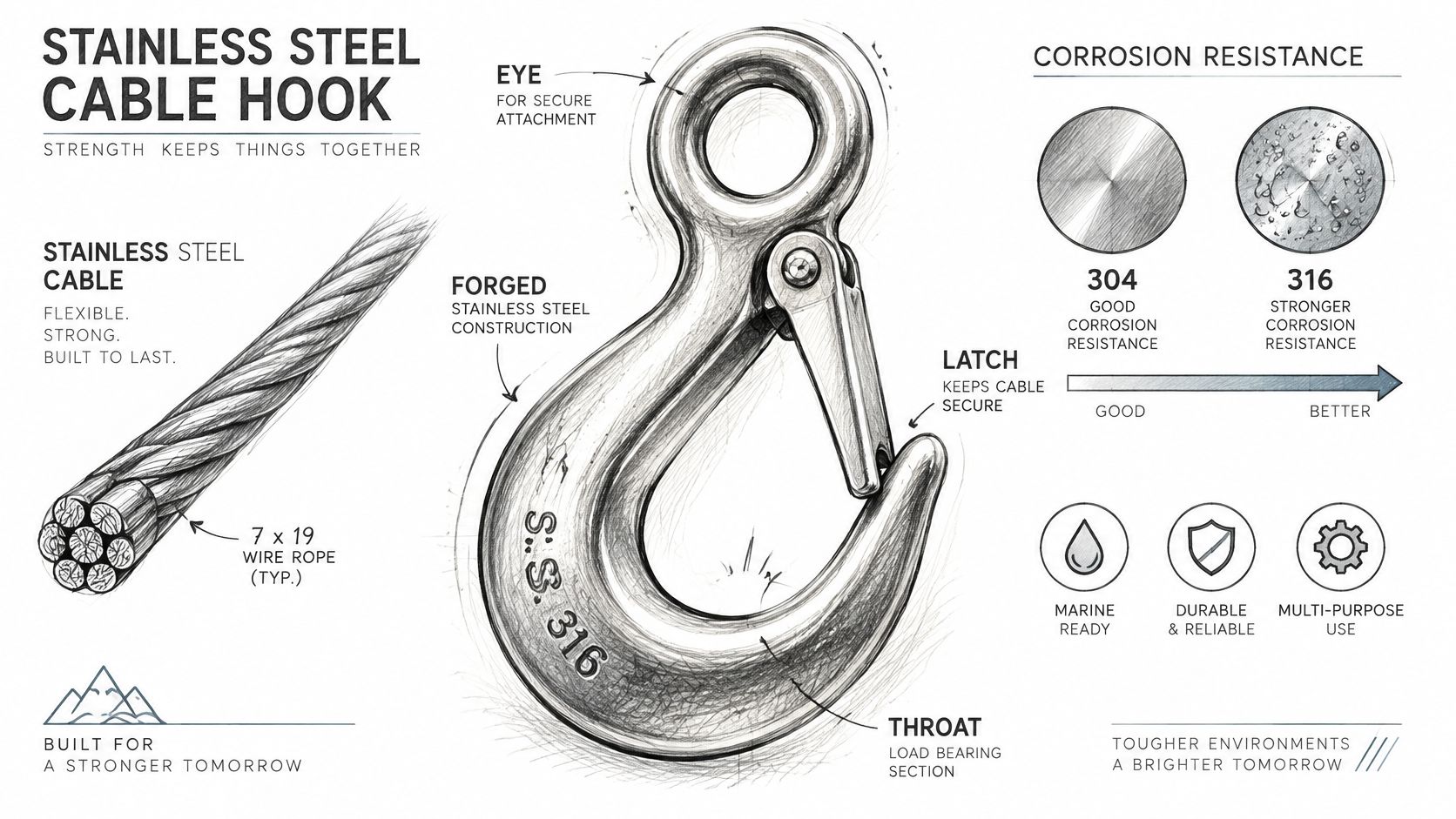
Stainless steel resists rust because chromium helps form a thin, self-repairing passive oxide film when oxygen is present. That protection is built into the alloy, unlike a coating that can be scratched through to expose less corrosion-resistant metal. But the film isn't a guarantee against every form of attack. A dirty or salt-contaminated surface, a sheltered crevice, or an alloy poorly suited to the site can still lead to corrosion.
The hook type matters as much as the finish
The main hook styles are eye hooks, which connect through a closed eye; clevis-style hooks, which attach with a pin or similar fitting; and quick-release hooks, which have a gate or other retention feature and are commonly used in rigging. Their shapes and attachment methods aren't interchangeable. Choose a hook that can connect properly to the hardware and keep the cable in its intended load path.
For railing, a hook is generally a tension fitting, not a lifting hook. A railing cable pulls through connected hardware to maintain tension, while a lifting hook handles a suspended load. Lifting standards and ratings don't automatically apply to railing fittings, and the reverse is also true. Don't treat a hook as suitable for either job just because it fits or carries a stainless designation.
Grades 304 and 316 are common choices for railing hardware, but the right one depends on the exposure. The grade comparison below is one part of the decision; the cable match, load rating, alignment and care routine matter too.
Choosing Between 304 and 316 Stainless Steel Hooks
The grade decision starts with exposure, not with the label on the hook.
| Property | 304 stainless | 316 stainless |
|---|---|---|
| Chromium | Forms the passive film | Forms the passive film |
| Nickel | Supports austenitic structure | Supports austenitic structure |
| Molybdenum | None | Added for chloride resistance |
| Ordinary rust resistance | Good | Excellent |
| Chloride or salt exposure | Limited, risk in crevices | Better, preferred for marine sites |
| Pool and deicing-salt areas | Use with caution | Recommended |
| Best fit | Dry or sheltered railings | Coastal, pool, de-icing and frequently wet sites |
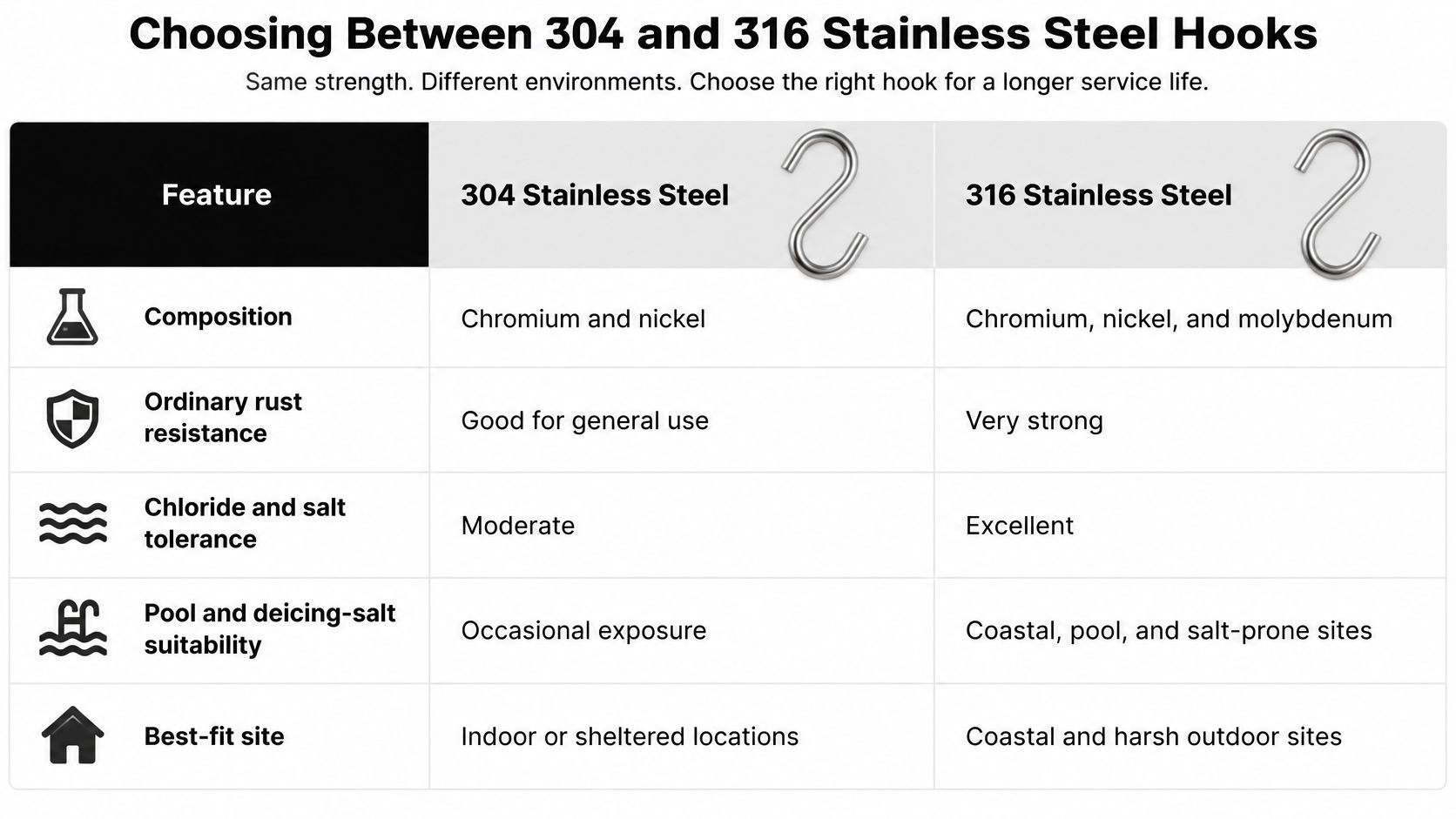
Chromium forms the passive film, and nickel supports the austenitic structure and toughness of these grades. The practical difference is molybdenum. 316 contains it, and that addition improves resistance to chloride attack. That makes 316 the better pick for marine locations, pools, roads treated with deicing salt, and sites that stay wet. I would not specify 316 by default for every railing, because it costs more and a dry interior stair rarely needs the extra alloy. Grade is the first filter, not the answer. A 316 hook with the wrong cable diameter or a loose connection is still the wrong hook.
The trouble spot often is not the exposed face of the hook. Chlorides collect in crevices such as the hook eye, a cable termination or a threaded joint, where moisture and debris are shielded from rinsing. Even a suitable alloy can suffer localized corrosion if salt remains trapped there. Keep connections clean and avoid creating pockets that hold water.
Match the grade to the site
A sheltered interior stair with little exposure to moisture or salt may be a sensible application for 304. An oceanfront deck exposed to salt spray and frequent rain calls for 316 hardware, including the hook and its mating cable fittings. The whole assembly matters. A 316 hook threaded to a mismatched fitting, or a cable termination that traps salt, gives up much of the benefit of the higher grade.
316 costs more than 304, so there is little reason to specify it everywhere by default. Use it where the environment warrants it, and make sure the hook, cable and terminals are the same grade or confirmed compatible. If you must combine stainless with a different metal, check the contact and provide electrical isolation where the design requires it.
On-site rule: If the railing will face salt, pool chemicals or long wet winters, choose 316 for the hook and matching cable hardware.
Load Ratings, Working Limits and What the Numbers Mean
A hook's advertised breaking strength doesn't tell you the load it may safely carry in normal service. Breaking strength is the load at which a component fails in a test. Minimum breaking force is the manufacturer's listed minimum for a specific rope construction and size. The working load limit (WLL) is the rated limit for normal use, and it sits well below the breaking value. A safety factor is the ratio between the breaking strength and WLL; don't guess it from appearance or apply a generic number when the supplier hasn't stated it.
| Term | What it means | Where to check |
|---|---|---|
| Breaking strength | Load at which the component fails in a test | Test data or supplier datasheet |
| Minimum breaking force | Listed minimum for a rope construction and size | Rope manufacturer's specification |
| Working load limit (WLL) | Rated safe load for normal use | Marking on hook or datasheet |
| Safety factor | Ratio between breaking strength and WLL | Supplier documentation |
| Cable diameter rating | Rope size the hook is designed to take | Hook marking and product specification |
| Loading angle | Side or angled pulls reduce usable capacity | Supplier derating table |
Cable diameter alone doesn't establish capacity. Wire-rope breaking force changes with both construction and size, and a hook designed for one rope size isn't automatically safe with another. Check the cable manufacturer's specification and the hook's stated diameter range together. If either is missing, don't infer a rating from a product photo or nominal size.
Standards apply to specific designs and uses
ISO 2308:1972 specifies forged eye hooks made from solution-annealed grade 4 stainless steel for use primarily with welded grade 4 stainless-steel chain slings. The standard assigns working-load values and mechanical requirements to those hooks and chains. It also sets an operating range of −100 °C to +400 °C for the certified grade 4 lifting hooks covered by that standard, not for every architectural cable hook (ISO 2308:1972). Its hook design shouldn't be assumed suitable for wire-rope or textile slings without checking that application.
Loading direction matters as well. Side loading, an angled pull, or applying force near the tip rather than the throat can reduce usable capacity. Suppose a hook is marked with a hypothetical 500 kg WLL and a cable pulls at 30 degrees. You still need the manufacturer's angle guidance before relying on that marked value; the example doesn't establish that the hook can carry 500 kg at that angle.
For details on the connection between a cable and its anchor, see this guide to stainless steel cable anchors. Before ordering, confirm the hook's WLL, its cable diameter rating, its permitted loading direction and any angle derating in the supplier's documentation.
Matching Hooks to Cable Railing Hardware
The hook is the easiest place to lose the rating you paid for. Stainless is the starting point; grade, fit and load path decide the rest. A railing hook has to hold tension in line with the cable path, and the fit at the cable, the post and the throat all affect whether it does that. Run these checks before installation:
- Match the cable diameter. Verify that the hook and terminal are designed for the cable size. A fitting that accepts the cable loosely, or pinches it, is the wrong match.
- Check the materials together. Confirm the alloy of the hook, cable and fasteners. Use compatible materials; where mixing cannot be avoided, keep electrical isolation at the contact.
- Verify the attachment. Match the thread type and length to the post or fitting. For a threaded connection, make sure the hardware seats fully without bottoming out or leaving too little engagement.
- Consider retention. Add a latch or other retention feature if the cable could jump out of the hook during use.
- Check clearance and alignment. Leave room for the cable to sit freely without binding against the throat or rubbing on an edge.
Keep the force in the hook's intended plane. An angled cable shifts load toward the tip or across the throat, where the fitting may not be designed to carry it. On a straight deck run, a standard hook may follow the cable path correctly. At a corner where the cable turns 90 degrees, use a corner fitting rated for that angled tension.
Check the whole connection
Galvanized or aluminum parts in contact with stainless can accelerate corrosion. Identify the metal type at each mating surface, then use compatible parts or electrical isolation where appropriate. Specify the hook, cable terminal and fasteners as one connection. The lowest-rated part sets the limit for the run.
A deck railing system with marine-grade 316 cable and hardware, such as Cable Railing - Outdoor Stainless Steel Railing For An Ocean View, is a useful example of specifying cable and mating components as a system. The actual hook still needs its own documented rating and a fit suitable for the run.
OSHA guidance says not to exceed manufacturers' recommended safe working loads and calls for damaged hooks to be removed from service (OSHA's hook and wire-rope inspection requirements). Use the manufacturer's removal criteria for the hardware you are installing, and check throat opening, twist and cable wear at each inspection.
For a broader check of parts and connections, use this guide to stainless steel cable railing hardware. Check the hook rating against the actual cable tension; run length alone is a poor proxy. A long straight run may still have a demanding tension requirement, and a corner or poor alignment can change how the connection is loaded. On site, measure the cable diameter with calipers, confirm thread engagement, and test clearance at the throat before you tighten the final connection.
Corrosion Care and When to Replace a Hook
Rinse stainless cable hooks with fresh water to lift salt and debris off the surface. Coastal sites need a rinse after storms plus a monthly inspection; inland work tolerates a quarterly check. Wash with mild soap and fresh water, and keep acids and aggressive cleaners off the metal, because they attack the passive layer that makes the alloy stainless in the first place.
Salt packs hardest where a cloth never reaches: the hook eye, the thread roots, the gap under a sleeve. Those shielded spots can sit wet for weeks while the exposed shank still looks clean, and stainless pitting, crevice corrosion and galvanic attack start in exactly that kind of pocket (OSHA's stainless-steel corrosion and maintenance bulletin). Flood the eye with fresh water, work a soft nylon brush through it from both sides, and rinse again. I would do that before a salt deposit hardens into a crust, because a dried ring inside the eye is where pitting usually begins on a coastal job.
For stainless screw threads, pre-drill with a cobalt drill bit at slow speed, then apply nickel-based or molybdenum-based anti-seize before inserting the screw. Grease and WD-40 do not belong on that joint. Check the installed connection periodically for roughness, discoloration, pitting, cable wear and threads that no longer turn cleanly. This stainless steel cable railing cleaning and maintenance guide covers the routine cycle in more detail.
| Sign | Limit or sign | Action |
|---|---|---|
| Throat opening | More than 15% beyond normal opening (OSHA's hook and wire-rope inspection requirements) | Remove from service |
| Twist | More than 10 degrees, same OSHA criteria | Remove from service |
| Cracks or gouges | Any visible crack or deep gouge | Remove from service |
| Deformation or sprung latch | Bent, sprung or distorted hook | Remove from service |
| Pitting or crevice corrosion | Pitting at eye or threads | Replace or consult supplier |
| Seized threads | Thread won't turn cleanly | Replace the fitting |
| Cable abrasion at the hook | Visible broken wires | Replace cable and hook |
Where a manufacturer publishes its own removal criteria for a specific hook, those rules take precedence over these benchmarks. A hook with a faulty latch, chemical damage or a bent shank gets replaced rather than straightened, since bending cold-worked stainless back into shape leaves a connection you can no longer trust.
Set a seasonal inspection reminder and do a full check at least annually on coastal sites. Inspect before reuse whenever the hardware may have taken a hit, whether from a ladder strike during a repair or debris during a storm. Replace the hook as soon as you find a removal sign, and replace the cable too if it shows broken wires or abrasion at the contact point.
Confirm Grade, Load and Inspection Before You Order
Before signing the quote, get the hook specification tied to the exact railing assembly. A product page may describe a hook, but the order documents should identify the model and show that it suits the proposed cable connection and load direction.
Ask the supplier to provide the hook's datasheet, product marking details, test documentation, and an assembly drawing. Have the quote or drawing state the working load limit, safety factor, compatible rope diameter, and any angle-related rating change. Keep these documents with the project records so the supplied part can be checked against the approved specification.
Ultra Modern Rails uses 100% stainless steel cable and hardware, and its railing systems are made with 304 or 316 steel. Standard cable is 5/32-inch 316 marine-grade stainless steel wire rope. These system details do not establish a separate hook's rating, so confirm the hook specification for the assembly being quoted.
Ultra Modern Rails offers stainless steel railing systems with 304 or 316 components and standard 5/32-inch 316 marine-grade cable. Review the options and request a custom quote for your layout.