

Search for a stainless steel cable size chart and the same three-line answer comes back every time: 1/8 inch for homes, 3/16 inch for commercial work, 1/4 inch for anything heavy. It reads like a rule, it gets repeated in every forum thread, and it's how people end up with cable that won't go into their posts.
Diameter isn't the size. A 3/16 inch rope that won't slide into a swage drilled for 1/8 inch never becomes part of a railing. A 1x19 cable forced around a corner it can't take kinks at the fitting and gives up capacity you paid for. A long bay running the same 1/8 inch cable sags at mid-span until the gaps between runs stop behaving the way the drawing said they would.
A usable size is a five-part statement, and every part has to agree with the others: diameter, construction, grade, minimum breaking strength, and the terminal that grips the end. Get those aligned and the railing works, passes inspection, and still looks like nothing is holding it up. Skip one and the other four can't rescue it.
Table of Contents
- What Stainless Steel Cable Size Really Means
- Stainless Steel Cable Sizes and Breaking Strength
- Cable Constructions and Stainless Grades
- Recommended Sizes for Spans and Uses
- Working Load and When Upsizing Fails
- Openings Tension and Post Spacing
- How to Specify and Order Cable
- Order the Run and Check the Fit
What Stainless Steel Cable Size Really Means
A spec that says only "1/8 inch stainless" has told you the diameter of a rope and nothing about whether it will hold. Diameter is a designation, not a measurement. It names a round rope, rather than describing what a caliper would find on a tensioned cable whose strands have already settled into place. The number still matters, because fittings, protector sleeves and post holes are machined to it, but on its own it says nothing about strength.
Here's the full statement, the one that belongs on a purchase order:
- Nominal diameter: in inches or millimetres, matched to the hardware it threads through.
- Construction: 1x19, 7x7 or 7x19, which sets both stiffness and how much load the rope carries.
- Grade: Type 304 or Type 316, which sets where the cable survives instead of staining.
- Minimum breaking strength: the published figure for that exact diameter and construction.
- Terminal: the swage, threaded stud or tensioner the end is fitted into, rated for that cable.
Change one part and the others move. Two cables of the same nominal diameter can carry different breaking forces because the strand pattern changed, which is why a strength comparison across constructions is meaningless. Stainless and galvanized ropes of identical size must never share a strength assumption either, because their breaking forces and fatigue behavior differ.
The set you'll meet in architectural work runs 1/16, 3/32, 1/8, 5/32, 3/16 and 1/4 inch, with 3 mm and 4 mm in metric catalogs. Some of those look interchangeable and aren't. 5/32 inch and 4 mm are effectively the same rope in most schedules, and so are 3/16 inch and 4.8 mm, but 1/8 inch and 3 mm are different sizes with different published breaks and different fittings.
Treat that list as a menu, not a safety ladder. Never step up to a larger diameter until construction, fittings and span have all been checked, because a heavier cable that won't terminate in your hardware, or won't bend where the run needs it to bend, is the weaker choice every time.
Stainless Steel Cable Sizes and Breaking Strength
A diameter is not a strength rating. The table below shows why: breaking strength depends on the cable's construction as well as its nominal size. The listed minimum breaking strengths for 1x19 cable are taken from Hayn's stainless steel wire rope range.
| Nominal size | Approx. metric | Construction | Minimum breaking strength | Where it shows up |
|---|---|---|---|---|
| 1/16 in | 1.6 mm | 1x19 | 427 lb | Light architectural infill, rarely a primary deck cable |
| 3/32 in | 2.4 mm | 1x19 | 819 lb | Short runs where a fine line is specified |
| 1/8 in | 3.2 mm | 1x19 | 1,869 lb | Residential deck and stair infill |
| 5/32 in | 4 mm | 1x19 | 2,937 lb | Stiffer residential runs and many factory railing kits |
| 3/16 in | 4.8 mm | 1x19 | Check the supplier's certificate | Commercial infill where a stiffer cable is specified |
| 1/4 in | 6.3 mm | 1x19 | Check the supplier's certificate | Heavy commercial or long bays called out by the engineer |
| 3 mm | 3 mm | 1x7 | 2,205 lb | Metric flexible alternative |
| 4 mm | 4 mm | 1x7 | 3,924 lb | Metric flexible alternative |
Breaking-strength values are from Hayn's schedule linked above. Its schedule also lists 4 mm 1x19 cable at 2,937 lb.
The jump from 1/16 inch to 1/8 inch isn't linear
Doubling the diameter does not merely double the listed breaking strength. On Hayn's schedule, 1/16-inch 1x19 cable is rated at 427 lb, while 1/8-inch 1x19 cable is rated at 1,869 lb, an increase of roughly 338%. That is a derived calculation from the two figures in the linked schedule.
The comparison is useful for understanding the scale of the change, not for choosing a railing cable by breaking strength alone. That figure describes a failure test, not the load a finished railing can safely carry.
Two rows you can't fill in from a chart
For 3/16-inch and 1/4-inch 1x19 cable, use the manufacturer's published minimum breaking strength or the certificate for the exact cable. Don't estimate from a smaller diameter: the specific product and construction need to match the figure.
Minimum breaking strength is a destruction-test result. It is not the working load a railing may carry with people leaning on it.
Specify the diameter and construction when requesting a strength value. A quote that says only “1/8-inch stainless cable” leaves out information needed to identify the rope and its matching terminal.
Cable Constructions and Stainless Grades
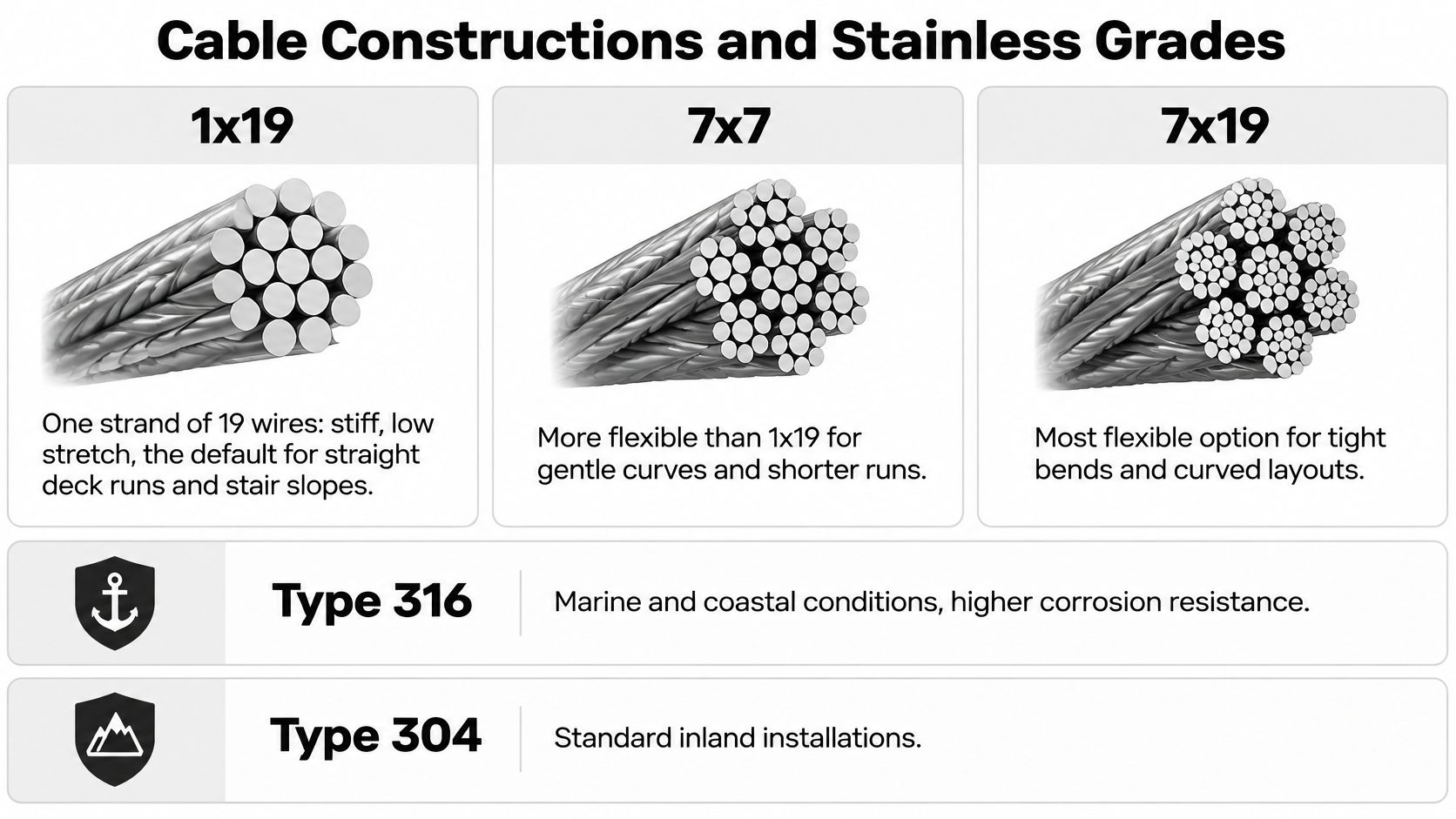
A cable's diameter alone does not specify what you are buying. Construction affects flexibility and stretch, while stainless grade affects resistance to corrosion. The terminal must also suit the cable's construction and diameter.
Three construction families, three jobs
- 1x19, for straight runs. One strand contains 19 wires. The construction is stiff, with low stretch, and holds a straight line between posts. It suits runs without a change of direction.
- 7x7, a more flexible option. Seven strands contain seven wires each. This construction bends more readily, but stretches more under tension. It may not suit hardware designed for 1x19, even when both cables have the same diameter.
- 7x19, the most flexible of these three. Its finer wires allow more bending. That flexibility can suit winch and pulley applications, while the extra stretch may be undesirable in a railing.
A cable that must turn at a corner or enter a short terminal needs a construction that can accommodate the bend. Increasing its diameter does not make an unsuitable bend workable.
Type 304 versus Type 316
Grade affects corrosion resistance, while the required strength depends on the full cable and railing specification. Type 304 is commonly used for posts, brackets and indoor metalwork. Type 316 contains molybdenum and offers greater resistance to corrosion from salt spray, pool chemicals and de-icing salts.
For a coastal project, specify the grade for the exposure rather than assuming a larger diameter will solve corrosion. Ultra Modern Rails uses 316 grade steel for projects near the ocean when the customer identifies the coastal location.
Bend radius sets the limit before strength does
A thicker rope needs more room to turn. The U.S. Navy Wire-Rope Handbook guidance summarized by Hayn gives a basket-sling bend of about 20 times the rope diameter, with an absolute minimum of 8 times the diameter for other sling types. For a 1/4 inch cable, eight diameters is a 2-inch bend radius.
That is one reason upsizing can fail in practice. A cable with a higher breaking force may not fit the terminal or make the turn the railing requires. Ask the supplier to confirm that the cable and terminals are sized to the same diameter before placing the order.
Recommended Sizes for Spans and Uses
Cable size depends on the clear distance between posts, the terminal, and the railing's performance requirements. The ranges below are starting points for comparison, not substitutes for checking the complete system.
| Case | Post spacing | Construction | Nominal size | Why this size |
|---|---|---|---|---|
| Residential deck, standard bay | About 4 ft | 1x19 | 1/8 in | Common infill when posts control deflection |
| Residential deck, longer bay | About 4 to 5 ft | 1x19 | 5/32 in | Added stiffness; confirm the terminal is sized for it |
| Residential stairs | Intermediate posts on the slope | 1x19 | 1/8 or 5/32 in | Keeps the cable choice within the deck-run range while accounting for the slope |
| Commercial guard | As engineered | 1x19 | 3/16 or 1/4 in | Used where specifications call for stiffer infill and a point-load check |
| Pool, coast, or de-icing exposure | Same as the span case | 1x19 in 316 | 1/8 or 5/32 in unless engineered otherwise | Choose the corrosion-resistant grade for the exposure before considering a diameter change |
| Run that must bend at a fitting | Short, with a large radius | 7x7 only if the fitting allows it | Match the fitting, often 1/8 in | Flexibility matters when the cable must turn through a fitting |
Two bays, worked through
A 12-foot deck edge with posts every 4 feet has three bays, each about 4 feet clear. For that layout, 1/8-inch 1x19 is a common starting point. The posts limit deflection, so the cable spans a relatively short distance between supports.
Now use only two bays across the same 12 feet. Each bay is about 6 feet, leaving more unsupported cable between posts. The longer span can increase mid-bay deflection and change the openings between runs. Adding a post is one solution. Another may be 5/32-inch 1x19, provided the terminals are sized for it. A larger cable alone does not correct weak posts, excessive span, slack tension, or a mismatched fitting.
Stairs, and why they get their own row
Stair cables follow the slope, so their spacing is measured perpendicular to that slope rather than horizontally. The bottom of the run deserves particular attention: the angle can create a wedge-shaped opening there. With intermediate posts on the slope, 1/8- or 5/32-inch 1x19 can be a starting range. Lay out the cable runs along the stair angle, then check the openings across the full run.
What the code is actually measuring
Code checks openings and loads, not cable diameter alone. A guard has to reject a 4-inch sphere. Because cable can move under load, Feeney's cable railing FAQ recommends spacing runs no more than 3 inches apart and gives typical installed tension of roughly 200 to 300 pounds per cable.
A commercial specification may list both 3/16 inch (4.8 mm) and 1/4 inch (6.3 mm) 1x19 options while separately requiring a 50-pound concentrated infill load. The Feeney cable railing FAQ describes that 50-pound load. The engineer must select a cable and railing layout that meet the performance requirement together.
Commercial 3/16- and 1/4-inch options are specification choices tied to an engineered point-load check, not automatic upgrades for a home deck. For a 4-foot bay with sound posts, a larger cable may add little while requiring larger terminals and affecting cost and visibility.
Working Load and When Upsizing Fails
A cable's diameter alone cannot tell you what a railing can carry. The working load depends on the cable's construction and grade, the terminal holding it, the bend radius, the swage quality, corrosion at a cut end, and the tension already in the run.
| Nominal size | Construction | Minimum breaking strength | What still has to fit inside it |
|---|---|---|---|
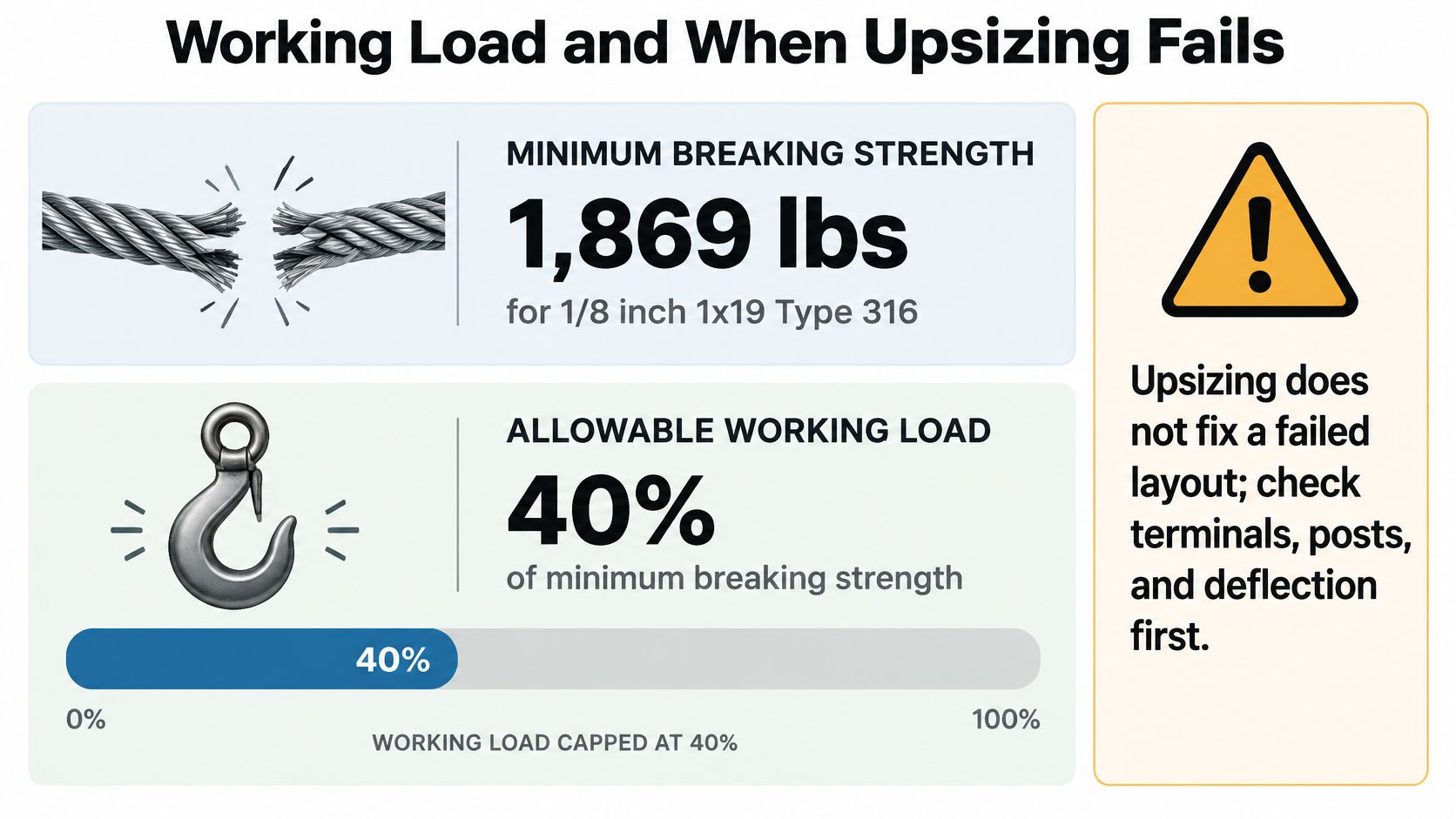
| 1/8 in | 1x19 | 1,869 lb | About 748 lb of working load, which must still cover the terminal, bend, swage quality, pretension and corrosion |
| 5/32 in | 1x19 | 2,937 lb | About 1,175 lb of working load, with the same limits |
| 4 mm | 1x7 | 3,924 lb | About 1,570 lb of working load on a flexible construction, so confirm the fitting allows the bend |
The Carl Stahl Technocables stainless steel wire rope catalog sets working load at no more than 40 percent of published minimum breaking strength for the systems it references. Applying that 40 percent limit gives about 748 pounds for 1/8-inch 1x19, 1,175 pounds for 5/32-inch 1x19, and 1,570 pounds for 4 mm 1x7.
Those are working-load figures, not breaking loads. They help assess what the cable-and-fitting assembly can carry in service; a mill certificate's breaking strength is not a usable railing load.
The same catalog lists 6x7 rope from about 0.12 to 6.00 mm and 6x19 from about 0.45 to 8.00 mm, with breaking forces ranging from tens of newtons to more than 33,000 N, depending on size and construction. These broad ranges serve applications such as cranes, winches, and rigging as well as railings. A diameter without its construction and terminal does not specify a complete cable assembly.
Three ways a bigger cable still fails
The first is a mismatched terminal. A 1/4-inch cable will not grip in a fitting drilled for 1/8-inch cable. The rope's greater breaking strength cannot compensate for a terminal that cannot hold it.
The second is a tight bend. If a stiff construction is forced around a corner tighter than it allows, the outer wires take the load first. Use a more flexible construction or a terminated corner when the bend cannot be opened up.
The arithmetic that matters: working load is a limit for the complete cable assembly, not a rating for the cable diameter alone.
Procurement documents should specify certified breaking strength for the exact cable-and-terminal assembly, rather than relying only on nominal diameter or material grade. A cable tension gauge can help check the tension in a run, but it does not replace confirming that the cable and its fittings are properly matched.
Openings Tension and Post Spacing
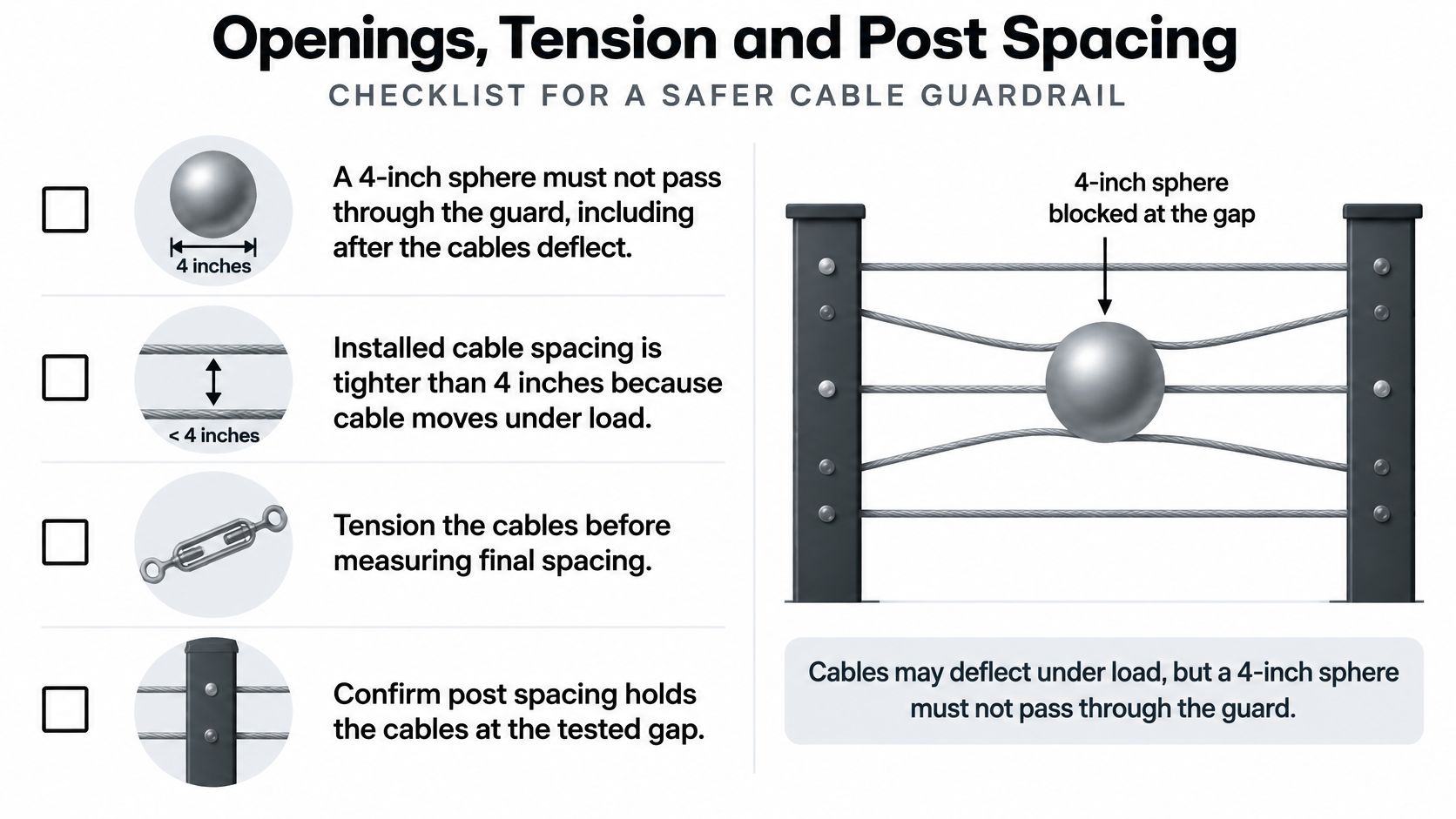
A cable guard passes or fails on one physical test: a sphere of the size the code names must not pass through the opening, and it must still not pass after the cables deflect under a hand or a shoulder. Because cable is flexible, the installed gap has to be tighter than the sphere itself. The number that gets measured at inspection is the gap after load, not the gap you laid out on a calm afternoon.
Laying out the runs on the rail
Work from the bottom up. Set the first cable so the bottom opening falls inside the rule, then space the rest evenly at or under the maximum the guard allows, up to a graspable top rail. On a 42-inch guard that typically means more runs than a 36-inch one, with the spacing identical in both cases.
Even spacing matters for more than looks. If the gaps vary, the widest one is the one that gets tested, and the visual rhythm of a railing with one tight gap and one loose gap reads as sloppy from the far side of the deck.
The post spacing for cable railing layout is what holds that spacing at the tested dimension. Posts set too far apart let the middle of a bay bow outward, and once the middle bows, the gaps around it grow.
The mid-span check, done properly
Tension the cables first, then push at the middle of a bay with a flat hand and check the opening again. Do this on the longest bay, on the stair section, and at any corner where cables change direction.
If the check fails, the sequence of fixes is: add a post, shorten the bay, confirm the cable construction is 1x19, then look at cable size. Upsizing is last on that list because it's the most expensive and the least likely to fix a deflection problem caused by layout.
Cable tension limits sag. It doesn't prove the cable is strong. Tension is set far below breaking strength because its job is to keep the run straight between posts, not to make the system carry more.
Tension from the middle out
Load one end first and you pull the posts out of plumb before the run is even tight. We tension from the middle cable and work outward, which keeps the post line straight and spreads the load evenly across the fittings.
Go around the run more than once. The first pass takes up the slack, and the second brings each cable to its final tension with a gauge rather than by feel. On a stair section, tension the same way and recheck the perpendicular gap afterward, because a run that shifts on the slope can open a gap at the bottom.
Corners and stairs ask different questions
A corner post has to accept cable from two directions, which means it carries roughly twice the load and needs to be anchored accordingly. A stair run has to be measured on the angle, with intermediate posts close enough that the cables don't bow away from the slope. Both are layout problems, and both get solved before anyone considers a heavier cable.
How to Specify and Order Cable
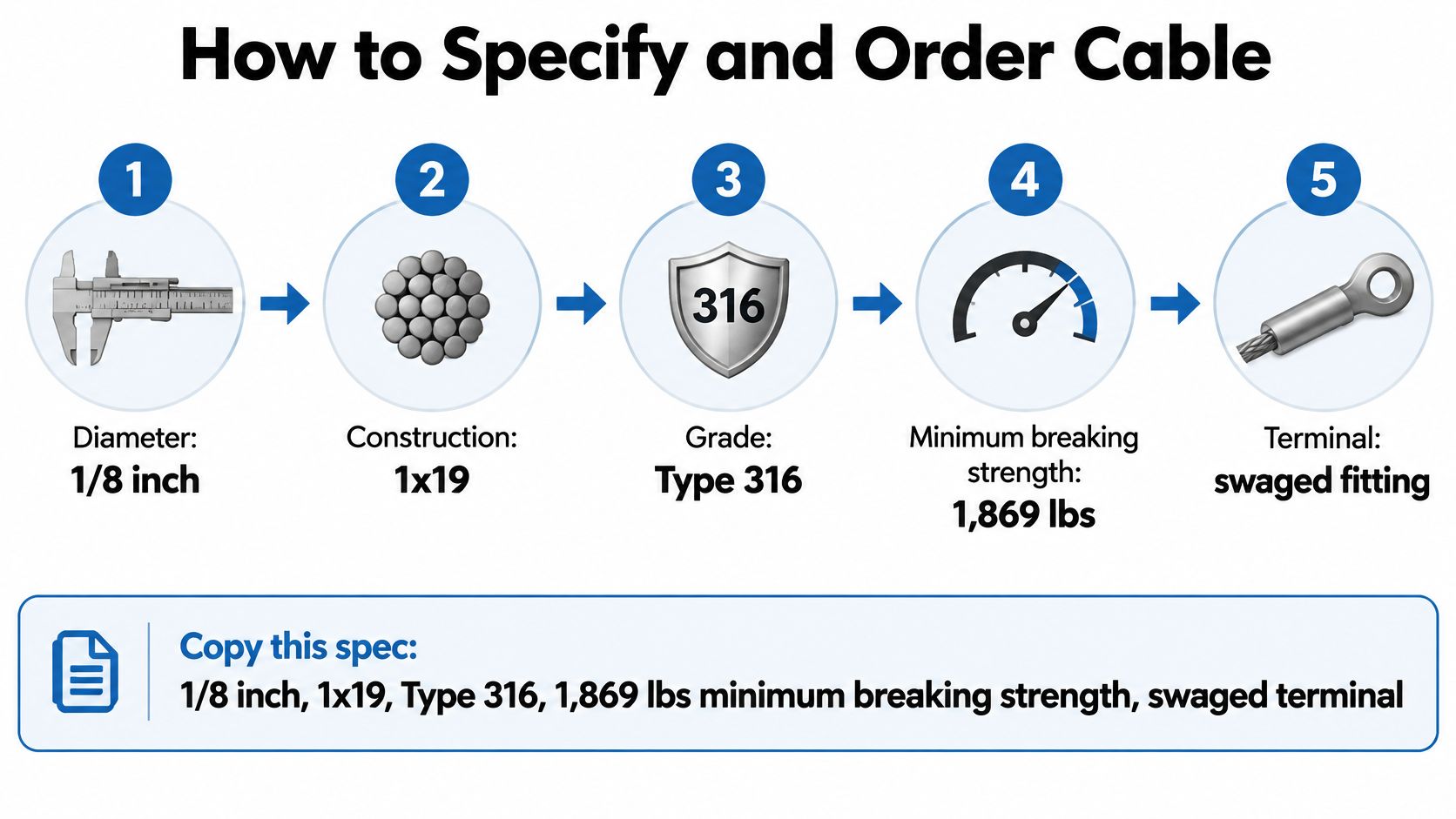
A specification line you can hand to a supplier has five parts and fits in one sentence. Everything else is negotiation.
Two specification lines to copy
For a standard residential bay with posts about 4 feet apart: 1/8 inch, 1x19, Type 316, 1,869 pounds minimum breaking strength, swaged terminal sized to 1/8 inch.
For a stiffer kit-style run: 5/32 inch, 1x19, Type 316, 2,937 pounds minimum breaking strength, with every fitting, protector and post hole sized to 5/32 inch.
That level of detail isn't fussiness. EN 12385-1 defines nominal diameter as the designation dimension for round rope and leaves the minimum breaking force for each size, grade and construction to the standard or manufacturer, and the measured breaking force has to meet or exceed it. Diameter alone was never a specification in the standard's terms either.
The order checklist
- Take the diameter and construction from the case, not from a photo. A picture of a finished deck tells you nothing about whether the run is 1x19 or 7x7.
- Confirm the breaking strength on the strength table or the mill certificate, for the exact diameter and construction you're buying.
- Match every terminal, protector and intermediate post hole to that diameter. Fittings are size-specific, and a 1/8 inch fitting will not accept 3/16 inch cable.
- Reject substitutes that only match the inch size. A 7x7 rope offered as "the same 1/8 inch" has different stretch and different terminal behavior.
- For a nonstandard or metric size, require the manufacturer's minimum breaking force under the applicable standard. An in-between diameter is not equivalent to the nearest stock size unless someone documents it.
- Ask for the standard, construction, grade and breaking-force document when you compare inch and metric products across regions, because the labels don't line up one to one.
The backdrop for those documents is mundane and useful. ISO 3444:2023 covers stainless steel wire ropes for architecture and structures, addresses manufacturing, classification and testing, requires stainless to conform to ISO 15510, and carries a normative annex of minimum breaking forces. ASTM A492 covers the round stainless wire that gets stranded into the rope in the first place. Neither one picks your cable, and both tell you what a supplier's certificate should contain.
Hardware is where the specification fails, not the rope. Corrosion at a fitting, a terminal that doesn't match the cable, a protector that binds the run: check the cable railing hardware against the cable before the order goes out.
Write the five parts, then check the certificate against them line by line. A supplier who can't produce a breaking force for the exact construction is a supplier who hasn't specified anything.
Order the Run and Check the Fit
A cable order can be correct on paper and still come up short at installation. Measure and specify each run on its own before choosing a kit or cutting cable.
- Measure each side separately. Record straight runs, corners, and stair sides from post center to post center. Include the allowance needed for the terminations at both ends.
- Round each side up to a suitable kit length. Avoid ordering loose rope and cutting your own allowance from a spool.
- Confirm that cable and fittings are compatible. Terminals, protectors, and post holes must suit the selected cable diameter.
- Allow enough length for both ends and a small margin. Cable left over from a different diameter cannot finish the run, and a cable cut two inches short will not reach.
- Get stair and corner layouts drawn before ordering. These sections combine cable sizing with changes in direction or angle, so measurements alone may not show the full fit.
Ultra Modern Rails' standard cable is 5/32 inch 316 marine-grade stainless steel wire rope. Each kit includes 10% extra 5/32 inch 316 stainless steel cable, and all cable and hardware are 100% stainless steel.
To check a proposed layout before ordering, request a free custom quote and drawing from Ultra Modern Rails. The company provides them within 24 hours.
Before placing the order, compare the drawing with each measured run, including the end allowances, corners, and stair angles. For available system options, visit Ultra Modern Rails.
Cable diameter alone does not confirm that a run will fit. Ultra Modern Rails offers a free custom quote and drawing within 24 hours, which can help you check your measurements and layout before ordering. Visit Ultra Modern Rails to view the system options and request a quote.