

You're standing on a new deck, looking along the cable line, and the bottom run has a visible belly in it. The posts are straight, the stainless wire looks clean, and yet the railing feels less secure than it did on installation day. The part you need to understand is usually small, threaded, and easy to overlook: the stainless steel cable tensioner.
A tensioner isn't a decorative cap or a substitute for a properly engineered post. It's the adjustable part of a cable assembly, and it works only when the rope, fittings, posts, threads, material grade, and working load are selected as one system. The right choice removes slack, preserves adjustment, and helps the finished railing remain serviceable as the cable and structure respond to use, vibration, temperature, and weather.
Table of Contents
- What Stainless Steel Cable Tensioners Actually Do
- Anatomy of a Cable Tensioner and the Standards Behind It
- Stainless Steel Grades and Where Each One Belongs
- Sizing Rope, Thread, and Working Load as a System
- How Tensioners Fit Into a Cable Railing Run
- Real Projects and How the Hardware Choices Change
- Common Misconceptions and Long-Term Serviceability
- Choosing the Right Tensioner for Your Project
What Stainless Steel Cable Tensioners Actually Do
A cable railing run has a simple problem to solve. The wire must stay tight enough to maintain its intended position, but the installation also needs a way to compensate when the cable settles or the posts move slightly under service loads. A tensioner is the adjustable hardware at one or both ends of a cable run. You turn it to draw the cable tighter, then secure it so the setting doesn't back off.
That makes it different from a fixed terminal. A swage stud, lag terminal, or similar end fitting grips or anchors the cable, but it doesn't give you useful adjustment after the cable has been cut and secured. A tensioner performs the active part of the job. It pulls the wire taut during installation and gives you a practical way to correct slack later.
Fixed ends and adjustable ends
Most cable railing systems use one fixed end and one tensioned end for each run. The fixed end establishes the anchor point. The tensioned end provides the adjustment range. On a longer or more demanding assembly, the exact arrangement depends on the manufacturer's hardware and the post layout, but the working principle remains the same.
The part you turn may be a threaded stud, a turnbuckle body, or another tensioning mechanism. The important question isn't whether it looks substantial. Ask how much travel it provides, how the cable is retained, and whether you can reach the adjustment point after the handrail and trim are installed.
Practical rule: A tensioner should be installed with enough adjustment remaining to correct future slack. Don't use the entire travel just to make a poorly measured cable fit.
Why tension has to last
A cable system doesn't stop changing when the wrench is put away. Rope construction, fitting seating, post deflection, vibration, and thermal movement can all affect the line. That's why the tensioner has two jobs: take up cable elongation and maintain clamping force.
The tensioner also transfers force into the end post and its connection to the deck or structure. If the post bends, the cable may appear loose even when the tensioner itself is working correctly. Treat the fitting as one part of the load path, not as a cure for weak framing.
Anatomy of a Cable Tensioner and the Standards Behind It
The easiest way to understand a tensioner is to think of a traditional turnbuckle. It has a central body, threaded ends, and a rotation that draws those ends together or pushes them apart. Stainless steel cable tensioners use the same basic mechanical idea, adapted for wire-rope terminals and railing hardware.
On a specification sheet, you'll commonly see a body, an eye or fork terminal, a lock nut or jam nut, and a threaded shank. The body carries the tension. The threaded shank determines the available adjustment and transfers force into the terminal. The nut helps prevent the setting from changing under vibration.
Reading the hardware shelf
Common configurations include:
- Eye-and-eye: Each end has a closed eye, useful where pins, bolts, or cable terminals pass through.
- Jaw-and-jaw: Forked ends accept a clevis pin and can articulate more readily than a rigid eye.
- Hook-and-hook: Open ends allow quick attachment, but they require careful assessment of whether the hook can remain securely loaded.
- Mixed ends: An eye on one side and a jaw or hook on the other can match different post and cable fittings.
DIN 1480 is a long-standing European turnbuckle specification still used for stainless steel tensioners. Current product documentation describes metric sizes from M6 to M16, covering hardware approximately 6 mm to 16 mm in diameter, and identifies AISI 316, V4A, or material 1.4401 as common stainless designations for outdoor exposure. The same documentation lists wire-rope constructions such as 7x7 and 7x19. See the DIN 1480 stainless tensioner range when comparing body and thread conventions.
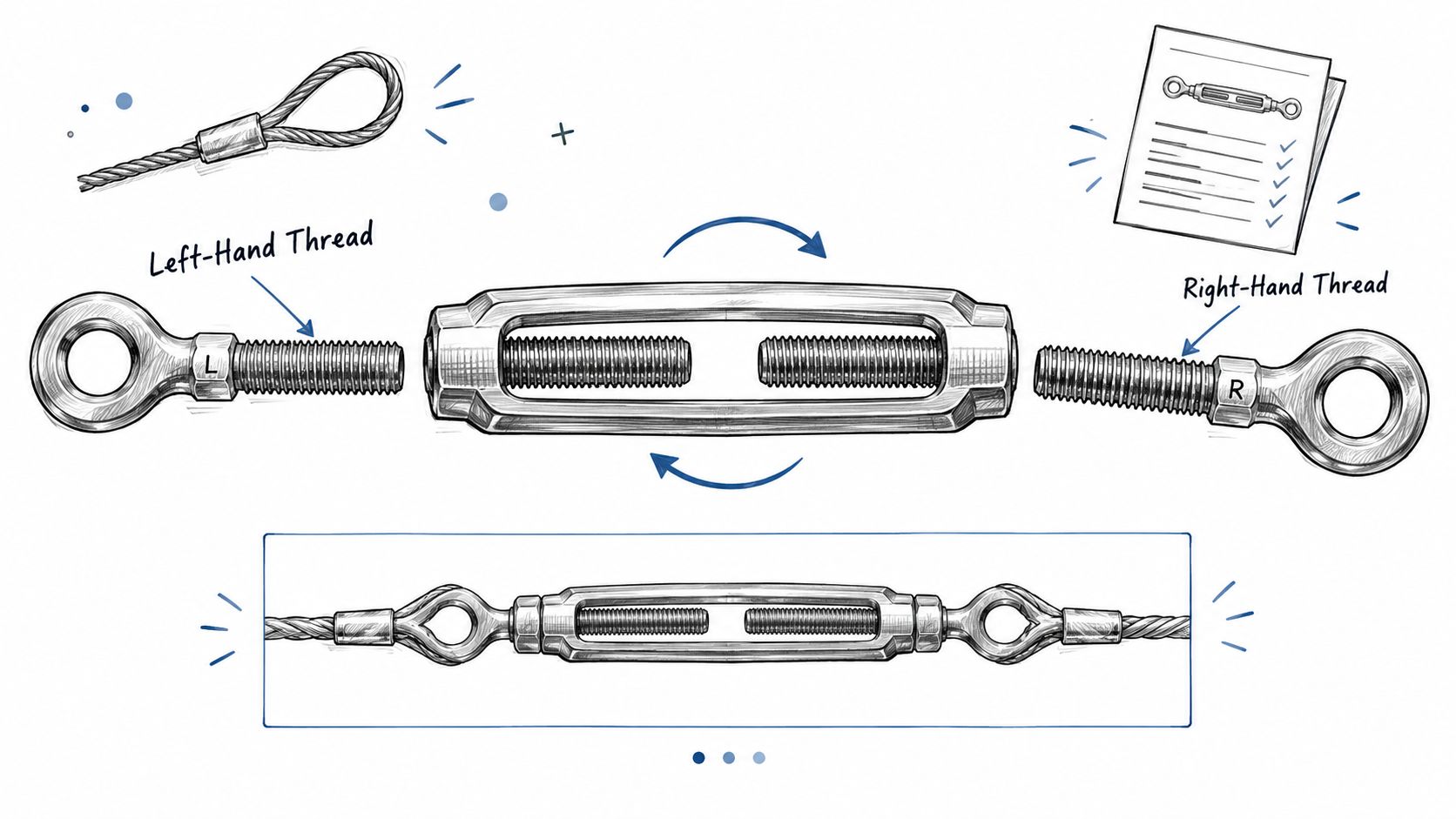
For a broader overview of how tensioners relate to terminals, posts, and cable layouts, review this guide to stainless steel cable railing hardware. The key lesson is simple: the body, threads, nuts, cable construction, and end fittings need to be compatible. A strong-looking turnbuckle can still be the wrong choice if its thread, cable entry, or terminal geometry doesn't match the rest of the run.
Stainless Steel Grades and Where Each One Belongs
“Stainless steel” describes a family of alloys, not one universal performance level. For cable tensioners, 304, 316, and 316L are the grades buyers most often compare. They can look nearly identical when new, but their suitability changes sharply with salt, humidity, pool chemicals, industrial contaminants, and welded connections.
304 is the general-purpose option for dry interiors and mild exterior exposure. 316 contains molybdenum, which improves resistance to pitting and crevice corrosion in chloride-rich environments. 316L is the low-carbon form of 316, selected particularly for welded assemblies because it helps reduce sensitization during welding.
| Grade | Key Alloying Elements | Corrosion Resistance | Best Environment |
|---|---|---|---|
| 304 | Chromium and nickel | Suitable for general indoor and mild exterior conditions | Dry interiors, rural decks, and suburban installations |
| 316 | Chromium, nickel, and molybdenum | Better resistance to salt, chlorides, and corrosive moisture than 304 | Coastal air, marine settings, pools, and areas exposed to de-icing salt |
| 316L | Low-carbon version of 316 | Similar corrosion family to 316, with advantages at welded joints | Welded structural components in coastal, pool, or industrial environments |
Make the choice by exposure
A rural deck with limited moisture may not need the added corrosion resistance of 316. A balcony near the sea, a pool enclosure, or a project exposed to road salt has a different maintenance burden. Independent guidance distinguishes 304 for interior or mild exterior use from 316 for marine and industrial exposure, with 316L favored for harsher saltwater conditions and more frequent inspection planning in this stainless cable railing comparison.
Don't treat 316 as an automatic upgrade for every location. Treat it as an exposure decision. The initial hardware cost is only part of the calculation. Cleaning, inspection, staining, replacement, and access to a difficult balcony can make the lower-grade choice more expensive over the life of the railing.
For a product-level look at how cable systems use stainless components, see stainless steel cable railing options. Also check whether the supplier identifies the grade on the tensioner body, cable, terminals, washers, and fasteners. Mixing grades within a wet, highly exposed assembly can undermine the reason you selected a corrosion-resistant alloy in the first place.
Sizing Rope, Thread, and Working Load as a System
The cable diameter, tensioner thread, and working load belong on the same line of your selection sheet. Choosing one dimension at a time creates a weak-link problem. A larger cable doesn't protect an undersized body or thread, and a large tensioner doesn't make a small cable capable of carrying a higher service load.
Published specifications show the relationship clearly. A 3/16-inch rope system is listed at approximately 2,200 lb breaking strength with an M10 × 1.5 thread. A 1/4-inch system rises to about 3,800 lb with M12 × 1.75, while a 1/2-inch system reaches 12,500 lb with M20 × 2.5 in the referenced product range. These figures come from the stainless wire-rope tensioner specifications.
Start with the weakest link
The breaking load isn't the working load. One independent stainless tensioning product family applies a 5-fold safety factor, while some cables use a 10-fold factor in alignment with DGUV 215-313 guidance. For example, a component with a minimum breaking force of 765 kg would have an approximate working load of 153 kg under a 5:1 factor, as explained in the working-load calculation for stainless tensioning ropes.
Use the manufacturer's rated working load, not a rough comparison based only on metal diameter. Verify the cable construction, terminal, thread engagement, post strength, and anchorage together. If one of those parts has a lower rating, the assembly is governed by that lower value.
| Rope and Hardware Example | Published Breaking Strength | Thread | Selection Meaning |
|---|---|---|---|
| 3/16-inch rope system | 2,200 lb | M10 × 1.5 | Match the body and terminal to this cable class |
| 1/4-inch rope system | 3,800 lb | M12 × 1.75 | Upgrade the tensioning body with the rope |
| 1/2-inch rope system | 12,500 lb | M20 × 2.5 | Requires a substantially larger tensioning assembly |
A tension gauge can help you apply consistent force rather than relying on feel. The cable tension gauge guide is useful when you're trying to avoid one cable carrying noticeably more load than its neighbors.
How Tensioners Fit Into a Cable Railing Run
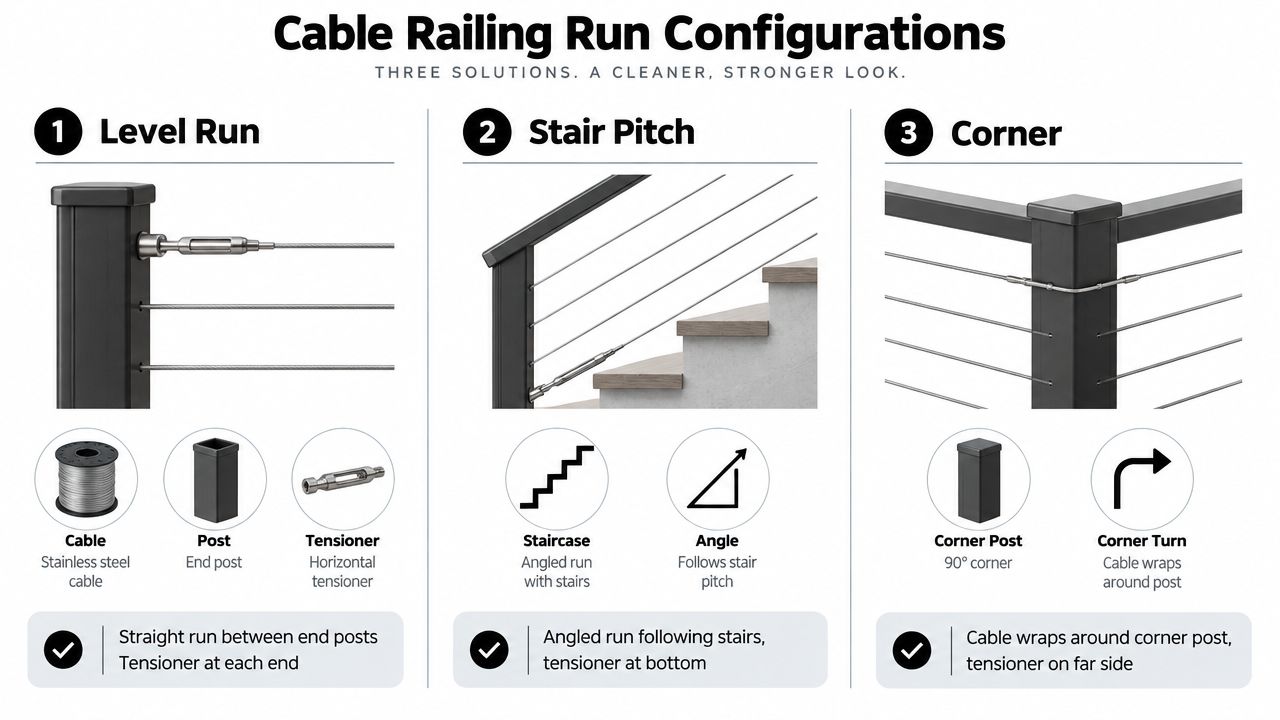
A tensioner is only useful when the cable run has been laid out correctly. Level runs, stair runs, and corners place the hardware in different geometric positions, so the same straight turnbuckle may not suit every location.
For a level run, the cable travels horizontally between end posts. One end is fixed and the opposite end is tensioned. Intermediate posts guide the cable and limit deflection. For a stair pitch, the cable follows the slope, and the end fittings need to align with that angle rather than forcing a straight fitting to bend. At a corner, the cable may terminate at the corner post or continue through with a fitting designed for the change in direction.
Build the run around the end conditions
A corner deserves special attention. A sharp bend concentrates contact and can shorten the useful life of the cable or fitting. If the line changes direction, use a compatible angle or articulation solution, or terminate separate runs rather than forcing the rope around an unsuitable edge.
Post spacing affects how much the cable moves when someone pushes against it. More closely supported runs generally control deflection more effectively, but the correct spacing depends on the engineered system, post stiffness, cable diameter, and local code. Don't select tensioners before you know the post layout and the direction of every cable.
The tensioner shares the work with other fittings:
- Levelers help accommodate alignment differences at the post.
- Lag terminals anchor the cable into suitable wood or structural blocking where approved.
- Swage fittings lock the cable mechanically when installed with the specified tool.
- Intermediate posts guide the cable and keep the infill geometry consistent.
- End-post connections transfer the combined cable force into the deck or supporting structure.
The infill also has to resist the applicable point load. One referenced code discussion identifies a 0.89 kN point load for railing infill, so the tensioner's working load must remain adequate after considering the actual cable, terminals, thread engagement, environment, and post connection. The tensioner isn't the whole guard. It is the adjustable link in a chain that must work together.
Real Projects and How the Hardware Choices Change
The drawing may show the same number of railing lines in each project, but the bill of materials can change once you add salt air, occupancy, structural loading, and geometry. These examples are representative selection exercises, not measured performance claims.
A coastal balcony
A balcony near the coast exposes every crevice, thread, cut end, and washer interface to chloride-rich moisture. For this situation, I'd specify a 316 family throughout the cable hardware, and I'd favor 316L where the tensioner or post connection includes welding. The design should avoid moisture traps and make washing and inspection practical.
A 304 fitting may look acceptable during installation, but that doesn't mean it belongs in a marine exposure class. The alloy decision should include the cable, tensioner, terminals, washers, and fasteners, not just the visible body. If the assembly combines stainless with aluminum, use appropriate isolation at contact points so the dissimilar metals don't create a corrosion problem.
A hotel rooftop deck
A rooftop hotel deck sees more hands, carts, cleaning activity, and repeated contact than a quiet residential balcony. The project team should confirm the applicable commercial loading requirements and select the cable and tensioner from that design basis. That may lead to a larger rope and thread combination than a small residential run, but the correct change comes from the engineered load envelope, not from choosing hardware by appearance.
The fittings also need accessible adjustment points. A maintenance crew can't inspect or re-tension a concealed fitting easily, especially when a finished surface or planter blocks the terminal. Put service access into the drawing before the posts are fabricated.
A lakeside stair
A stair changes direction continuously along its pitch, and a landing or turn can create another abrupt transition. Straight turnbuckles may bind when the cable approaches at an angle. Use articulating or stair-specific fittings, or divide the geometry into properly terminated runs.
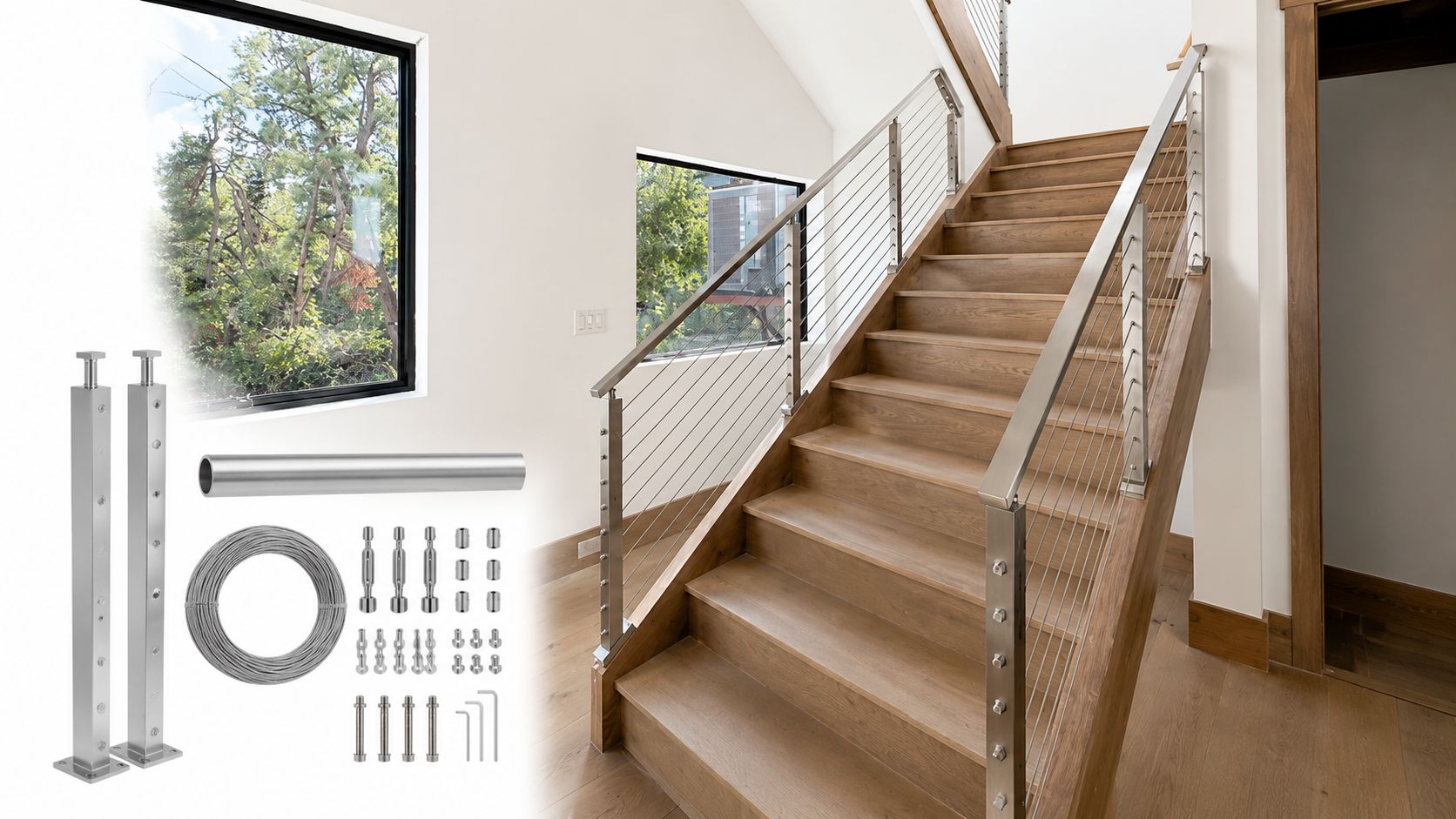
For an indoor or sheltered mountain-lodge setting, the Cable Railing - Indoor Stainless Steel 36" or 42" System - High End Custom Railing is one example of a system described with pre-drilled posts, a top handrail, and marine-grade 316 stainless cable and hardware. Its catalog description also identifies indoor and outdoor use and a stated tension strength of up to 3,000 lb, so the project team would still need to verify how that figure relates to the complete installed assembly and local requirements.
The throughline is the matched-system principle. Environment changes the alloy, loading changes the rope and thread, and geometry changes the terminal. A railing drawing becomes a reliable order only after those three filters are applied together.
Common Misconceptions and Long-Term Serviceability
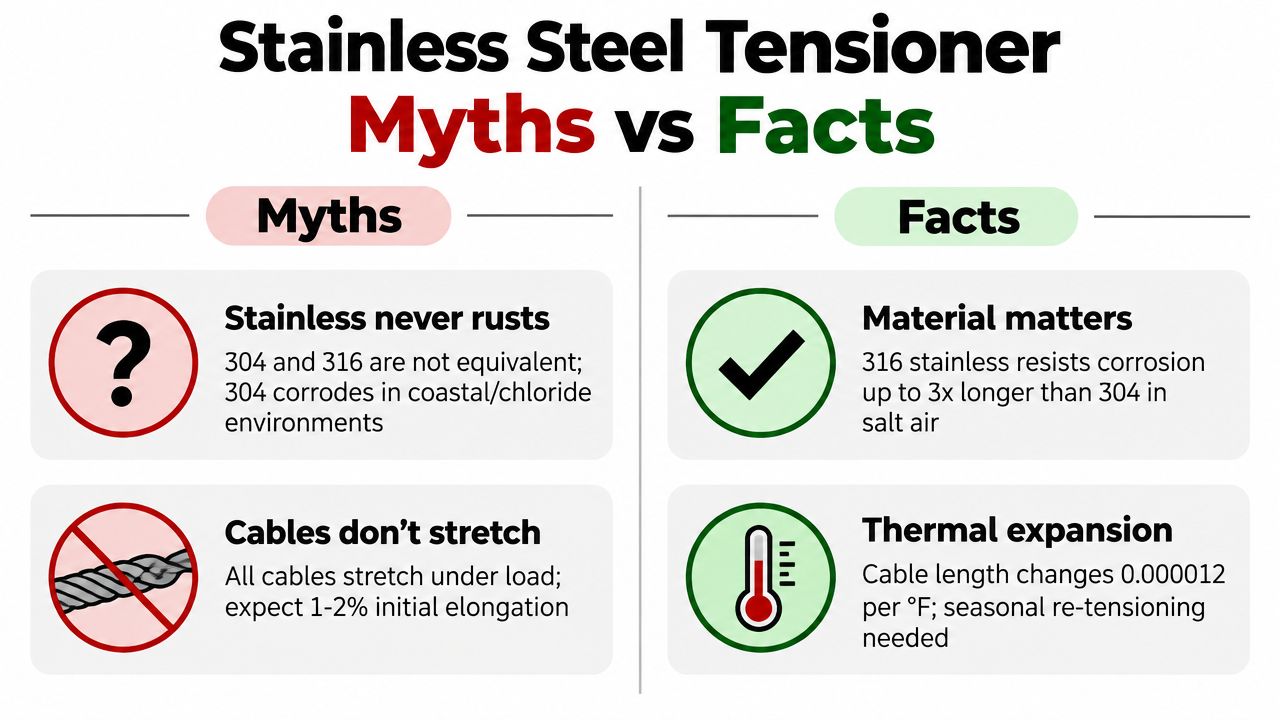
The word “stainless” often leads buyers to expect maintenance-free hardware. That expectation causes trouble. Stainless alloys resist corrosion, but the result still depends on grade, contamination, crevices, installation quality, dissimilar metals, and the amount of moisture the fitting sees.
304 and 316 aren't interchangeable in chloride-heavy environments. Cable also doesn't become dimensionally static after installation. Load, temperature changes, vibration, and fitting seating can create a need for adjustment, which is why the tensioner's remaining travel matters more than its appearance on day one.
Questions that expose a weak specification
Ask the supplier these questions before ordering:
- Can it be re-tensioned? Find out whether adjustment remains after the cable has settled and whether the fitting can be reached with the railing fully assembled.
- What happens at full extension? A tensioner at the end of its travel has no useful reserve for future correction.
- What thread does it use? Confirm the size, pitch, direction, and required engagement. A left-hand or right-hand thread can affect how the body adjusts and locks.
- Does it trap moisture? Closed cavities and poorly drained interfaces deserve closer inspection in coastal or pool environments.
- Are all materials compatible? Mixing stainless and galvanized fittings can create galvanic corrosion when moisture bridges the metals.
- Can the cable be replaced? A swageless press-fit terminal may offer little or no adjustment once the cable has been cut short.
Thread galling is another practical concern. Stainless threads can seize when assembled dry or forced under load, so follow the fitting manufacturer's instructions for lubrication, tightening, and tool use. Don't substitute a galvanized terminal because it appears to fit. Compatibility includes corrosion behavior, not just thread dimensions.
A service plan should be written down. Inspect the cable, terminal, lock nut, post connection, and isolation washers after installation, then repeat the check at an interval appropriate for the exposure and use. Outdoor, coastal, pool, and commercial systems deserve more attention than a dry interior installation. If you can't reach the tensioner without removing finished components, the design has already compromised its own serviceability.
Choosing the Right Tensioner for Your Project
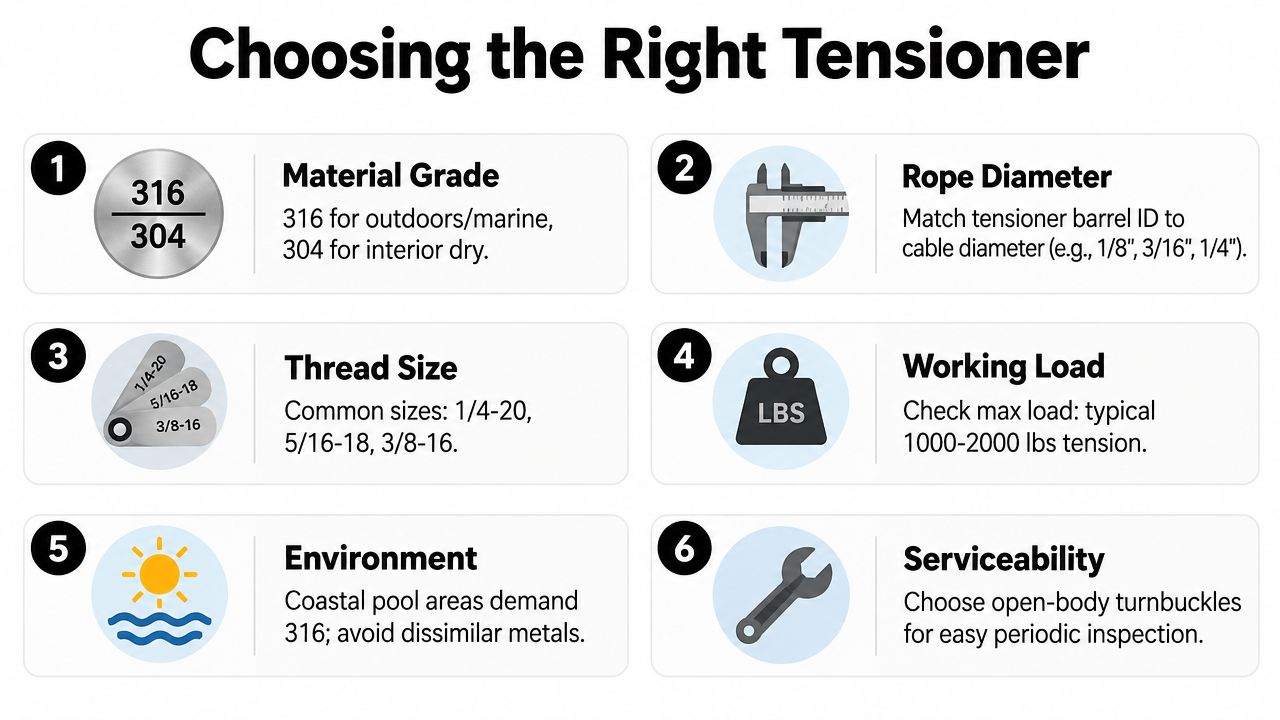
Stand at the hardware shelf with six questions, not one. “Is it stainless?” is only the first filter.
- Confirm the load requirement. Start with the applicable code, the railing type, occupancy, and the manufacturer's working-load data. Never use breaking strength as the service limit.
- Classify the environment. Use 304 where the exposure is dry and mild. Use the 316 family for outdoor, coastal, marine, pool, or salt-exposed locations. Consider 316L at welded joints.
- Match the rope and thread. The cable construction, diameter, terminal, body, thread size, and post hole must belong to the same product system or have documented compatibility.
- Check the safety factor. Apply the factor specified for the assembly and confirm that the resulting working load exceeds the design demand after environmental and installation considerations.
- Reserve adjustment travel. The cable shouldn't require a fully extended tensioner just to reach the correct starting tension. Leave practical room for re-tensioning.
- Plan inspection access. A fitting hidden behind trim, decking, or a fixed panel may be technically adjustable but functionally impossible to maintain.
A one-minute rejection test
Rule out any tensioner that has an unknown alloy, no working-load rating, an incompatible thread, an unsuitable end fitting, or no clear adjustment procedure. Also reject a component when the supplier can't explain how it connects to the cable and post.
| Check | Accept when |
|---|---|
| Material | The grade suits the exposure |
| Cable interface | The rope construction and diameter are specified |
| Thread | Size, pitch, and engagement match the terminal and post |
| Load | Working load is documented and properly derated |
| Adjustment | Useful travel remains after installation |
| Service | Inspection, cleaning, and re-tensioning are practical |
Before you buy, sketch each run, mark fixed and tensioned ends, identify corners and stairs, record the exposure class, and list the cable and thread sizes. If the project includes structural or commercial requirements, have the complete assembly reviewed rather than approving the tensioner in isolation.
Ultra Modern Rails supplies factory-direct cable railing systems with stainless steel cable and hardware for indoor and outdoor projects, including decks, balconies, stairs, patios, pools, and hospitality spaces. Use the custom quote process at Ultra Modern Rails to share your measurements and project conditions, then ask for a system recommendation that addresses alloy, cable size, tensioner compatibility, load requirements, and future adjustment access.