

You're standing on a new deck with two railing samples in hand. One is bright, brushed stainless steel. The other is dark, clean-lined, and far more dramatic. Both look suitable in the showroom, but your real concern is what happens after years of rain, salt, hand contact, cleaning, and the occasional impact.
The choice between stainless steel vs black stainless steel is often presented as a choice between two different metals. That's the first mistake to avoid. Black stainless steel is usually conventional stainless steel with a dark surface treatment, so the alloy grade and the finish system solve different problems. The grade controls much of the underlying corrosion performance. The finish controls color, reflectivity, fingerprints, and what a scratch looks like.
For most outdoor railings, choose the alloy for the environment first, then select the finish that suits your design and maintenance expectations.
Table of Contents
- The Big Question Which Railing Finish Is Right for You?
- Understanding the Materials Behind the Looks
- Comparing Appearance Durability and Maintenance
- Best Environments for Each Railing Finish
- How to Care for Your Stainless Steel Railings
- Why Choose Ultra Modern Rails for Your Project
The Big Question Which Railing Finish Is Right for You?
A homeowner renovating a deck often starts with appearance. The house has dark window frames, charcoal siding, or a black pergola, so a black cable railing seems like the obvious choice. A contractor may prefer standard stainless because it's familiar, easier to modify on site, and more forgiving when a handrail or post gets scratched. Neither instinct is wrong, but neither is enough to specify a railing system.
The practical question is this: will the railing live in a low-contact residential setting, or will people constantly touch, lean against, move around, and clean it? A sheltered balcony and a poolside stairway place very different demands on the same finish. Coastal air, chlorides, deicing salt, construction debris, and incompatible fasteners can matter more than whether the visible surface is silver or black.
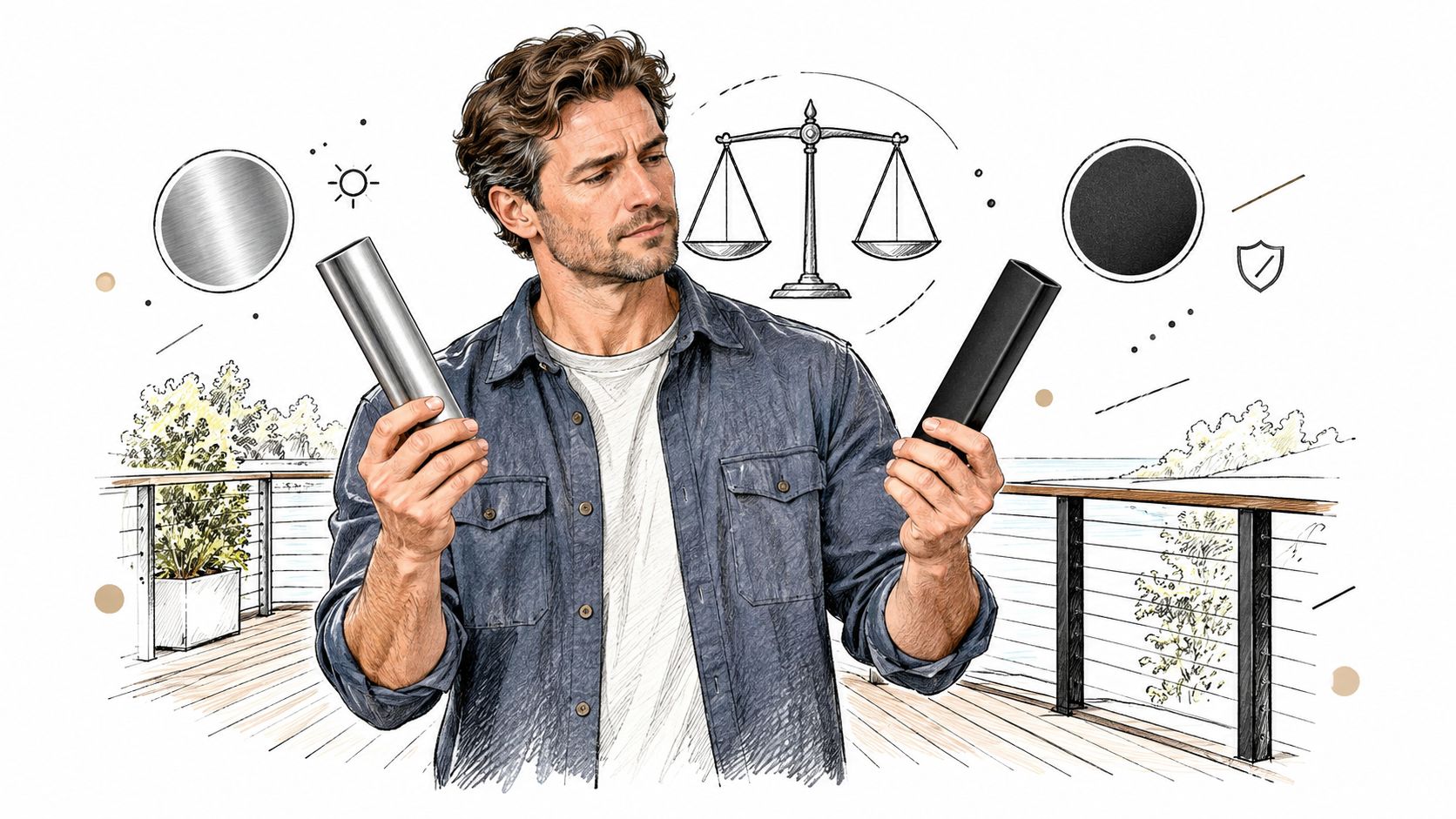
Start with the exposure, not the color
Use conventional stainless steel when you want a bright architectural appearance, straightforward cleaning, and maximum flexibility for future refinishing. It's the sensible choice for busy stairs, commercial handrails, and projects where installers may need to drill, cut, or adjust components in the field.
Choose a black finish when the dark appearance is central to the design and the project can support more careful handling. Black PVD and other dark treatments can produce a refined, low-glare look, but damage can reveal the bright metal beneath. That contrast is often more noticeable than a similar mark on brushed stainless.
Practical rule: Specify the stainless grade and the finish process separately. A dark color doesn't make an unsuitable alloy suitable for a harsh environment.
A quick decision table
| Project condition | Recommended direction | Reason |
|---|---|---|
| Sheltered residential deck | Black or conventional stainless | Appearance can lead the decision when exposure is moderate |
| Coastal deck or balcony | Appropriate stainless grade, commonly 316 | Chlorides make alloy selection critical |
| Poolside railing | Appropriate grade with compatible hardware | Moisture and chemicals require a complete system specification |
| Busy commercial stair | Conventional stainless is usually more practical | Scratches and field repairs are easier to manage |
| Modern home with dark exterior details | Black stainless finish | The finish coordinates with the architecture |
| Frequent field modification | Conventional stainless | Cutting and refinishing are less visually complicated |
The right answer isn't the finish that looks best under showroom lighting. It's the finish that matches the site, the traffic, the installer's process, and your tolerance for visible wear.
Understanding the Materials Behind the Looks
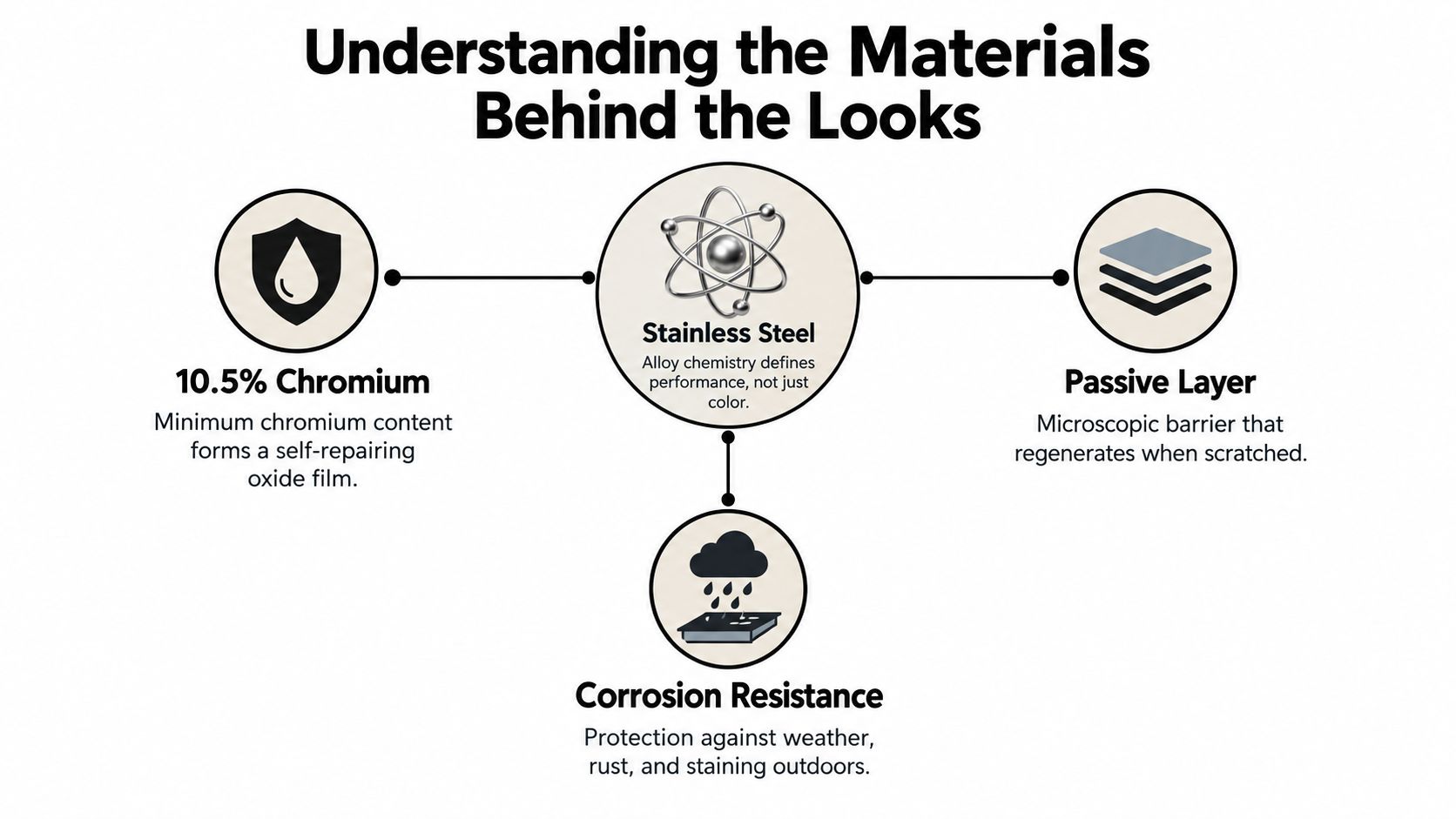
A homeowner choosing between silver and black railings is choosing more than a color. Stainless steel is defined primarily by alloy chemistry, not surface color. The British Stainless Steel Association on the discovery of stainless steel reports that German scientists P. Monnartz and W. Borchers identified a major increase in corrosion resistance when steel contains at least 10.5% chromium.
Chromium enables stainless steel to form a thin, passive oxide film. The film protects the metal beneath it and can repair itself after surface disturbance, provided the surrounding conditions allow the material to remain passive. A stainless railing therefore is not painted steel with a silver appearance. Its underlying alloy supplies the starting point for corrosion resistance.
Grade determines the foundation
Architectural railings commonly use 304 and 316 stainless steel. Austenitic 304 typically contains approximately 18% chromium and 8% nickel. Grade 316 generally contains about 16–18% chromium, 10–14% nickel, and 2–3% molybdenum, according to the British Stainless Steel Association reference and the International Molybdenum Association on black and grey stainless steel.
Molybdenum gives 316 better resistance in chloride-rich conditions, including coastal air and swimming-pool surroundings. It does not make the railing invulnerable or eliminate the need for cleaning, drainage, and compatible hardware. It makes 316 the stronger starting choice where salt and chlorides are part of the exposure.
Black stainless adds a surface system
Black stainless usually is not a separate bulk alloy. Manufacturers create its dark appearance with physical vapor deposition, an oxide-based finish, or a factory-applied coating over a conventional stainless substrate, often 304 or 316. The substrate supplies the alloy-level corrosion performance and structural foundation. The treatment supplies the visible color and texture.
PVD layers are typically extremely thin, approximately 1–5 micrometers, which preserves component dimensions and does not materially change the underlying steel's strength or bulk corrosion behavior. That thin layer suits precision components, but it also means a deep scratch, impact, or aggressive cut can expose the silver substrate.
Specify the alloy and finish separately. Ask for the base grade, surface preparation, coating or deposition process, installation limitations, cleaning instructions, and warranty exclusions. A supplier who can describe only the color has not provided enough information to judge durability for your project.
Comparing Appearance Durability and Maintenance
Standard stainless steel and black stainless steel can both produce a durable railing, but they age differently. Brushed stainless shows the natural metallic character of the material and usually fits decks, stairs, and commercial spaces without demanding that every surrounding element match its tone.
Black stainless creates stronger visual contrast. It works especially well beside dark framing, wood, masonry, and contemporary landscaping. It also tends to reduce the visibility of fingerprints and light smudges, which can matter on a handrail. The trade-off is that a deep abrasion may expose bright metal and leave a sharp visual interruption.
For a broader look at the conventional material in deck applications, see this guide to stainless steel deck railing systems.
Feature Comparison
| Feature | Standard Stainless Steel | Black Stainless Steel |
|---|---|---|
| Base material | Stainless-steel alloy | Usually stainless steel with a dark treatment |
| Appearance | Bright, brushed, or reflective metal | Dark, matte, satin, or coated appearance |
| Fingerprint visibility | Can show hand marks, especially on smoother finishes | Often hides fingerprints and light smudges better |
| Scratch response | Marks may be cleaned, blended, or refinished | Deep damage can expose contrasting bright substrate |
| Cleaning | Mild soap, water, and a soft cloth are generally suitable | Non-abrasive cleaning and careful cloth selection are essential |
| Field modification | More forgiving after cutting or drilling | Cut edges and repairs may disrupt visual consistency |
| Best fit | High-contact, high-traffic, or easily serviced installations | Design-led projects with controlled installation and maintenance |
What durability actually means
A finish can resist ordinary wear and still be a poor choice for a project that needs frequent field changes. PVD provides a hard, wear-resistant surface, but it remains a thin bonded layer. Impact, drilling, abrasive pads, and careless handling can create defects that are difficult to blend on site.
Uncoated or brushed stainless is more repairable. An installer can often clean, passivate, or refinish a damaged area so it blends with the surrounding grain. That doesn't mean every scratch disappears, but the repair path is generally less complicated.
A black railing is a finish system, not a stronger version of stainless steel.
For a private deck where appearance is the priority and installation can be carefully controlled, black stainless is a strong design choice. For a restaurant stair, shared apartment entry, or handrail that will see constant contact, conventional stainless usually gives you a more practical ownership experience.
Best Environments for Each Railing Finish
A coastal deck can look excellent with a dark railing, but salt air still attacks exposed materials. Around pools, the same rule applies: black stainless is a finish, not a different metal. Select the base alloy and hardware for moisture and chloride exposure first, then choose the color.
Match the base metal to the site
For ordinary outdoor exposure, 304 stainless may suit the project when the supplier confirms the site conditions. Coastal air, pool surroundings, and deicing salt call for 316 stainless unless the project engineer or material specialist specifies another grade. Its molybdenum content improves chloride resistance within the alloy.
The finish cannot compensate for an unsuitable substrate or incompatible components. For a dark cable system in a demanding location, review the posts, fittings, fasteners, cable, and cut ends as one assembly. Hidden hardware still determines how the railing performs.
Use this specification sequence
- Describe the exposure. Record coastal air, pool chemicals, road salt, heavy rain, sheltered conditions, or indoor use.
- Choose the stainless grade. Decide on the alloy before approving a sample based on color alone.
- Identify the finish process. Confirm whether the dark surface uses PVD, an oxide-based process, or a factory coating. Request documentation supporting outdoor use.
- Check the complete assembly. Verify compatibility among posts, cable, fittings, fasteners, cut ends, and the site environment.
- Set handling rules. Protect finished parts during transport and installation. Keep abrasive tools and steel contamination away from visible surfaces.
For design references and installation considerations, review these black metal deck railings. Use the visual examples to guide the look, while keeping alloy, finish, and assembly decisions tied to the site.
After installation, rinse exposed railings with fresh water and wipe them with a soft cloth when deposits appear. Avoid abrasive pads and aggressive chemicals, particularly on dark finishes. On coastal or pool projects, inspect ledges, fittings, and connection points because residue often remains in those areas.
How to Care for Your Stainless Steel Railings
A railing usually fails its appearance test before it fails structurally. Water spots, construction dust, fingerprints, salt residue, and metal contamination can make a sound stainless system look neglected. A simple maintenance routine protects the finish and gives you an early warning when fittings or connection areas need attention.
For conventional stainless steel, start with mild soap, clean water, and a soft cloth. Follow the direction of a brushed grain rather than rubbing in circles. Rinse away cleaning residue and dry the surface so minerals don't remain behind.
Black stainless needs the same basic discipline, with less tolerance for rough treatment. Use a non-abrasive cleaner and a soft microfiber cloth. Don't use scouring pads, powdered cleaners, or tools that can cut into the dark layer. Avoid unapproved harsh chemicals that may alter the color or sheen.
A maintenance plan that fits real projects
| Situation | Action |
|---|---|
| Fingerprints on a handrail | Wipe with a damp microfiber cloth, then dry |
| Dust after construction | Rinse loose particles before wiping |
| Salt or pool residue | Wash with clean water and mild soap, then dry thoroughly |
| Light marks on brushed stainless | Clean with the grain and assess before refinishing |
| Deep scratch on black finish | Photograph it, check the warranty, and ask the supplier about repair options |
| Debris around fittings | Clean the connection area and inspect for trapped moisture |
The most important habit is preventing damage during installation. Don't drag finished posts across concrete, tape abrasive materials directly to visible surfaces, or use a finished component as a support for drilling. If field cutting is unavoidable, confirm whether the finish can be repaired and how the exposed edge should be treated.
Choose based on your maintenance tolerance
Homeowners who want a dramatic dark appearance should accept that black stainless requires finish-specific care. It can hide everyday smudges well, but a single deep defect may stand out more than a comparable mark on brushed steel. Conventional stainless asks for more visible cleaning in some settings, yet it gives you a broader path for blending and refinishing.
Use this practical stainless steel cable railing cleaning and maintenance guide as a project reference, then follow the exact instructions supplied with your chosen finish. Always request a finish sample and written cleaning guidance before approving a large order.
Why Choose Ultra Modern Rails for Your Project
A railing supplier should make the material decision easier, not hide it behind a color name. Ultra Modern Rails offers custom-made cable railing systems in stainless steel and black metal finishes, allowing homeowners, contractors, and designers to compare the visual result while specifying the underlying system for the project environment.
The company supplies systems for decks, balconies, stairs, patios, pools, and commercial spaces. Its catalog includes straight and stair sections, handrail choices, mounting styles, and wood-top options, so the finish decision can be coordinated with the actual layout rather than made from a loose sample alone.
Compare the two finish directions
Stainless steel systems suit projects that favor visible metal character, straightforward care, and easier long-term refinishing. They're a practical fit for busy stairs, rental properties, commercial circulation areas, and installations where future field work is likely.
Black metal systems suit projects that need a darker architectural line. They can connect railing posts and cable hardware with black window frames, dark siding, charcoal decking, or contemporary outdoor design elements. The specification should still identify the stainless cable and hardware, the finish process, and the exposure conditions.
Ultra Modern Rails states that its systems use 100% stainless steel cable and hardware, including systems intended for indoor and outdoor applications. That makes the complete-system review easier, but you should still confirm the exact grade and finish details for your site, particularly near salt water, pools, and deicing chemicals.
Design support matters before fabrication
Cable railing looks simple after installation, but the result depends on post spacing, stair geometry, end conditions, mounting surfaces, handrail selection, and cable alignment. A supplier that reviews drawings before fabrication can catch conflicts that would otherwise appear during installation.
Ultra Modern Rails provides a free custom quote and drawing within 24 hours, according to the company information supplied for this project. Customers can tailor sections, handrails, mounting styles, and wood tops to match the building. For contractors and architects, that process can help turn a finish preference into a complete, buildable specification.
Ask for these items before you approve the order:
- Material schedule: Confirm the stainless grades for posts, cable, fittings, and fasteners.
- Finish schedule: Identify whether the dark appearance comes from PVD, an oxide process, or another coating system.
- Installation guidance: Check requirements for drilling, cutting, protection, and field adjustments.
- Cleaning instructions: Get written care guidance for the exact finish, not generic stainless advice.
- Warranty terms: Review exclusions for abrasion, chemicals, salt exposure, improper cleaning, and unauthorized modifications.
- Shop drawing: Verify stairs, corners, mounting surfaces, handrail returns, and cable paths before production.
The right supplier won't tell you that black stainless is automatically more durable. It will help you select the base alloy, finish, hardware, and installation method as one coordinated system. That is the approach that prevents an attractive railing from becoming an expensive repair problem.
Ultra Modern Rails supplies custom cable railing systems in conventional stainless steel and black metal finishes, with stainless cable and hardware for residential and commercial applications. Compare your site exposure, desired appearance, and maintenance expectations, then request a custom quote and drawing from Ultra Modern Rails before you finalize the finish.