

You're standing on a new deck with the posts installed, the handrail finished, and one decision left before the project can pass inspection: which cable should run between the posts? The inexpensive option may look identical in the box, but the wrong grade, construction, or fitting can reveal itself later through sagging lines, stained hardware, or pitting around a post hole.
For cable railing, stainless steel wire rope isn't selected like a lifting rope or marine rigging assembly. It works as part of a visible guard system that must hold a clean line, tolerate sustained tension, resist the project's environment, and maintain openings that satisfy the applicable building requirements. The cable, posts, terminals, tensioners, and spacing all have to work together.
Table of Contents
- Introduction to Stainless Steel Wire Rope for Modern Railing
- Stainless Steel Grades and What They Mean for Railing
- Construction Types Diameters and Breaking Strength Explained
- Corrosion Resistance in Real World Railing Environments
- End Terminations Fittings and Tensioning Systems
- How to Select the Right Stainless Steel Wire Rope for Your Project
- Maintenance Inspection and When to Replace Cable
- Quick Reference Glossary and Cross Reference Index
Introduction to Stainless Steel Wire Rope for Modern Railing
In a railing system, stainless steel wire rope is a group of small stainless wires stranded into a flexible cable. The rope runs horizontally or follows a stair angle, with fittings at the ends transferring tension into the posts or framing. The objective isn't to achieve a high breaking load. A railing cable also needs predictable deflection, clean appearance, reliable terminations, and enough corrosion resistance for the location.
That distinction matters on a residential deck. A cable can remain intact yet perform poorly if it stretches or loosens enough to create an oversized opening. A fitting can remain tight while trapped moisture creates corrosion at the end of the cable. A polished cable can look excellent at installation and develop dark deposits if the surface finish and drainage were poorly considered.
Practical rule: Specify the cable and the hardware as one system. A premium rope paired with unsuitable terminals is still an under-specified railing.
Cable railing also differs from overhead lifting because the visible line and the code-required guard geometry matter as much as the material's nominal strength. Post spacing, cable spacing, corner details, stair transitions, and tensioning sequence all influence whether the finished guard feels rigid and remains compliant. The applicable building code and project authority still control the final requirements, including opening limits and loads.
The material itself has a long engineering history. ASTM A492 was first listed in 1982 as a specification for stainless steel rope wire, and the standard was later reapproved in 1991, 1995, 2000, 2004, 2009, and 2013. The ASTM catalog continues to list A492 in 2026, alongside standards for stainless steel wire strand and chromium-nickel weaving and knitting wire, which supports treating stainless rope as an established engineering product category, not a decorative specialty ASTM A492 history and related standards.
This guide focuses on the decisions that matter on decks, balconies, stairs, pool edges, and hospitality projects: grade, construction, diameter, strength, corrosion, termination, installation, inspection, and replacement.
Stainless Steel Grades and What They Mean for Railing
The grade sets the starting point for corrosion performance, but it doesn't determine the entire service life. 304 stainless steel is a sensible choice for dry interior railings where salt, chlorides, and persistent moisture aren't part of the environment. 316 stainless steel is the usual outdoor choice because its molybdenum content improves resistance to chloride-related attack. Duplex and super-duplex stainless steels enter the conversation when chloride exposure is severe and the cost of premature replacement outweighs the higher material price.
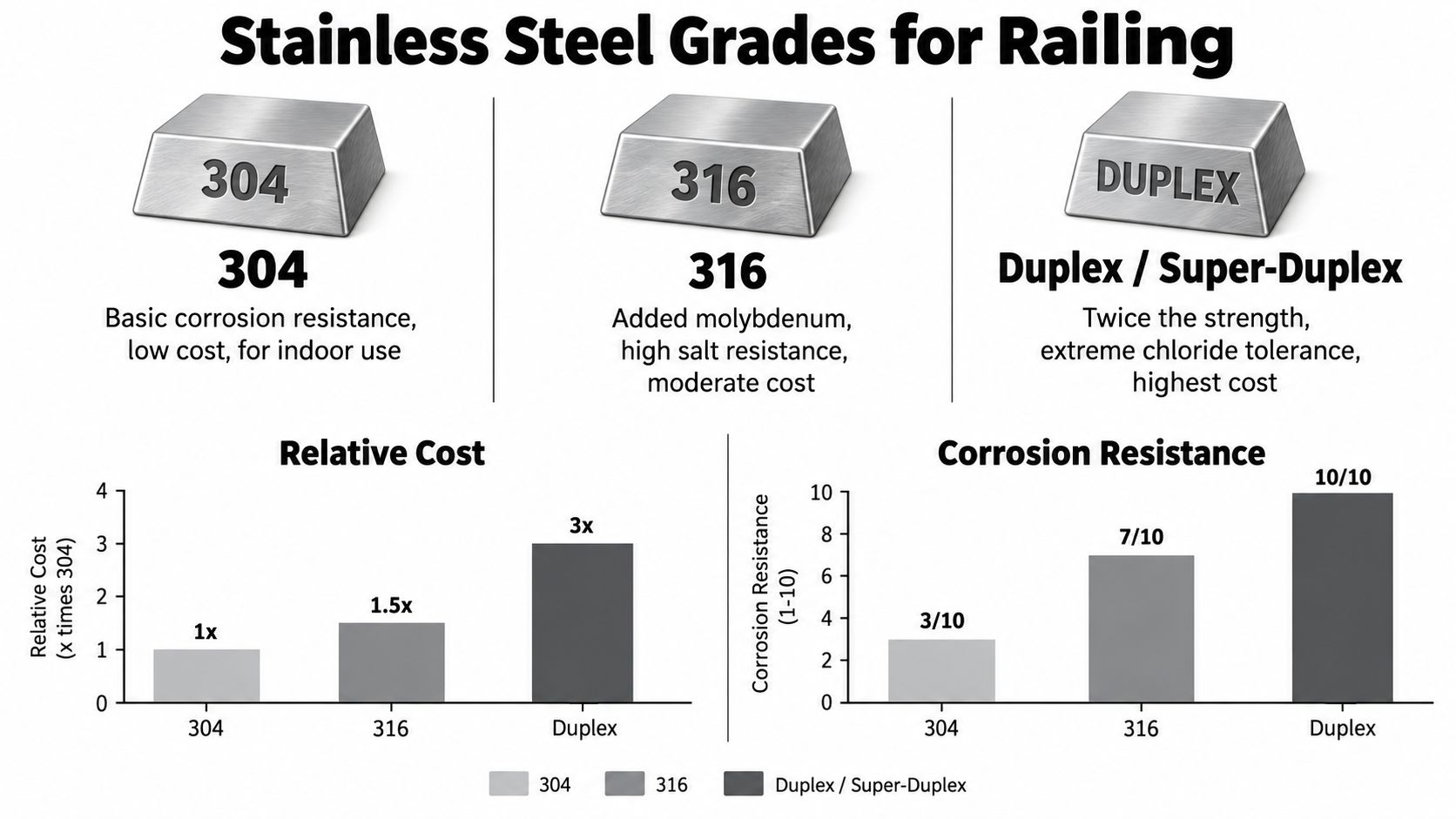
304 for controlled interior conditions
304 works well for stair guards, loft railings, and interior balconies that stay dry and receive ordinary cleaning. It offers useful corrosion resistance at a lower material cost than more specialized grades. It isn't the right default for every exterior project, especially where salt spray, chlorinated water, or de-icing residue can remain on the cable.
A dry interior gives the grade a relatively easy job. The design still needs compatible fittings and proper tensioning, but the environment isn't constantly challenging the passive surface.
316 for most exterior railings
316 is the practical baseline for outdoor cable railing. It suits exposed decks, covered porches, balconies, and many poolside applications, particularly when the fabricator also provides drainage, airflow, and a cleaning plan. Ultra Modern Rails describes its cable railing kits as using marine-grade 316 stainless steel cable and hardware, with tensioning devices included for installation. Its 316 stainless wire guide is useful when the specification needs to distinguish outdoor service from dry interior use.
316 isn't corrosion-proof. Chlorides can still concentrate in crevices, around fittings, and beneath deposits. Poolside systems also face a combination of moisture, cleaning chemicals, and splash that can expose weaknesses in geometry or maintenance.
Duplex when chloride exposure is unusually severe
Duplex and super-duplex grades can provide higher strength and improved resistance to pitting, crevice corrosion, and stress corrosion cracking in chloride-rich environments compared with 316. They may be justified for demanding coastal hospitality, offshore-adjacent work, chemical facilities, or projects where access for replacement is difficult.
The trade-off is cost, availability, fabrication familiarity, and specification complexity. Don't upgrade automatically. First confirm the actual exposure, drainage conditions, finish, fitting compatibility, and inspection access. A poorly drained duplex assembly can still develop a localized problem, while a well-designed 316 system may perform appropriately in a less aggressive setting.
| Grade | Practical railing use | Main advantage | Main limitation |
|---|---|---|---|
| 304 | Dry interior stairs and guards | Lower cost with useful corrosion resistance | Less suitable for chloride exposure |
| 316 | Outdoor, coastal, and poolside systems | Better chloride resistance than 304 | Still vulnerable to pitting and crevices |
| Duplex or super-duplex | Severe chloride or difficult-replacement environments | Higher strength and stronger localized-corrosion resistance | Higher cost and more specialized sourcing |
The right choice is therefore environmental, not purely aesthetic. Treat 304 as an interior option, 316 as the normal exterior starting point, and duplex as a reasoned response to unusually aggressive service.
Construction Types Diameters and Breaking Strength Explained
A cable's construction describes how the strands are arranged. In railing work, 1x19 is stiff and orderly, 7x7 provides a useful balance of flexibility and clean appearance, and 7x19 bends more easily around curves and routed hardware. The first number identifies the number of strands, while the second identifies the wires in each strand.
That structure changes how the cable behaves between posts. A stiff 1x19 cable tends to hold a straight visual line and resists casual bending. A 7x7 or 7x19 cable is more accommodating during installation, especially where a stair run, corner transition, or compact fitting requires a tighter route.
Diameter is only one part of the specification
Railing projects commonly use slim cable, often 1/8 inch or 3/16 inch, but the correct choice depends on the complete assembly. Diameter affects appearance, handling, fitting size, and available breaking strength. Construction affects flexibility and how the line settles under tension.
A larger cable isn't automatically the safer cable. If the terminal, post, drilling detail, or tensioner doesn't match the cable, the larger diameter can create installation problems without improving the finished system. Select the rope and fitting family together.
| Diameter and construction | Breaking strength range | Flexibility and appearance | Best railing application |
|---|---|---|---|
| 1/8 inch, 1x19 | Use the manufacturer's certified table for the selected grade and product | Stiff, crisp, minimal visual movement | Straight residential runs with properly supported posts |
| 1/8 inch, 7x7 | Use the manufacturer's certified table for the selected grade and product | More flexible, balanced appearance | General deck, balcony, and stair railing |
| 1/8 inch, 7x19 | Use the manufacturer's certified table for the selected grade and product | Most flexible of these options, useful around transitions | Curves, stair routes, and fittings requiring easier bending |
| 3/16 inch, selected construction | Use the manufacturer's certified table for the selected grade and product | More visually substantial, potentially less forgiving at fittings | Longer-looking runs or designs requiring a heavier cable presence |
Read strength tables as system data
Breaking strength is the load at which the cable itself fails in a specified test. It isn't the same as the allowable service load for a guard, and it doesn't account for the terminal, swage, bend, post, or connection. The manufacturer's table should identify grade, construction, diameter, and test basis.
Termination efficiency can reduce the capacity of the finished assembly. A cable that tests strongly in a straight pull may deliver less performance after it passes through a fitting, bends, or receives an improperly formed swage. For that reason, the designer should use the weakest component and apply the project's required safety factors rather than treating the rope's catalog value as the system rating.
Choose stiffness for the visual line
Use 1x19 where the run is straight, the posts are rigid, and the installation benefits from a very clean line. Use 7x7 when the project needs moderate flexibility without a visibly loose or overly soft cable. Use 7x19 where routing and bending matter more than maximum stiffness.
The final test is deflection between supports. A compliant guard can fail the practical test if the cable bows excessively under hand pressure. Post layout, cable spacing, tensioning, and the selected construction all contribute, so confirm the complete railing design rather than choosing by diameter alone.
Corrosion Resistance in Real World Railing Environments
A cable railing can look perfect at installation and still develop pits around a terminal months later. Stainless steel resists corrosion through a passive, chromium-rich surface, but that film must stay clean and able to repassivate. Chlorides, stagnant moisture, deposits, rough finishes, and tight geometry interrupt that protection. Even 316 cable beside the ocean or a pool can pit when water and contaminants remain between strands or around fittings.
Inspect the details before judging the cable span. Post holes, end terminals, turnbuckles, swage transitions, corner fittings, and contact points can retain moisture longer than exposed rope. Those crevices concentrate chlorides and often show corrosion first.
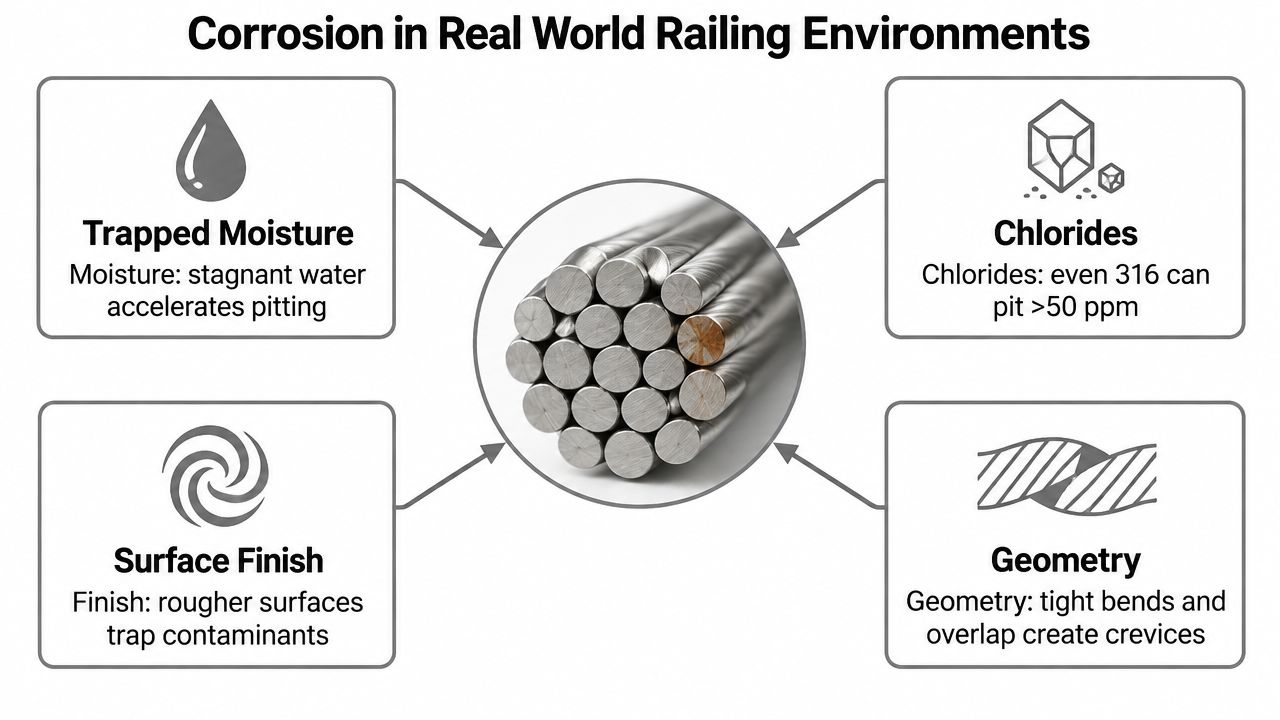
Match design to exposure
A coastal balcony needs more than a 316 label. Salt air deposits chlorides on the cable, while wind-driven spray and humidity keep the surface wet. Poolside railings face splashed, chlorinated water, repeated cleaning, and horizontal surfaces where residue can sit. On a cold-climate deck, de-icing salts can be tracked across walking areas and carried toward the posts.
Give water a clear route out. Avoid blind pockets where practical, include drainage in post details, keep fittings accessible, and stop the rope from resting against wet debris. A suitable smooth finish also makes rinsing and inspection easier. European guidance points out that international standards for stainless steel rope surface treatments and coatings are not consistent, so the supplier's finish specification matters. Do not assume every polished or coated cable will perform identically European technical guidance on stainless steel rope applications.
Stainless grade protects the alloy. Drainage, finish, and cleaning protect the installation.
Treat fittings as corrosion components
A 316 cable can still be paired with an accessory made from a different alloy or finished in a way that traps contamination. Dissimilar materials can create compatibility concerns in wet service. Specify the complete exposed hardware package, including terminals, washers, turnbuckles, post sleeves, and fasteners.
Cleaning technique matters. Abrasive methods scratch the surface, giving deposits more places to collect and making later maintenance harder. Use a stainless-safe cleaner, rinse thoroughly, and examine the points where strands enter fittings.
Clean the cable before inspection so corrosion can be separated from surface contamination. Inspection guidance identifies heavily pitted or slackened outer wires as discard conditions. Severe internal corrosion also requires immediate removal wire rope inspection guidance.
Know when 316 has reached its limit
316 suits many exterior railings, but high-salinity or chemical exposure can exceed its practical margin. Duplex and super-duplex grades may be more appropriate where pitting, crevice corrosion, or stress corrosion cracking would make replacement difficult or create serious access problems. Select the grade from the environment and the consequences of failure, then confirm that the cable, fittings, finish, drainage, and cleaning plan support the railing's required appearance and service life.
End Terminations Fittings and Tensioning Systems
Cable railing performance depends heavily on how the rope ends. A fitting must transfer tension into the post or frame without damaging the cable, loosening during service, or creating a corrosion trap. The best terminal for a straight interior run may be a poor choice for a stair, corner, or exposed pool installation.
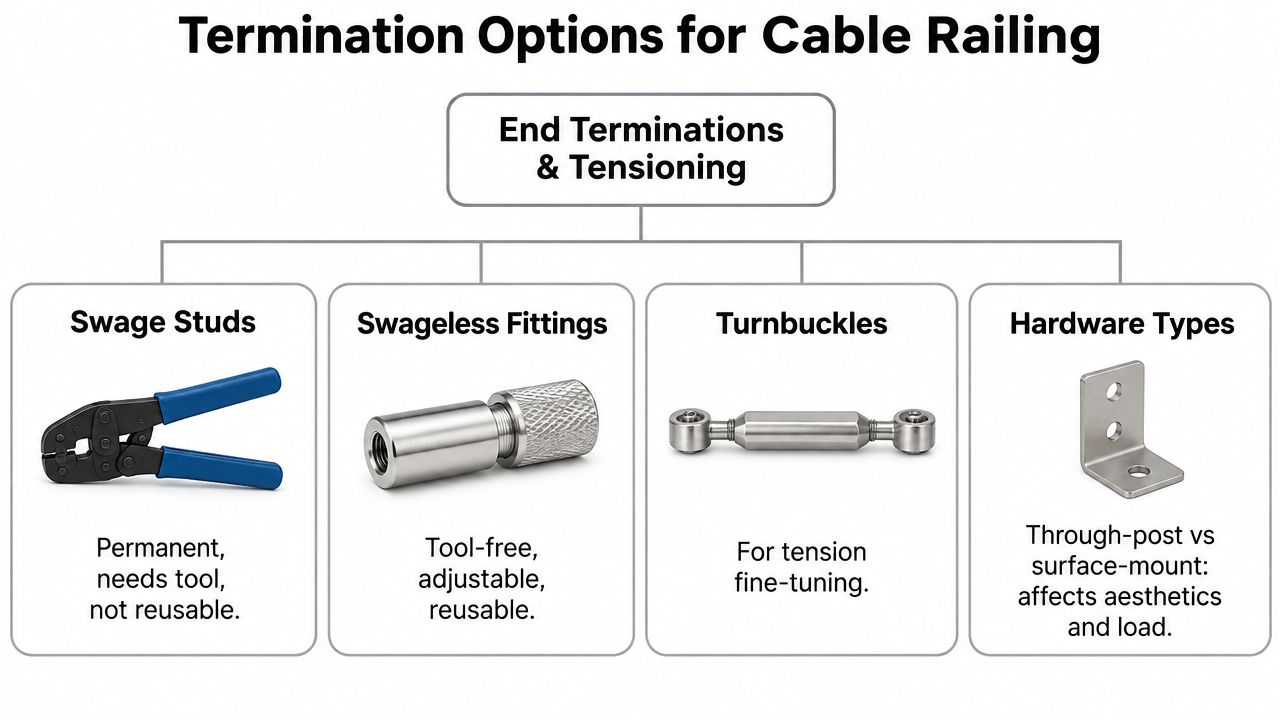
Choose the terminal around the installation
Swage studs create a permanent connection by compressing a fitting onto the cable with a compatible swaging tool. They can produce a clean, compact finish, but the installer needs the correct dies, cable preparation, and calibrated technique. Once swaged, the assembly generally isn't reusable.
Swageless fittings use mechanical components to grip the cable without a dedicated swage press. They're useful for field adjustment, repairs, and projects where the installer needs more flexibility. They still require careful assembly, correct cable insertion, and inspection of the gripping components. This guide to swageless fittings explains why tool-free doesn't mean installation-free.
Turnbuckles allow fine tension adjustment through a threaded body. They're valuable when a long run needs controlled tightening or when seasonal movement produces a small amount of slack. The visible barrel may not suit every minimalist design, and exposed threads need protection from contamination.
Tension in a sequence
Install the cables in the manufacturer's recommended order rather than tightening one line fully before moving to the next. Incremental adjustment helps distribute tension through the post assembly and reduces the chance of pulling a post out of alignment. On stairs and corners, changes in direction can transfer forces differently from a straight run, so verify the post and terminal design before final tensioning.
The cable should feel firm without being forced beyond the fitting or post design. Excessive tension can distort posts, overload anchors, or make later adjustment difficult. Insufficient tension can allow excessive deflection and create openings that don't meet the project's guard requirements.
Don't confuse rope strength with guard compliance
A strong cable doesn't guarantee a compliant railing. The authority having jurisdiction, adopted code, engineering documents, and manufacturer instructions determine the required loads, spacing, and opening limits. The installer must also confirm that the posts, fasteners, framing, and terminals can transfer the applied forces.
Document the cable construction, grade, diameter, terminal type, and tensioning method. That record makes later inspection and replacement much easier, especially on commercial properties.
How to Select the Right Stainless Steel Wire Rope for Your Project
Start with the environment, not the catalog diameter. Ask where the railing sits, what reaches it, how water drains, whether cleaning chemicals are present, and how easily the owner can inspect the fittings. Then choose grade, construction, diameter, terminal, and post layout as a connected package.
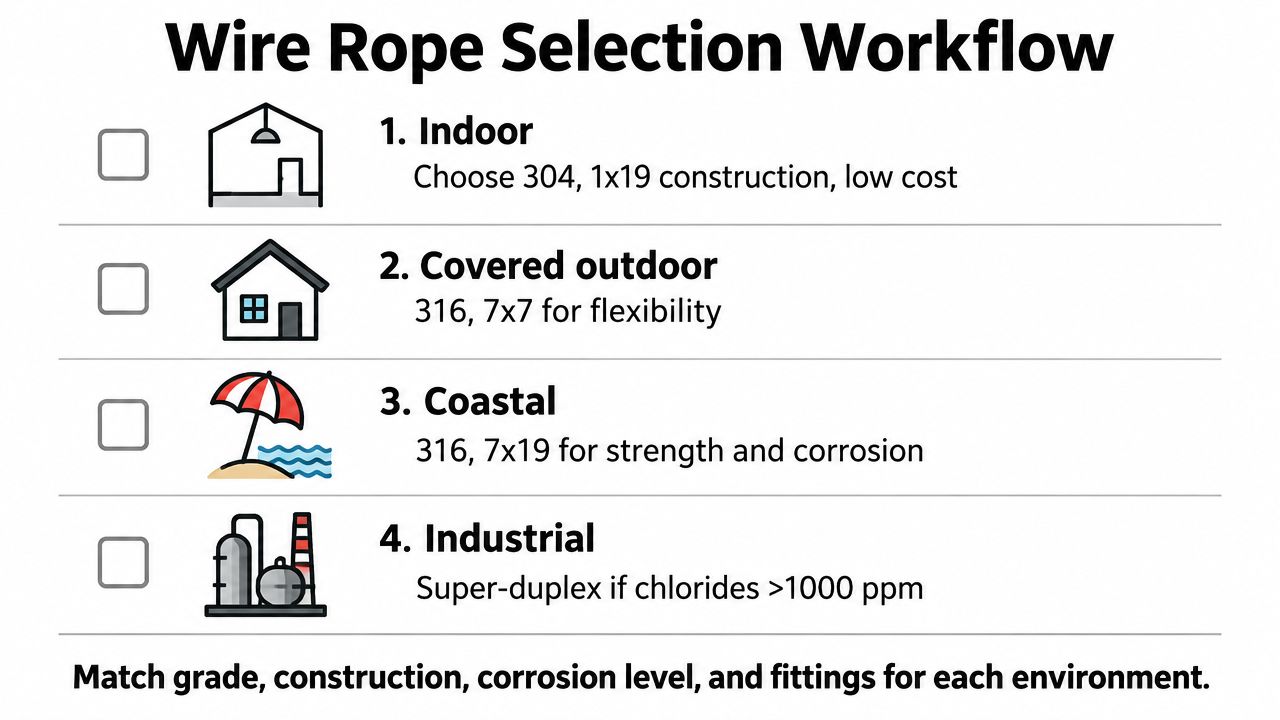
Use an environment-first decision path
For a dry interior, 304 with a stiff 1x19 construction can provide a tidy, economical result. For a covered exterior, 316 remains the safer starting point, with 7x7 often offering a practical balance where the route includes modest changes in direction. For coastal or poolside work, use 316 with careful drainage, compatible hardware, and a cleaning plan. Consider duplex or super-duplex for unusually aggressive chloride exposure or installations where replacement would be disruptive.
The infographic's industrial example includes a super-duplex selection for chloride levels above 1000 ppm, but that threshold should not be treated as a universal railing rule. Verify the measurement method, chemical conditions, temperature, finish, and supplier recommendation before specifying a material on that basis.
Balance three costs
The lowest purchase price can become expensive when the cable needs early replacement. The highest grade can also be wasteful if the environment is mild and the design creates no meaningful corrosion risk. Evaluate:
- Initial material cost: Include cable, terminals, tools, post hardware, and compatible fasteners.
- Installation cost: Swaged systems may need specialized tooling, while swageless systems may simplify field work and adjustment.
- Ownership effort: Coastal, poolside, and hospitality railings need more deliberate cleaning and inspection than protected interior systems.
- Replacement consequences: Difficult access, tenant disruption, or a large public-facing installation can justify a more conservative specification.
- Appearance requirements: A highly visible balcony may need a finish and construction that remain visually consistent across every run.
Verify the complete design before ordering
Confirm post spacing, cable spacing, stair angles, corner details, end conditions, and the code requirements for the project. Check that the chosen fitting accepts the exact cable construction and diameter. Ask for product documentation that identifies the grade, construction, strength data, and installation method.
Factory-direct suppliers can also help reduce measurement errors when the system is custom sized. Ultra Modern Rails offers stainless cable railing sections, including straight and stair configurations, and provides custom quoting and drawings for project-specific layouts. Treat that service as a design coordination resource, then independently confirm site dimensions, framing, and code requirements before fabrication.
A practical specification might read: stainless steel grade, rope construction, diameter, finish, terminal family, tensioning method, post spacing, and inspection requirements. That is far more useful than writing only “stainless cable railing.”
Maintenance Inspection and When to Replace Cable
Stainless steel cable railing needs a repeatable maintenance routine. Salt, pool chemicals, dust, and trapped moisture collect around cable entries and fittings, where staining and pitting can start. Outdoor and poolside systems require closer attention than dry interior railings, particularly after salt exposure, chemical cleaning, or nearby construction.
Clean before you inspect
Rinse the cable and fittings with clean water to remove loose salt and residue. Use a stainless-safe cleaner with a soft cloth or brush, then rinse again and dry the surfaces. Avoid carbon-steel brushes, harsh abrasives, and cleaners that leave aggressive residues.
A dirty cable can hide the difference between surface contamination and corrosion. Cleaning first also exposes cable ends, fitting openings, and post penetrations, where broken wires, deposits, or pitting may be easier to identify.
Check the cable and hardware
Inspect every span, including sections below normal eye level. Check:
- Outer wires: Look for broken wires, flattened sections, severe pitting, or slack wires.
- End fittings: Check for discoloration, corrosion deposits, loose parts, and crevices that retain water.
- Post penetrations: Remove debris and confirm that moisture is not remaining around the cable entry.
- Tension: Compare adjacent cables and watch for unusual movement or sagging.
- Structure: Examine posts, anchors, handrails, and framing for movement that cable adjustment cannot correct.
Heavily pitted or slackened outer wires indicate that the cable should be removed from service. Severe internal corrosion also requires replacement, even when the exterior appears acceptable. Inspection guidance should be treated as a reference for identifying damage, while the railing manufacturer or qualified inspector determines the appropriate disposition.
Retension carefully
A small adjustment may restore the intended cable line. It should not compensate for a moving post, weak anchor, damaged terminal, or deteriorated cable. Excessive tension can also transfer unwanted force to posts and fittings. Commercial owners should record cleaning, inspections, repairs, and retensioning so recurring problems can be traced to drainage, hardware, installation, or exposure.
For a practical care sequence and product-specific considerations, use this stainless cable railing cleaning and maintenance guide. Replace the cable when inspection finds broken or severely pitted wires, significant corrosion, persistent slackness, or a terminal that cannot be verified as reliable. If damage affects a fitting or supporting structure, correct that cause before installing replacement cable.
Quick Reference Glossary and Cross Reference Index
Construction describes the strand and wire arrangement, such as 1x19, 7x7, or 7x19. Strand is a group of wires twisted together, while the core supports the strands in constructions that include one. Lay describes the direction and geometry of the strand helix.
Breaking strength is the tested force that causes the cable to fail. It isn't the permitted guard load. Working load is an allowable service value established by the manufacturer or engineer after applying the relevant safety considerations. Termination efficiency describes how the end fitting affects the capacity of the finished cable assembly.
For standards, ASTM A492 addresses round stainless steel rope wire intended for stranding and includes chemical composition and tensile-strength requirements. ISO 3444:2023 is the current international standard specifically for stainless-steel wire ropes. ISO 2408:2017 provides broader requirements for steel wire rope manufacture, testing, acceptance, packing, marking, and quality certification. The ISO standards reference is the appropriate starting point for confirming the applicable edition and terminology.
Use these cross-references during specification:
- Grade: See the grades section for 304, 316, and duplex selection.
- Construction: See the construction section when deciding between a straight, stiff line and a more flexible route.
- Corrosion: See real-world environments section before approving any exterior or poolside detail.
- Terminations: See the fittings section for swaged, swageless, turnbuckle, through-post, and surface-mount choices.
- Compliance: Confirm cable spacing, openings, guard loads, post strength, and stair geometry with the adopted code and project authority.
- Inspection: Use the maintenance section to document cleaning, tension, pitting, broken wires, and replacement decisions.
A good field specification names the grade, construction, diameter, finish, terminal, tensioning method, and environment. If one of those is missing, the installer may be forced to make a performance decision on site.
If you're planning a deck, stair, balcony, poolside, or commercial cable railing, visit Ultra Modern Rails for stainless cable systems, custom sections, hardware, and project-specific drawings. Share your layout and environment so the grade, cable, terminations, and mounting details can be coordinated before fabrication.