

You're comparing railing samples for a deck, balcony, or stair, and the brushed stainless steel looks reassuringly practical. The mirror sample looks sharper. Then you touch both, notice the fingerprints, and wonder which one will still look good after pollen season, salt spray, or a busy weekend.
The useful difference between stainless steel finish types isn't just shine. It's how the surface hides marks, holds deposits, and responds to cleaning. A finish that disguises dirt can still retain it, while a bright surface that shows every fingerprint may be easier to wash.
Table of Contents
- Stainless Steel Finish Types at a Glance and How They Are Made
- What Passivation and Electropolishing Actually Do
- Where Each Finish Fits for Interior and Exterior Railings
- How Often to Clean Each Finish by Exposure Zone
- What to Write on a Railing Finish Specification
- Confirm the Finish Before You Order
Stainless Steel Finish Types at a Glance and How They Are Made
A finish is a surface appearance produced by a mill route or a mechanical or chemical step, not an alloy grade. That distinction matters when you're comparing quotes: the appearance doesn't tell you which stainless alloy the fabricator used.
Stainless steel finish types compared by look and surface
The table moves broadly from dull industrial surfaces toward brighter architectural options, with treatments included alongside appearance finishes. It isn't a strict brightness ranking because passivation and electropolishing modify an existing surface.
| Finish | Designation | Look | Roughness (Ra) | Reflectivity |
|---|---|---|---|---|
| Hot-rolled, annealed and descaled | No. 1 | Dull grey, matte | Require a measured value if relevant | Low |
| Dull cold-rolled | 2D | Soft, non-reflective matte | Not fixed by designation | Low |
| Cold-rolled, skin-passed | 2B | Smooth, bright grey | About 0.30–0.50 µm | Moderate |
| Bright annealed | BA / 2R | Bright, clearly reflective | Specify separately from brightness | High |
| Brushed satin | No. 4 | Linear satin grain | About 0.30–0.60 µm, directional | Low to moderate |
| Bead-blasted | Specify blasting process and sample | Even, non-directional matte | Set by blasting media and process | Low |
| Passivated | Chemical treatment | Same as base finish | Essentially unchanged from base | Essentially unchanged |
| Electropolished | Electrochemical treatment | Bright, potentially mirror-like | Reduced from starting surface; verify target | High |
| Mirror polish | No. 8 | Mirror appearance | Very smooth; specify a measured limit if needed | Very high |
For the numerical roughness entries, worldstainless surface-treatment guidance gives typical 2B Ra of approximately 0.30–0.50 µm and commonly reported No. 4 Ra of approximately 0.30–0.60 µm. These are useful comparison ranges, not guaranteed values for every delivered component.
Think of each finish as a fingerprint of the processing steps. Just as progressively finer sandpaper leaves a different signature on wood, rolling, abrasion, blasting, and chemical treatment leave different textures on steel. The important difference is that some processes create the appearance, while others primarily improve the condition of a surface that's already there.
The international stainless steel surface-finishes educational guide describes No. 4 as mechanically polished, commonly using 120–150 mesh abrasive, and identifies BA or 2R as cold-rolled material annealed in an inert atmosphere. That explains why a brushed rail has visible lines while a bright-annealed surface looks more uniformly reflective.
Read texture separately from shine
Ra, the arithmetic mean roughness, describes average microscopic surface irregularity. It isn't a gloss reading, a scratch-resistance rating, or a complete description of the surface. Two samples can have similar average roughness yet look noticeably different because their grooves, polishing direction, and reflectivity differ.
For a railing, those differences are easy to see. Mill-produced 2B and BA surfaces offer relatively uniform appearances. Brushed satin deliberately introduces a linear texture that can make minor handling marks less conspicuous.
No. 1 belongs mainly in an industrial-looking specification, rather than being the default for a hand-contact architectural rail. Bead-blasting produces a subdued alternative, but don't mistake its visually even matte appearance for microscopic smoothness. Mirror polishing sits at the other end of the appearance spectrum, where reflections become a dominant design feature.
Practical rule: Approve the surface you'll receive, not just the finish name printed on the quotation.
A designation is a starting point. It doesn't fully control the final roughness, brightness, or consistency after a fabricator bends, welds, and blends the railing.
What Passivation and Electropolishing Actually Do
Passivation removes free iron left on the surface by cutting, handling, or fabrication and supports the chromium-rich passive layer that gives stainless steel its corrosion resistance. Wiping a rail removes loose dirt, while chemical passivation addresses embedded iron left after the metal has been worked.
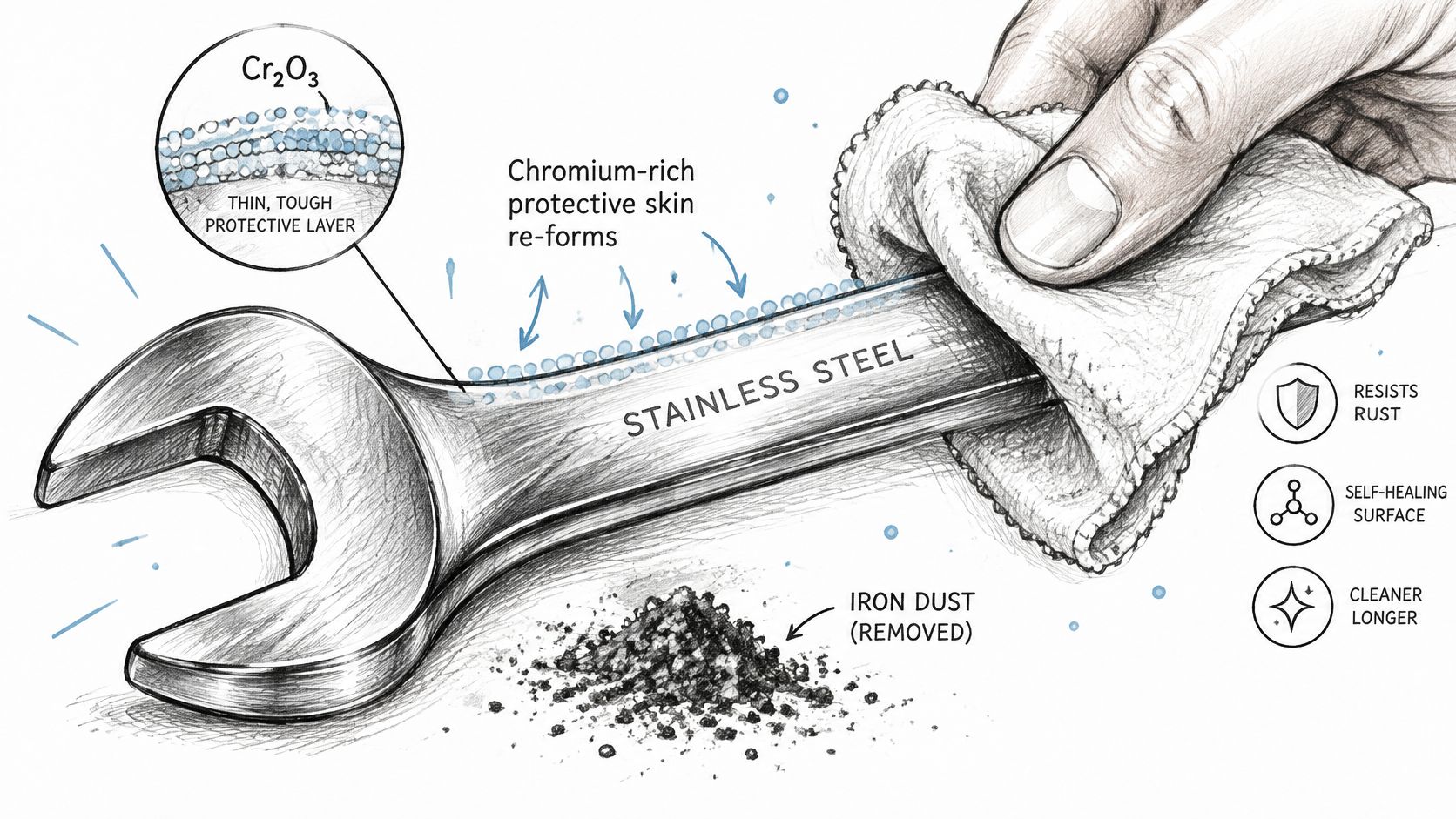
Restoration versus microscopic smoothing
Cutting, welding, and grinding can leave contamination, heat tint, or altered surface conditions. A sound sequence may include cleaning, pickling, and passivation, with passivation reserved for restoring the passive layer after heavier scale and tint have been dealt with.
worldstainless guidance on stainless steel finishes explains that abrasive processing can introduce contamination and that post-fabrication treatments can restore or improve surface condition. It also cautions that a brushed surface can perform less well than a mill finish on the same alloy when its texture or fabrication cleanliness is poorer.
Electropolishing changes the surface itself. The component sits in an electrolyte bath as the anode while current preferentially removes microscopic high points, lowering roughness and raising reflectivity. A smoother profile gives salt, dust, and grime fewer places to lodge, so deposits rinse away more readily in coastal or poolside exposure. The tradeoff is visual, since a brighter surface can show fingerprints and scratches more clearly between cleanings.
A surface can be easier to clean without looking clean for longer.
For coastal or poolside work, ask the fabricator to propose a post-fabrication treatment sequence and confirm compatibility, access to internal areas, and the supplier's process before ordering combined treatments. Electropolishing is a specialist operation, so verify that the actual posts, fittings, and rail geometry will be processed rather than assuming a polished showroom sample represents the finished assembly.
Where Each Finish Fits for Interior and Exterior Railings
An exterior balcony and an interior restaurant stair put different demands on the same-looking steel. Outdoors, prioritize deposit removal and exposure suitability. Indoors, hand traffic, fingerprints, cleaning access and lighting drive the choice.
Finish fit by railing setting
These verdicts address appearance and maintenance practicality, not a guarantee of corrosion performance.
| Finish | Exterior deck or balcony | Interior stair or lobby | Main drawback |
|---|---|---|---|
| No. 4 brushed satin | Strong visual choice with suitable grade and maintenance | Strong, disguises handling marks | Grain must run consistently along rails and posts |
| 2B mill finish | Practical, smooth and easy to rinse | Good where handling is light | Plainer appearance than brushed or bright options |
| BA / 2R bright annealed | Usable, but rain streaks are conspicuous | Good for a bright contemporary appearance | Shows fingerprints and marks |
| Bead-blasted | Matte appearance disguises dust, but needs careful cleaning | Good for a subdued design | Texture can retain more dirt |
| Electropolished | Useful where coastal or poolside cleanability is a priority | Suitable for a bright, sleek appearance | Added processing and conspicuous scratches |
| No. 8 mirror polish | Demanding appearance choice where spray and dust are frequent | Striking in controlled lobby settings | Fingerprints and scratches are highly visible |
No. 4 is a practical all-round architectural choice, especially where people frequently touch the handrail. Its grain works as visual camouflage for small marks rather than as immunity from scratching or staining. For a quiet interior stair, 2B can be entirely appropriate if you like its restrained, utilitarian appearance. BA and mirror finishes suit projects where you actively want reflections and accept the routine wiping that follows, since every smudge sits in plain sight on a bright surface.
The table's "disguises" and "retains" columns deserve equal weight. A bead-blasted post may look clean from across the deck while holding fine deposits in its texture. An electropolished fitting does the opposite: it reveals a fingerprint immediately but releases contamination readily during washing. Judge both the distant appearance and the close-up cleaning task, because a finish that hides dirt well can still hold it.
For layout and material coordination, the interior stainless steel cable railing guide provides additional project context. One catalog example of an indoor system is the Cable Railing - Indoor Stainless Steel 36" or 42" System - High End Custom Railing; confirm which finish options the quote includes rather than assuming cable, fittings, posts and handrail will share identical textures.
Match the finish to exposure and touch frequency. A sheltered lobby rail and an open pool surround shouldn't receive the same recommendation just because both belong to a modern building.
How Often to Clean Each Finish by Exposure Zone
| Exposure zone | Typical deposits | Suggested cleaning interval | Finish to favour |
|---|---|---|---|
| Urban | Traffic grime, soot | Inspect routinely and clean before grime becomes persistent | Smooth No. 4 or 2B |
| Inland | Dust, pollen, hard-water spots | Clean after visible seasonal buildup and spotting | No. 4 or 2B |
| Coastal | Salt spray, chlorides | Rinse frequently and after significant salt exposure | Electropolished or smooth 2B with an exposure-suitable alloy |
| Poolside | Chlorine splash, mineral residue | Remove splash deposits promptly and clean frequently | Electropolished surface with an exposure-suitable alloy |
| Hospitality | Fingerprints, food and cleaning residue | Include in the regular housekeeping routine; remove spills promptly | No. 4 where disguising handling marks matters |
Treat these as inspection-led routines, not universal calendar guarantees. Sheltered surfaces can retain deposits even when nearby exposed surfaces receive rain, so check beneath handrails, around fittings, and under covered balconies.
The exposure-zone graphic provides a visual reminder of common deposits; its calendar suggestions shouldn't replace a site-specific maintenance plan.
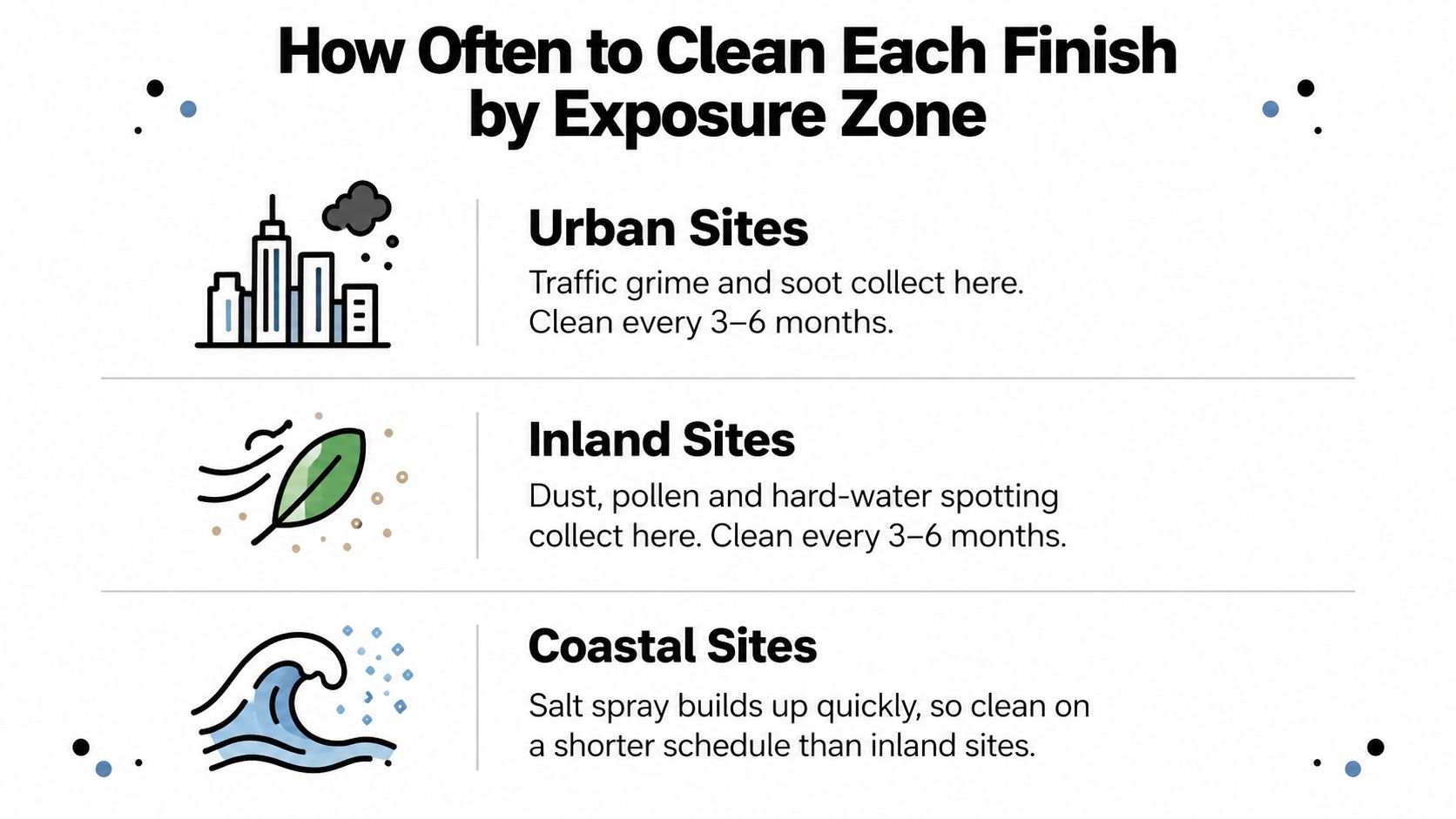
Let deposits set the pace
The British Stainless Steel Association's architectural selection guidance notes that rougher surfaces retain more contaminants and that a smooth surface with Ra approximately 0.5 micrometres or less helps reduce deposits and corrosion staining. Its cleaning guidance ranges from occasional attention in ordinary settings to much more frequent cleaning in aggressive or hygienic environments.
That's why a universal cleaning interval would be misleading. A sheltered seaside rail may need attention well before a rain-washed inland rail, even when both have the same finish.
Brownish tea staining, persistent salt residue, and dark grime around connections are reasons to review the routine. Don't wait for a matte surface to look obviously dirty before checking it closely.
Maintenance takeaway: Hiding deposits isn't the same as shedding them.
A cleaning routine you can use
- Rinse first. Use fresh water to loosen grit before wiping, so you don't drag particles across the finish.
- Wash gently. Apply mild soap with a clean microfiber cloth, working along the grain on brushed components.
- Keep incompatible materials away. Avoid steel wool, carbon-steel brushes, and chloride-based cleaners.
- Rinse and dry. Remove soap residue with fresh water, then dry with a clean cloth to limit spotting.
The stainless steel cable railing cleaning and maintenance guide can help you turn that routine into a property-care checklist. Confirm any special restrictions for adjacent wood, coatings, and proprietary fittings.
For a visual supplement to the written routine, use the video below.
Stainless steel is low-maintenance, not maintenance-free. Assign responsibility for cleaning before installation, particularly when a contractor will hand the completed railing over to a separate property team.
What to Write on a Railing Finish Specification
A quotation that says only "satin stainless steel" leaves too much unresolved. One supplier may read satin as a fine brushed surface; another may offer a noticeably coarser grain. Both qualify as satin on paper, yet on a coastal deck they behave differently, because a deeper grain holds salt residue and needs wiping more often than a tight one.
Compare two ways the same line item can appear on a quote:
- "Posts and handrail: satin stainless steel"
- "Posts and handrail: brushed No. 4, Ra max 0.5 µm, grain vertical on posts, longitudinal on top rail"
The first version prices a word. The second prices a surface you can inspect on delivery, and it tells the fabricator which way the grain should run around every corner and welded joint.
Aalco's surface-finishes and polishing guidance recommends recognized finish designations or clearly defined trade names for exactly this reason. Translate the appearance you want into requirements a fabricator can price, produce, and check.
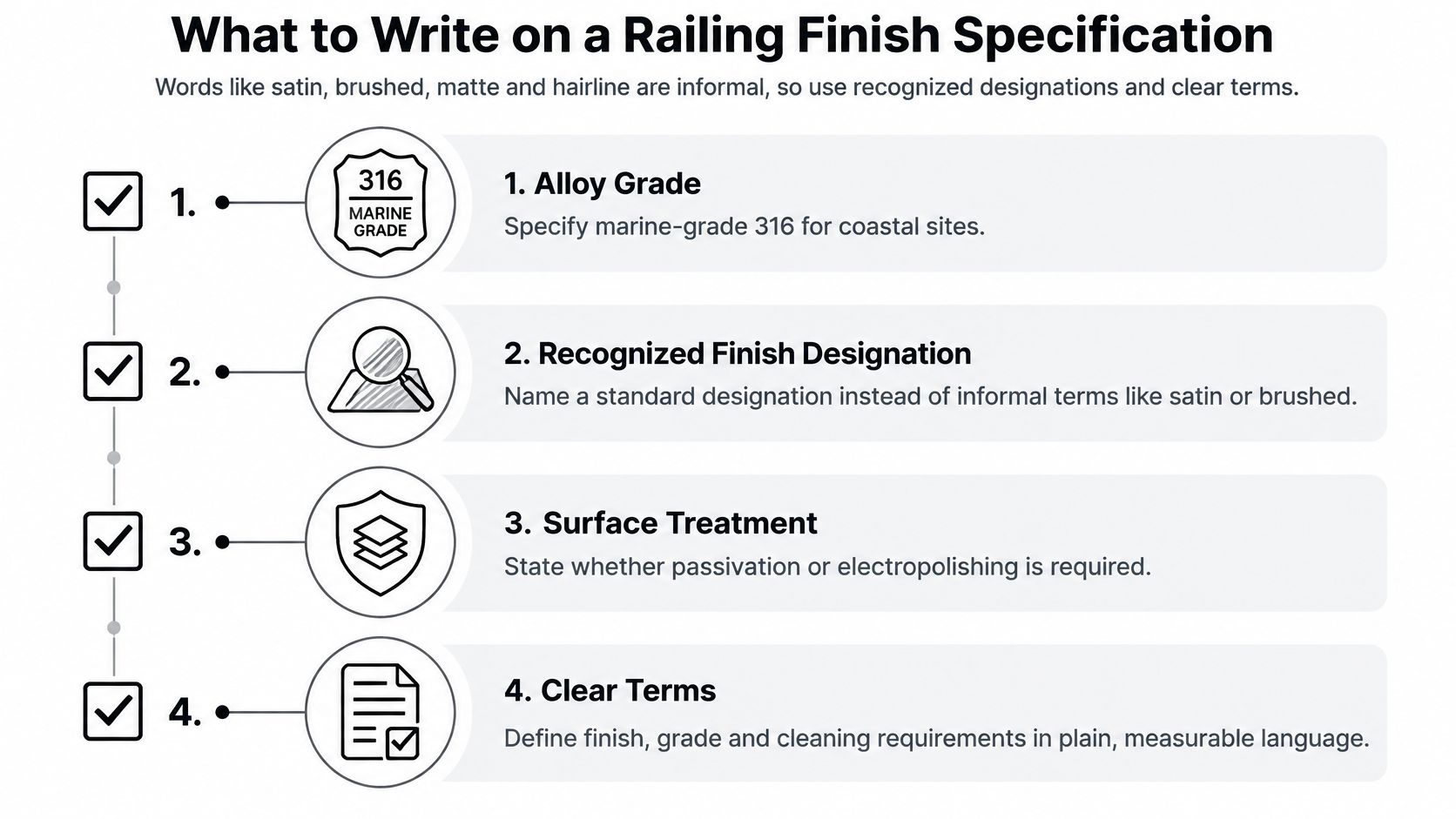
Copy these requirements into the quote request
- Alloy grade. Name the required alloy for each metal component and ask the supplier to confirm suitability for the actual exposure, particularly salt air and pool chemicals.
- Finish designation. Request a recognized finish, such as brushed No. 4, rather than relying on satin or hairline alone.
- Target roughness. Where deposit retention matters, state the agreed maximum Ra and how the supplier will verify it.
- Grain direction. Define the intended orientation along rails and posts, including transitions at corners.
- Weld finishing. Require agreed blending, heat-tint removal, and post-fabrication surface treatment so joints don't become conspicuous patches.
- Protection during handling. Identify protective film or wrapping, when it must come off, and who removes installation residue.
- Physical acceptance sample. Keep an approved sample available for comparison under agreed lighting and viewing conditions.
- Component coordination. Define an acceptable relationship between posts, cable, fittings, and handrail rather than demanding an unrealistic identical reflection from different shapes.
- Cleaning restrictions. Obtain written instructions covering permitted products, prohibited tools, and treatment of stubborn contamination.
Roughness and grain direction deserve extra attention if you are specifying for an exposed zone. They decide how much grime the surface traps between cleanings, so a tighter Ra limit earns its keep fastest where rain and hand traffic cannot carry deposits away.
Define acceptance before fabrication
A photograph records design intent. Gloss, grain depth, and small texture differences need a physical reference, so ask for a sample that represents the finished fabrication, including a blended weld where the project has visible joints.
Match each requirement to a test you can run on delivery. A measurable roughness figure needs a measurement method, and a visual requirement needs agreed viewing conditions plus the approved sample sitting next to the delivered work.
For material-selection questions, the stainless steel and steel corrosion guide offers supporting context. The quote should still identify the actual supplied material rather than treating marine grade as a complete specification.
Combining stainless components with a coated frame or wood top calls for a separate description of those interfaces. Confirm whether the wood arrives finished or needs on-site staining, and make sure the cleaning instructions for one material will not damage its neighbour.
Resolve differences on paper before production. Approving a sample takes an afternoon; debating whether an installed handrail looks sufficiently satin can stall a project for weeks.
Confirm the Finish Before You Order
Decide the cleaning commitment first, then approve the appearance inside that limit. The shinier the surface, the more it advertises fingerprints and water spots; a brushed grain hides more between cleanings while its texture still holds salt and grime. Approve a sample only where someone will keep the cleaning schedule that surface demands.
- Measure the site before quoting. Walk each deck, balcony, or stair run and record every side separately, noting where hands touch, where splash or rain lands, and which fittings sit beyond easy reach of whoever will clean them.
- Handle the sample where it will live. Judge the finish under the project's own daylight or interior lighting, and touch it with wet or oily hands to see what it will show between cleanings.
- Send measurements for supplier verification. Have the layout, mounting arrangement, corners, and stair transitions checked, and round each measured run up to the next offered module, typically an 8-foot length.
- Match the sample to production. Request a sample cut from the same batch as the posts before signing the order.
Finish approval settles appearance alone. Installation and structural checks remain separate sign-offs, and an approved sample does not stand in for either of them.
Ultra Modern Rails offers custom cable railing systems with finish choices that can be coordinated with your deck, balcony, or stair. Visit Ultra Modern Rails to submit your measurements and request a custom quote and drawing, and include your exposure conditions, preferred finish, and sample requirements so those decisions are clear before you order.